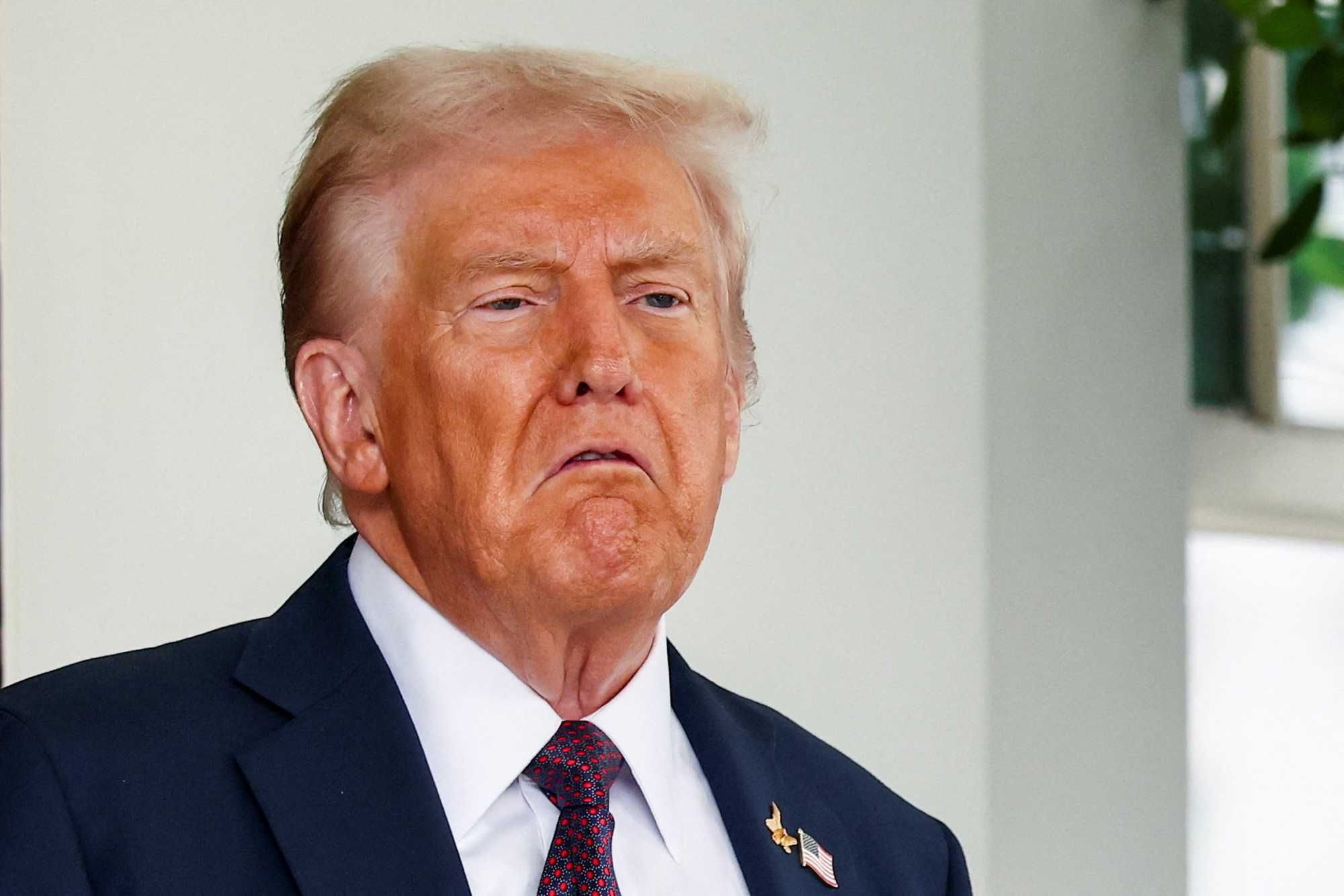
U.S. President Donald Trump reacts as he welcomes Israeli Prime Minister Benjamin Netanyahu (not pictured) at the White House in Washington, D.C., U.S., September 29, 2025. REUTERS Kevin Lamarque
President Donald Trump’s tariffs, which had already cost America at least 100,000 manufacturing jobs as of February, have previously been described by experts as “madness” and “senseless.” But according to a polling expert on Thursday, a new survey reveals that they have also literally created a “bizarro world” in terms of voter opinions on economic policy.
Speaking with CNN’s John Berman on Thursday, polling expert Harry Enten broke down a recent CBS News/YouGov poll which found that only 37 percent of Americans support Trump’s tariffs while 63 percent oppose them. Despite this lopsided view against tariffs, Trump continues to levy them in response to everything from foreign policy disagreements to concerns about the state of the economy.
“The bottom line is this: the American people have seen what tariffs have done to the economy, and they, simply put, do not like it and have turned against the president of United States who, like I said, it feels like bizarro world because from a political standpoint, it is absolute insanity,” Enten told Berman. “They keep trying to do something that the American people clearly, very much do not like.”
Speaking with AlterNet about the tariffs earlier in July, Dr. Robert Shapiro — undersecretary of commerce for economic affairs in the administration of President Bill Clinton and principal economic adviser to Clinton's 1992 campaign — explained that part of their unpopularity stems from how they destabilize the business community. American businesses need a steady tariff environment to be able to proceed with a sense of sound knowledge, but Trump’s constant tariff pivots have upended that.
“It's about uncertainty,” Shapiro told AlterNet. “Every investment is based on an assessment of the likely future demand for whatever you're investing in, and how much it's going to cost to produce it. So there are assumptions about labor costs, material costs and other input costs — and again, about demand. If you have a set of arrangements that give you some confidence about the price of your inputs coming from Mexico or Canada, or about demand for goods in Canada — and don't forget, we have virtually no trade deficit with Canada; we have enormous trade, and it goes in both directions — so it's certainly right, and it's not just about investments based on these probabilities that the trade agreement can help reduce uncertainty about.”
Shapiro added, “It's also about how much you're going to produce today, apart from investment, because you've got thousands of companies selling goods or services into Canada. And so there's uncertainty about whether this will lead to more conflict with Canada, which would hurt Canadian demand for US goods, or whether Canada will impose a new tariff in retaliation for ours that makes my goods less competitive there. Of course it's bad — it's bad for American workers, it's bad for American investment.”