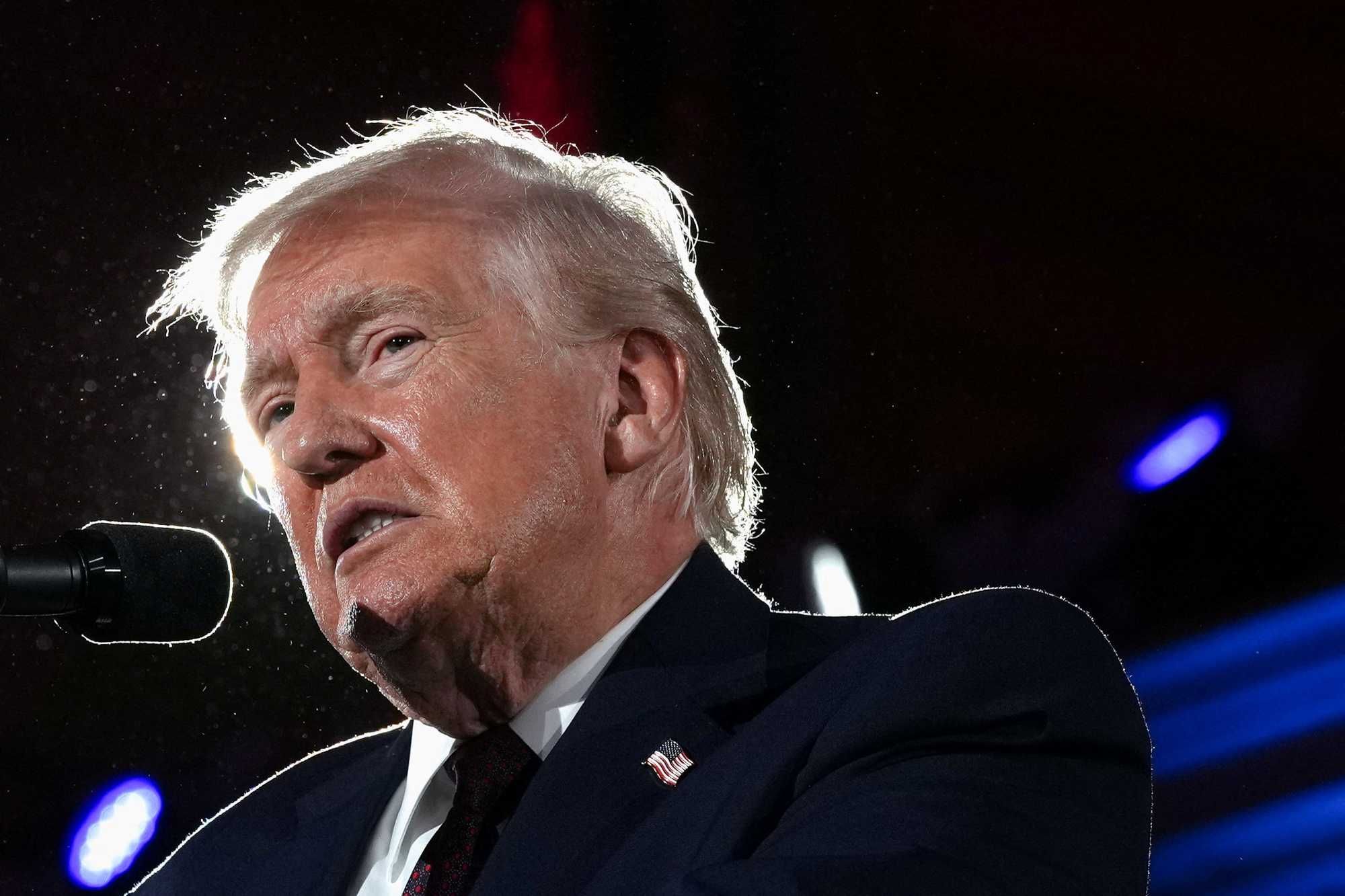
Donald Trump
President Donald Trump is putting Social Security in danger, a Democratic and Republican experts agree — although they arrive at that conclusion from different vantage points.
“In the post-Cold War era, our ability to do deficit spending is used to prop up Social Security and Medicare, which are too costly to be sustained through current revenues,” wrote The Bulwark’s Jonathan V. Last on Tuesday. “We sell Treasury bills to a world that is hungry for them so that we can pay our Social Security and Medicare obligations every year.”
Last argued that because America can borrow money cheaply, they are able to prop up Social Security and Medicare in this way. That will not last, though, he warned.
“And that is what it means when people talk about the U.S. dollar being the world’s reserve currency,” Last wrote. “I cannot underscore this boldly enough: The status of the dollar as the world’s reserve currency is built on the foundation of the petrodollar system.”
Because Trump has alienated Iran and the rest of the international community with his unprovoked invasion of Iran, Last predicted that this would undermine the stability of America’s currency.
“Which is to say that most of the congressional budget fights you hear about account for the minority of what the federal government spends—only about a quarter,” Last opined. “Most federal spending—the other roughly three quarters—is nondiscretionary.” As a result, he reached a dire conclusion.
“I am oversimplifying matters a bit—but only a bit—when I say the following,” Last wrote. “If the petrodollar system were to change, then America’s ability to finance debt as cheaply as we do would be imperiled. And so our ability to sustain Social Security and Medicare would be imperiled, too.”
He added, “I don’t want to overstate things. The changes wouldn’t happen overnight. These things take time to work their way through the global financial system. And we could still borrow money in a world without petrodollars. But the interest rates would be higher. Which means that we’d have to either raise taxes or cut benefits just to stay at par.”
Martin O'Malley, who served as Social Security Commissioner under President Joe Biden, disagreed with Last’s analysis about how Social Security is financed, but at the same time agrees that Trump is jeopardizing the program.
“This isn’t true — but it is often repeated,” O’Malley told AlterNet regarding Last’s claim that “our ability to do deficit spending is used to prop up Social Security and Medicare, which are too costly to be sustained through current revenues.” He clarified the matter to AlterNet.
“Social Security is a pay as you go program,” O’Malley said. “It is not funded by deficit spending. It is more akin to an insurance company. People premiums and benefits are paid out from those premiums. Even the surplus — which because of income inequality is being depleted sooner (2032) than thought in 1983, even that was built up by payroll tax, not borrowed money. “
He added, “An utter devaluation of the dollar — which Trump is causing and risking in so many reckless and self/serving ways (bitcoin), would be really bad for everything in US including Soc Sec, it is not true that Social Security depends on deficit spending for its support or benefits. (Except a small portion of admin expenses).”
Speaking with this journalist for Salon Magazine in 2024, O’Malley characterized Republican claims that Social Security could go insolvent as blatantly untrue.
“Social Security cannot go bankrupt because it is structured to be a pay-as-you-go program,” O’Malley told Salon at the time. “In other words, last year we paid out $1.35 trillion in benefits, and most of the dollars for paying those benefits came from people working last year in the economy.”
He then clarified, “If we're not going to ask millionaires to pay into FICA again and we're not going to have people pay in through their paychecks, then there won't be benefits to pay out. It's a simple mathematical equation.”
Last month a Social Security advocacy organization noted that there has already been a significant decline in the quality of Social Security’s services since Trump took office.
“An unpublished draft of the report... showed that the inspector general had planned to report another metric—called the ‘total wait time’—to measure the overall time it takes for callers to be connected with an SSA employee,” the Washington Post wrote. “According to that draft report, in 2025 total wait time averaged 46 minutes to over two hours.”
The Post added that this “information was deleted from the draft after the agency reviewed it before publication.”