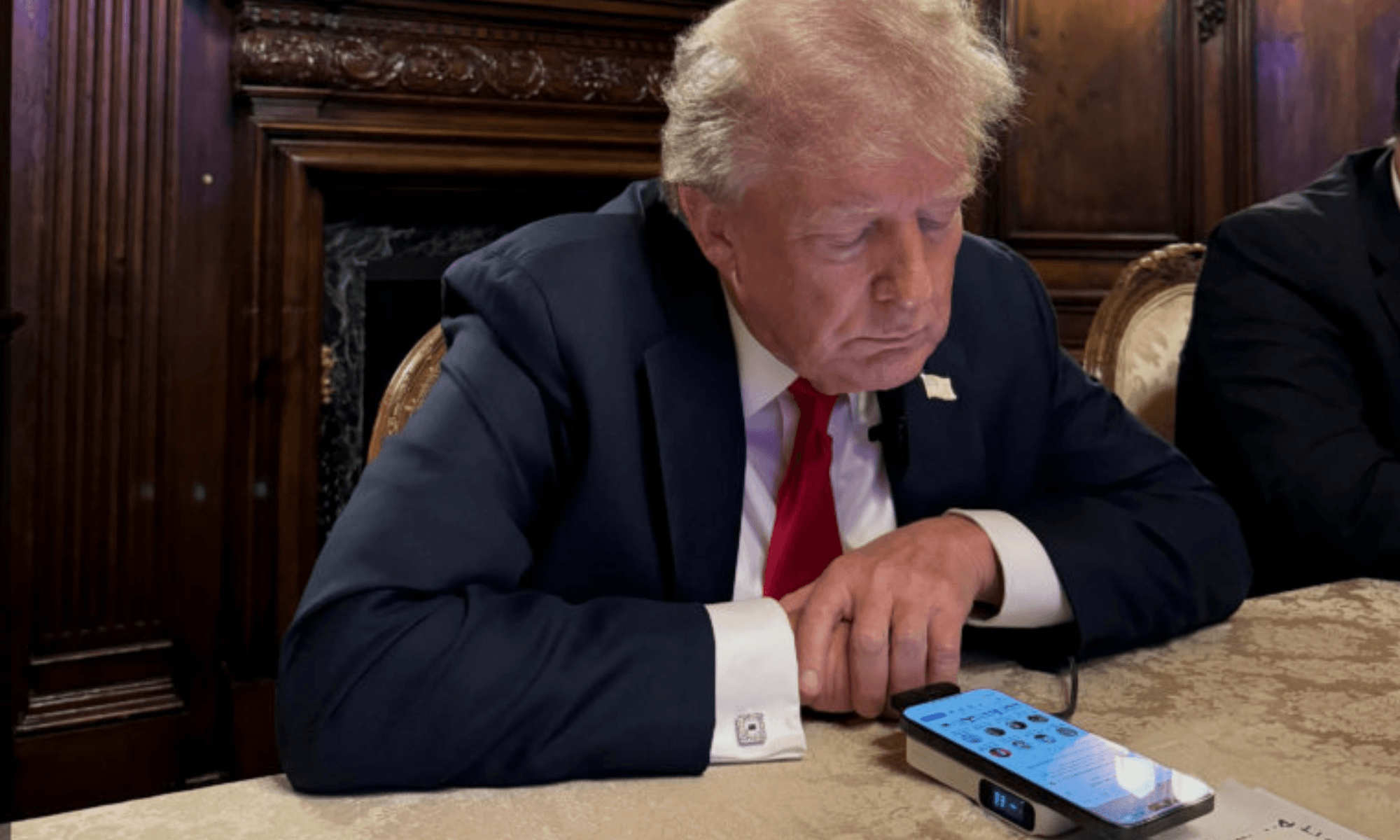
President Donald Trump speaks as he participates in an interview at Mar-a-Lago in Palm Beach, Florida, August 12, 2024 in this picture obtained from social media. Margo Martin via X/via REUTERS
President Donald Trump speaks as he participates in an interview at Mar-a-Lago in Palm Beach, Florida, August 12, 2024 in this picture obtained from social media. Margo Martin via X/via REUTERS
President Donald Trump's fixation on social media is nothing new, but according to a new analysis from the Wall Street Journal, his use of his own platform as a "unique form of online diplomacy" amid the war in Iran is a new development, and one some experts have called "jarring."
"Three weeks into the war, the commander in chief has used his favorite platform — Truth Social — to cajole allies, berate adversaries, reassure embattled Gulf states and conduct his own unique form of online diplomacy," the Journal explained. "Never before has a U.S. president, the world’s most powerful figure, telegraphed his thoughts about war planning so publicly, broadcasting his decision-making and communicating his views in real time."
As of the report's publication on Friday, Trump had used his Truth Social account to post about the war in Iran, Israel and other topics related to the conflict nearly 90 times, including posts with "videos, reposts of other people’s comments and his own views, some running longer than 200 words." In total, the war has accounted for roughly 25 percent of his social media output since it began late last month.
The rest of the content of his posts, meanwhile, has often contrasted with the serious nature of the conflict.
"His messages about the war have been interspersed with posts on other topics, including one about the threat presented to Lake Michigan by Asian carp, which came up during a recent meeting with Democratic Gov. Gretchen Whitmer of Michigan," the Journal detailed. "An update on the approval process for his planned White House ballroom; and links to articles chronicling his deteriorating relationship with comedian Bill Maher."
Richard Haass, president emeritus of the Council on Foreign Relations, told the outlet that the effect of Trump using something so traditionally unserious as social media to chronicle, react to and dictate a war has had an unsettling effect.
“There’s an inconsistency between the seriousness of war and the informality of social media,” Haass said. “It’s jarring.”
Trump's fixation on posting has come to dominate much of his second term, forcing his staff to work around it. According to the Journal, White House press secretary Karoline Leavitt had a television monitor installed over her desk to display the latest posts from her boss. According to former biographer Michael Wolff, White House staffers have been at the mercy of Trump's posts, often waking up to find that he had shared some new demand or declaration, which they would be required to translate into actual policy.
“This certainly goes right to the heart of who Donald Trump is and how he governs,” Wolff explained during a January podcast appearance. “And I use the word ‘govern’ loosely. It is literally off the top of his head... I know people in the White House, and I speak to people in the White House often, and I think this is very difficult to appreciate — and probably impossible to appreciate — that the people within the White House are often as surprised as we are by what happens. They go to bed at night, and then they open up their phones in the morning, and they look to see what he has posted. And that becomes policy, that becomes reality.”