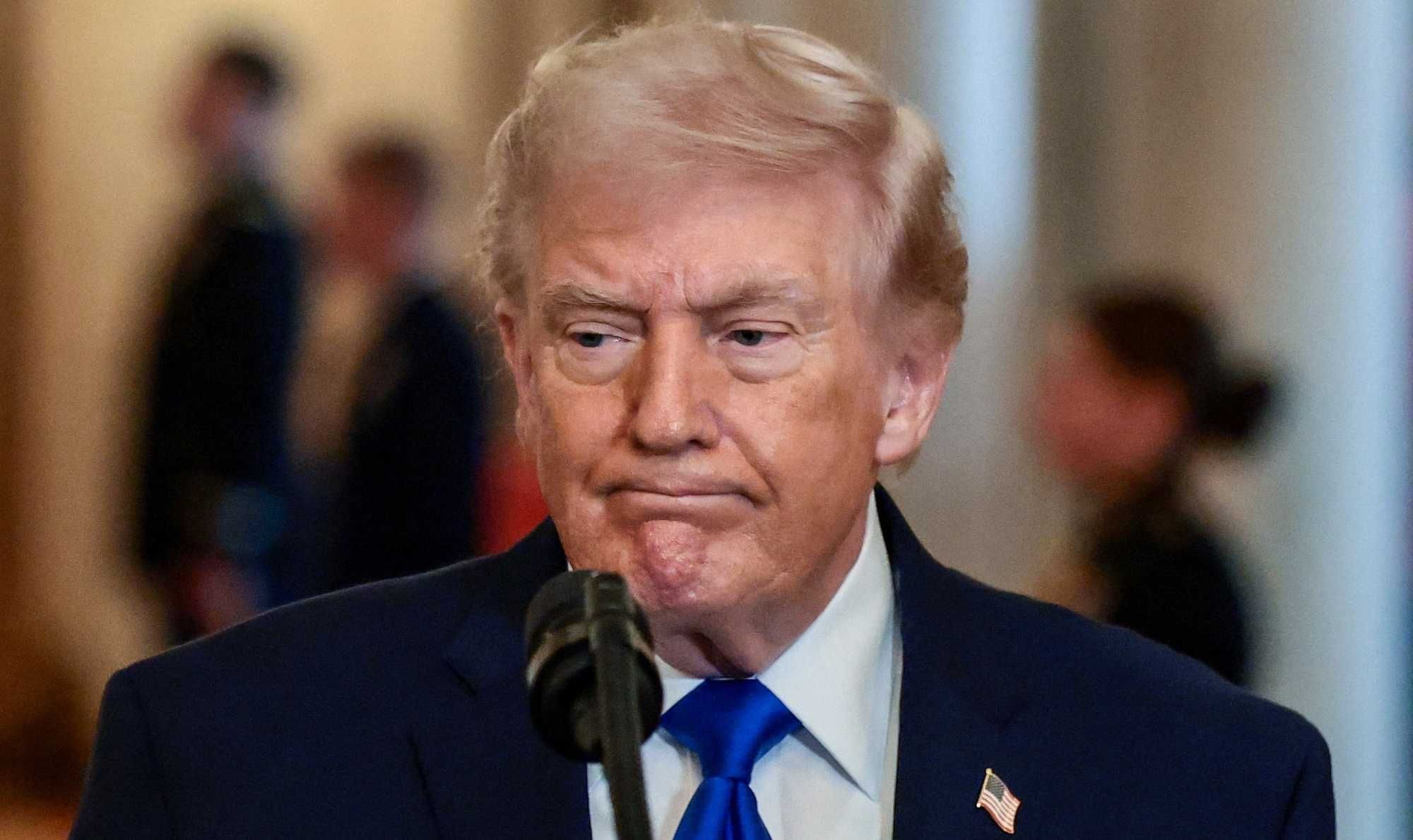
U.S. President Donald Trump attends an event to honor Angel Families at the White House in Washington, D.C., U.S., February 23, 2026. REUTERS
On Monday, it was announced that President Donald Trump will drop his $1.8 billion slush fund, with sources saying, “It’s dead for now.” As some experts are pointing out, however, that “for now” could mean something, and Senate Republicans may still have to take action to prevent the administration from giving the fund another try.
“They disagree with the ruling, but ‘will abide’ by it,” posted Punchbowl News founder Jake Sherman over a retweet of the DOJ’s announcement. “I think Rs are still gonna want something in reconciliation to make sure that admin doesn't do this in the future.” Punchbowl’s senior congressional reporter shared his sentiments, posting, “Something tells me this is not going to be satisfactory to enough Senate Republicans.” “This won’t satisfy Senate R’s,” Reese Gorman of NOTUS agreed.
“Boy do we have a bill for them!” replied Jacob Peters, Communications Director for Senator Mark Kelly (D-AZ). Kelly has become a vocal opponent and frequent target of the administration ever since advocating that military service members refuse illegal orders.
The announcement of the fund’s demise comes on the heels of news that Senate Majority Leader John Thune (R-SD) had told Trump that he either had to shut down the fund or lose his budget reconciliation.
“I made my views very clear on the issue,” Thune said. “I do think the best way to handle it is if the administration decides to shut it down themselves.”
The fund had drawn bipartisan fury over the likelihood that it would benefit convicted January 6 rioters, with a major Florida editorial board calling it “the biggest heist in history.” In a rare moment of alignment, anger at the fund prompted vocal pushback from Republicans, “imaginative” plans to thwart it from Democrats, and even a legislative collaboration between the two parties.
The final straw seems to have come when a number of Republican Senators threatened to block an immigration and border control budget reconciliation bill, a key GOP priority that has faced an uphill battle. Now the bill has been cleared of this impediment, but another remains. “This likely clears way for Senate GOP to pass the $70 billion immigration enforcement funding bill in the coming days,” noted Semafor congressional chief Burgess Everett, “assuming ballroom security stays out of bill.”
This is a reference to what has proven to be another hindrance to the bill: $1 billion in funding for security at Trump’s White House ballroom. Americans oppose the project by an overwhelming margin of 2-to-1, and with the midterms looming, Congressional Republicans are desperate to diminish the already heavy headwinds caused by the war with Iran and skyrocketing prices. The elimination of the slush fund provides much-needed breathing room to their jam-packed, make-or-break legislative week ahead, and takes off some pressure with November approaching.
But while many opponents of the fund are celebrating its demise, some experts point out that the delay may not be permanent. “That ruling is temporary order while litigation proceeds,” noted Ryan Goodman, Chaired Professor at NYU Law. “Reporting sounds broader than complying with temporary order, but instead responding to political concerns from Republicans on Hill etc to drop the fund.”
As Politico senior legal affairs reporter Kyle Cheney clarified, “Folks the court did NOT rule that the fund is dead. She only ruled that for a two-week period the fund would be on pause while the judge could sort through the legal issues. Abiding by the court order does not mean killing the fund.”