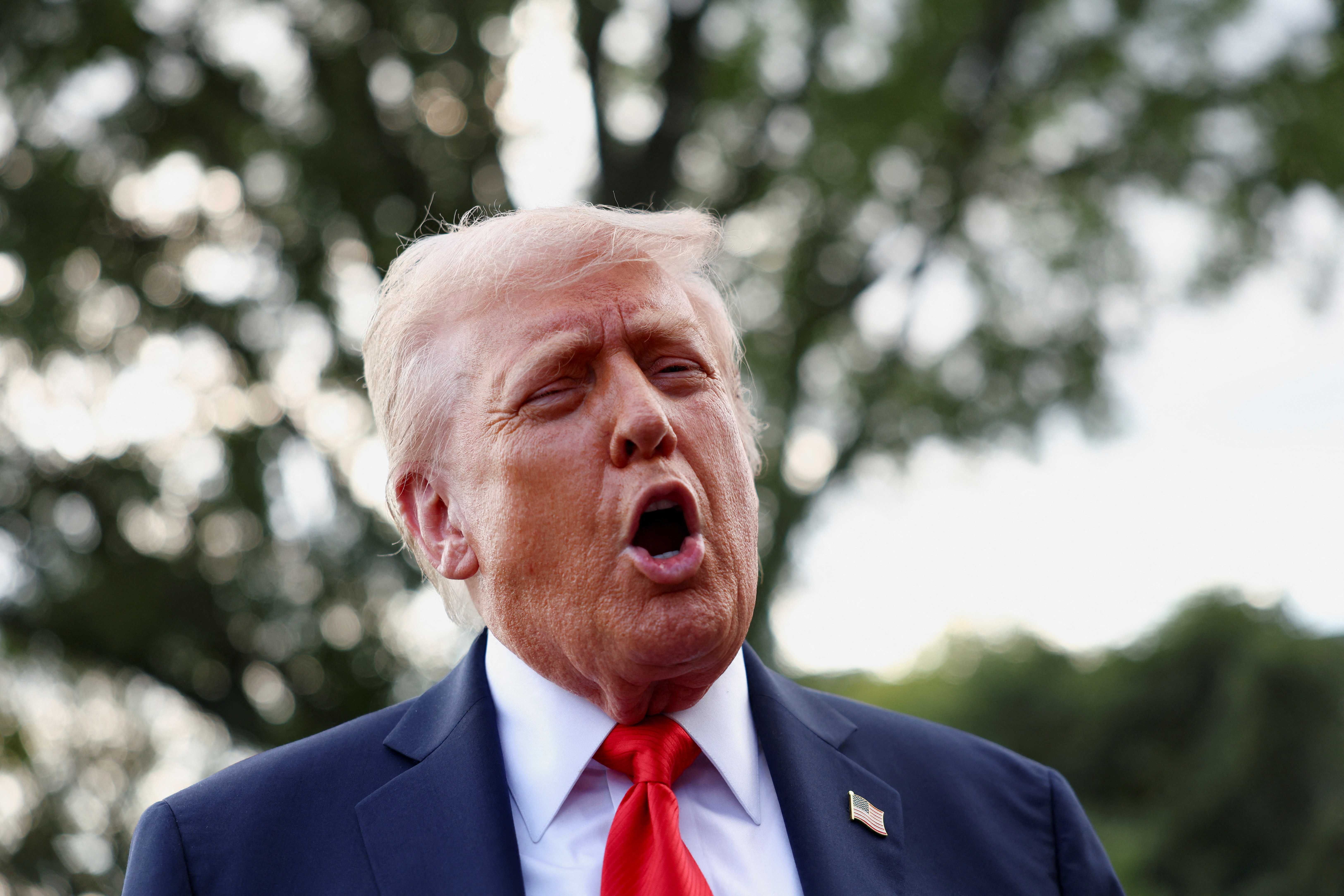
U.S. President Donald Trump speaks to the media before boarding Marine One upon departure for New York, in Washington, D.C., U.S., September 11, 2025. REUTERS/Evelyn Hockstein
Few events in President Donald Trump’s second term have prompted as much outrage as the announcement that the DOJ will create a $1.776 billion “anti-weaponization” fund to compensate those “harmed” by the Biden administration, which has been broadly denounced as a “slush fund” for convicted J6 criminals. There has been bipartisan discussion of how to block the fund, and now famed Esquire political commentator Charles P. Pierce is applauding one “imaginative” idea.
Earlier this week, New York Democratic state assemblymember and House candidate Alex Bores unveiled legislation that would level a 100 percent tax against payouts from the fund. Then on Wednesday, California Governor Gavin Newsom gave even greater visibility to the idea, telling reporters, “Anyone from California that receives any of those funds, we want to tax 100 percent of those proceeds.” Other congressional Democrats have gotten behind similar efforts.
“I love this,” said Pierce. “This is the kind of imaginative grassroots pushback the national Democratic party needs. The more that this incredibly corrupt bargain is subjected to public scorn and ridicule, the better.”
While the concept may have a hard time catching on among Republicans who are famously antagonistic toward enacting new taxes, conservative lawmakers have been so angered by the fund that they may be willing to take dramatic steps to oppose it. Even congressional Republicans who are usually hesitant to break with the president have blasted the move, with former Senate Majority Leader Mitch McConnell declaring, “So the nation’s top law enforcement official is asking for a slush fund to pay people who assault cops? Utterly stupid, morally wrong — take your pick.”
The tax idea hasn’t been the only effort to stymie the fund.
Shortly after it was announced, the Bipartisan Transparency for American Taxpayers Act was introduced by Representatives Tom Suozzi (D-NY) and Brian Fitzpatrick (R-PA), which declared simply that “no federal funds may be used for the payment of any claim submitted to the Anti-Weaponization Fund, established by the Department of Justice on May 18, 2026.” If enacted, it would essentially kill the fund. Representative Jamie Raskin (D-CA) introduced the No Taxpayer-Funded Settlement Slush Funds Act, which would similarly deny federal cash to the fund.
Interestingly enough, in February, a slate of Republican lawmakers began pushing the Stop Settlement Slush Funds Act of 2026, which has so far failed to gain traction. If enacted, it would prohibit government officials from entering into settlement agreements that divert funds to third-party organizations, with the intention of preventing the Executive Branch from circumventing Congress and steering settlement money to its preferred recipients — an exact description of the circumstances surrounding the J6 slush fund.