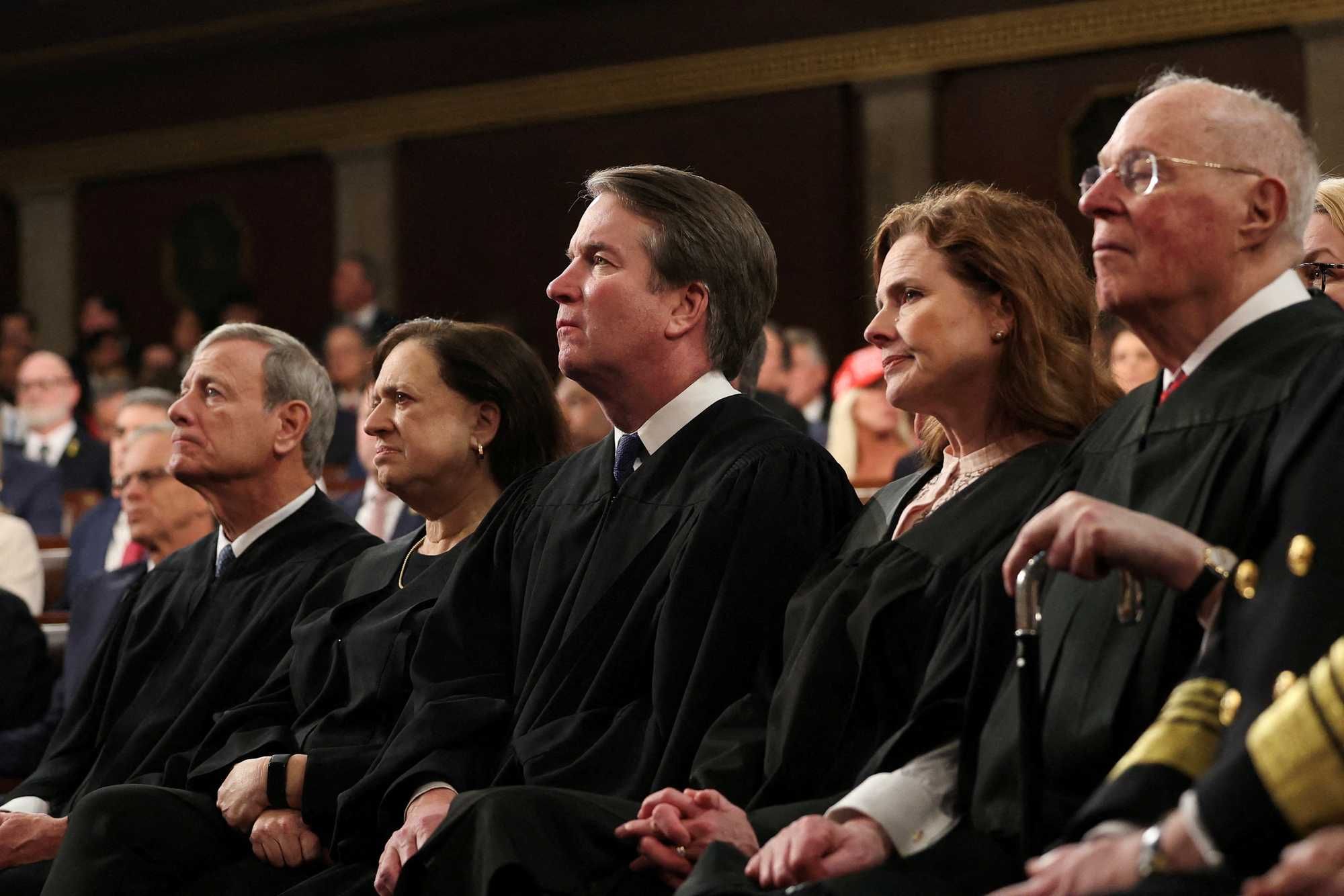
Chief Justice John Roberts, Justice Elena Kagan, Justice Brett Kavanaugh, Justice Amy Coney Barrett and retired Justice Anthony Kennedy on March 04, 2025 in Washington, DC. Win McNamee/Pool via REUTERS
Chief Justice John Roberts, Justice Elena Kagan, Justice Brett Kavanaugh, Justice Amy Coney Barrett and retired Justice Anthony Kennedy on March 04, 2025 in Washington, DC. Win McNamee/Pool via REUTERS
After the U.S. Supreme Court ruled, in a 6-3 decision, that most of President Donald Trump's tariffs are illegal, he wasted no time attacking the justices as a "disgrace" —including two he appointed: Amy Coney Barrett and Neil Gorsuch, who were joined by Chief Justice John Roberts and three Democratic appointees (Sonia Sotomayor, Ketanji Brown Jackson and Elena Kagan) in the majority. The three dissenters were Justices Clarence Thomas, Brett Kavanaugh and Samuel Alito.
Trump even called for the justices in the six-person majority to be investigated for foreign influence.
During a conversation for The New Republic's podcast "The Daily Blast" posted on February 23, host Greg Sargent and his guest, Stanford University legal scholar Matthew Seligman, discussed the implications of Trump railing against the justices. Sargent argued that Trump is failing to respect "separation of powers" and the role that the federal government's legislative and judicial branches play in economic policy.
The New Republic noted that Republicans "voiced concerns about Trump" attacking the justices, and some are applauding the decision.
Sargent told Seligman, "(Trump) vowed to revive his tariffs using other authorities, and he declared that he has zero obligation to go to Congress to do so. It's all supposed to sound very scary, yet this time around, Trump really looks like a floundering, diminished figure who's struggling to keep up the appearance that he isn't afraid to wield 'dictatorial power.' And yet, there are signs it's already backfiring as well, with at least one Republican declaring that Trump's threats should prompt the GOP Congress to take more of a stand against him on all this."
The Republican that Sargent was referring to was former Sen. Majority Leader Mitch McConnell (R-Kentucky), who reminded Trump that "Congress is not an inconvenience to avoid."
Sargent told Seligman, "So, Trump says here he doesn't have to go to Congress. He also says here that when a handful of Republicans voted against him on this recently, that was because they were 'not good Republicans' — because a 'good Republican' is one who does whatever he wants at all times, apparently. You know, Matt, I think Trump struggles a little bit with the concept of the separation of powers."
The Stanford University legal scholar responded, "Well, I think it's revealing in several ways. You know, the bottom line is the Constitution doesn't care about Donald Trump's views about who’s a 'good Republican' and who's a 'bad Republican.' This is a power —just like taxation — where it's very clearly Congress' power. And so, Congress has to pass a statute. It's arguable that it already did in these certain narrow, specific circumstances, but this is ultimately Congress' power."
Seligman also argued that Trump fuels doubts about his competence when he demonizes justices he appointed.
Looking back on the firings from Trump's first presidency, Seligman told Sargent, "Again and again, he kept firing his secretary of state, firing his chief of staff, firing his national security advisor — again and again. And then tweeting out or posting on Truth Social that they were incompetent. Well, OK — if you're such a 'great businessman,' why did you hire them? Now, we're seeing that hit the Supreme Court."
Seligman added, "If you feel like you need to investigate Justice Gorsuch and Justice Barrett for potential foreign interference — which, I should be very clear, there's absolutely no evidence of whatsoever — then the question is: Why did you nominate them to the Supreme Court in the first place?"