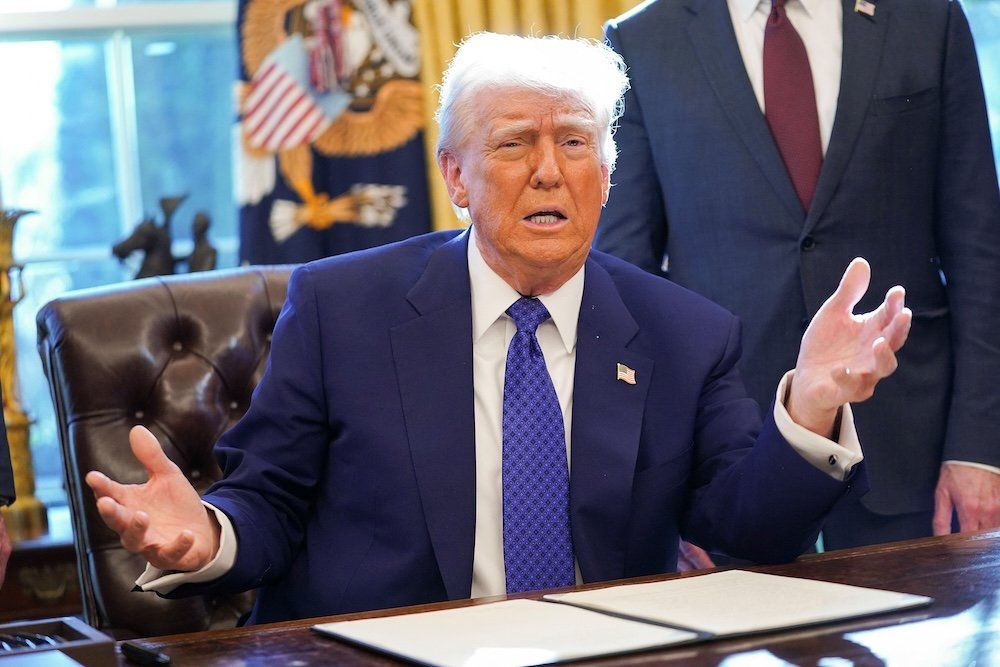
U.S. President Donald Trump speaks, as he sits to sign an executive order, in the Oval Office, at the White House in Washington, D.C., U.S. February 14, 2025. REUTERS/Nathan Howard
President Donald Trump is suing the IRS for $10 billion, roughly two-thirds of the agency’s annual budget. Yet because there is a conflict of interest in a sitting president trying to pocket money from the government he controls, a judge presiding over the case has caused it to hit a snag.
Explaining that there is no precedent for Trump’s request, on Wednesday US District Judge Kathleen M. Williams appointed three law firms to serve as friends of the court and advise whether her court even has jurisdiction over the case. The lawyers in question include John Gleeson and David A. O’Neil from Debevoise & Plimpton LLP; Donald B. Verrilli, Jr. from Munger Tolles & Olson LLP; and Faith E. Gay, Philippe Z. Selendy, and Corey Stoughton from Selendy Gay PLLC.
Some of these lawyers are connected to high-profile Democrats. Gleeson was previously appointed as a judge by President Joe Biden; Verrilli served as President Barack Obama’s Solicitor General; Faith E. Gay represents New York Gov. Kathy Hochul; and Corey Stoughton worked as Obama’s Assistant Attorney General for Civil Rights in the Department of Justice.
“As set forth in its Order (DE 41), the Court has concerns about whether it has subject matter jurisdiction in this case,” Williams explained in her ruling. “Accordingly, the Court appoints attorneys from the following law firms as amici curiae to assist the Court in identifying the applicable law governing an analysis of this issue.” Williams then listed the aforementioned attorneys and firms.
In his lawsuit, Trump accuses the IRS of liability for his tax returns being leaked to the press, as those returns revealed he had a number of previously-undisclosed financial failures, only paid $750 in federal income taxes in 2016 and 2017 and paid no taxes at all in 10 of 15 years after 2000. Because the returns were leaked by a third-party contractor for the digital transformation company Booz Allen, Trump’s lawsuit holds the IRS responsible for the contractor’s actions.
Procedurally, this lawsuit is controversial because the Justice Department is legally charged with defending the IRS, yet as Williams pointed out last week, Trump’s Justice Department treats the president as its “chief client” and therefore may not provide the IRS with legitimate representation.
“Although President Trump avers that he is bringing this lawsuit in his personal capacity, he is the sitting president and his named adversaries are entities whose decisions are subject to his direction,” the judge wrote last week. “Accordingly, it is unclear to this court whether the parties are sufficiently adverse to each other.”
Factually, The New Republic's Timothy Noah observed in February that Trump’s lawsuit is flagrantly flawed when one analyzes its merits.
"Trump's $10 billion, if he got it, would be the third-biggest civil judgment in United States history," Noah wrote. "It would be the biggest civil judgment ever awarded to a plaintiff in a case where the defendant didn't kill at least one person…. The Trump Administration has requested $15 billion to fund the IRS this fiscal year. So yes, Trump wants to help himself to two-thirds of the IRS' annual budget. So, wow, the whole thing is pretty nuts."