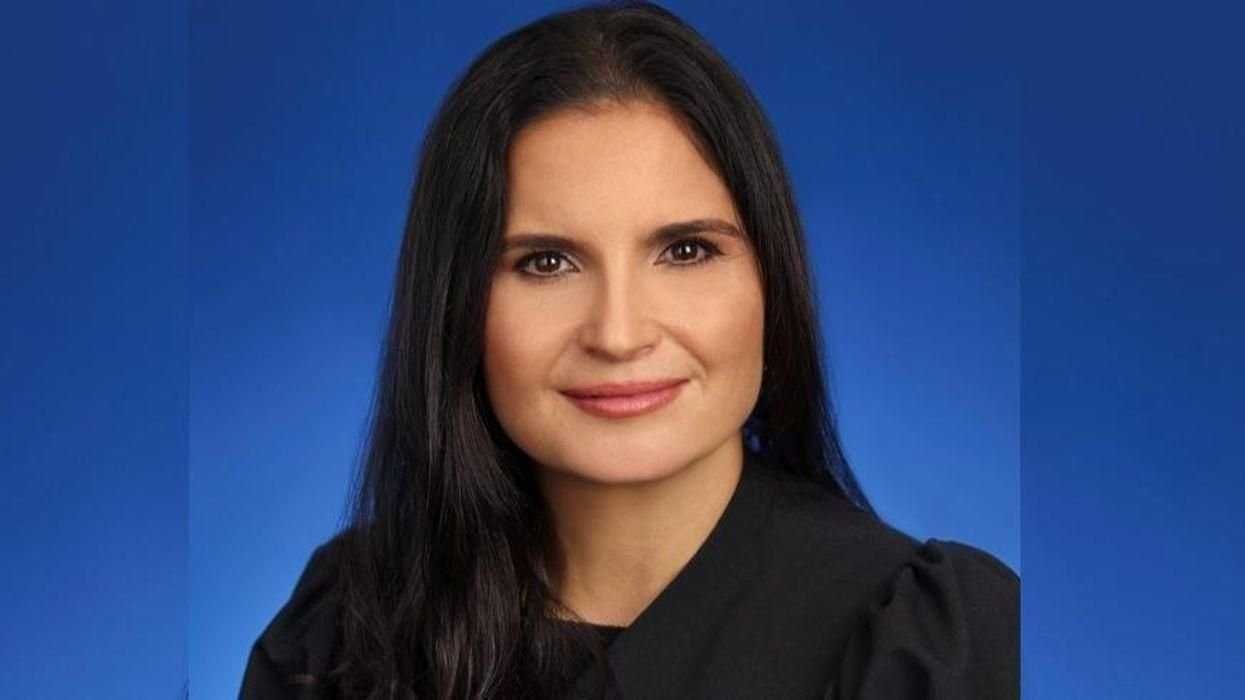
Judge Aileen Cannon in 2021 (Wikimedia Commons)
A judge appointed by President Donald Trump — and who has been repeatedly accused of ignoring proper legal procedure to make decisions in his favor — is now blocking the release of files in a case regarding some of the most serious criminal charges previously filed against him.
“In an opposition brief on Tuesday, Trump attorney Kendra Wharton tore into the Knight First Amendment Institute and American Oversight for persistent yet ‘meritless’ attempts to fast-track appeals,” reported Matt Naham from the legal news website Law and Crime. The “appeal” in question involves attempts by the pair of non-profits, which respectively focus on free speech rights and fighting government corruption, to prevent Judge Aileen Cannon from destroying Volume II of a criminal case involving Trump’s alleged stealing and misuse of classified state documents after his first term.
“In February, and after ignoring American Oversight and the Knight Institute's attempts to intervene in the closed criminal case for nearly a year, Cannon permanently blocked the DOJ from releasing Volume II,” Naham reported. “Prior to that ruling, the groups filed emergency appeals, fearing that Cannon would order Volume II's destruction. That did not happen, but the rush to prevent it has led to a messy appellate posture as to her denial of the groups' interventions.”
Defending the judge Trump appointed near the end of his first term, the president argued in a recent filing that the groups "should not be rewarded" with speedy relief. By contrast, the non-profits argued in their filing that “if anything” the "public's interest in prompt access to Volume II has […] intensified since January[.]"
They added, "The grounds the Court credited in granting expedition in January 2026 apply with equal or greater force now. The need for expedition does not diminish merely because a procedural prerequisite—consolidation—remains to be resolved. To the contrary: it is the absence of a ruling on consolidation that is now standing in the way of the expedited disposition this Court already ordered."
In their own filing, Trump’s legal team argued that “lacking any credible argument for expedition at this juncture in the proceedings, Appellants falsely assert that this Court has 'already determined' that good cause exists, and they wrongly accuse this Court of undue delay in declining to expedite the appeals, all while refusing to acknowledge that their own sequencing decisions and repeated missteps resulted in the very posture of which they now complain. At this point, Appellants' modus operandi is clear. They will continue to deflect, cause unnecessary motion practice, and cast aspersions against any judicial officer who does not deliver their desired outcome."
"The public interest in the Special Counsel's report is extraordinary, and the public right of access to the report requires timely access," Knight Institute senior counsel Scott Wilkens told Naham about this issue. He added that there is "no valid reason for further delay."
Writing in February for the legal news website Above The Law, Kathryn Rubino pointed out that Cannon has “showed her whole a—— as a partisan hack willing to do the bidding of Donald Trump.”
“She really upped her status as ‘favorite judge of the most aggressively red-hatted MAGA crowd’ when she dismissed the criminal case against Trump,” Rubino wrote. “Her theory — that Smith’s appointment as special counsel was unconstitutional — was… creative. So creative, in fact, that it flew directly into conflict with decades of precedent. But after Trump won the 2024 election, the DOJ dropped the appeal.”
The special prosecutor behind that case, Jack Smith, has refused to remain silent despite legal pressures to do so. Speaking at a private Washington DC event on April 20, Smith warned that “we have a Department of Justice today that targets people for criminal prosecution simply because the president doesn't like them…. We have a department that fails to investigate cases because they might uncover facts that are inconvenient narratives the president would like to press."
Similarly, last fall Smith spoke to a George Mason University audience and described how “my career has been about the rule of law, and I believe that today, it is under attack like in no other period in our lifetimes.”