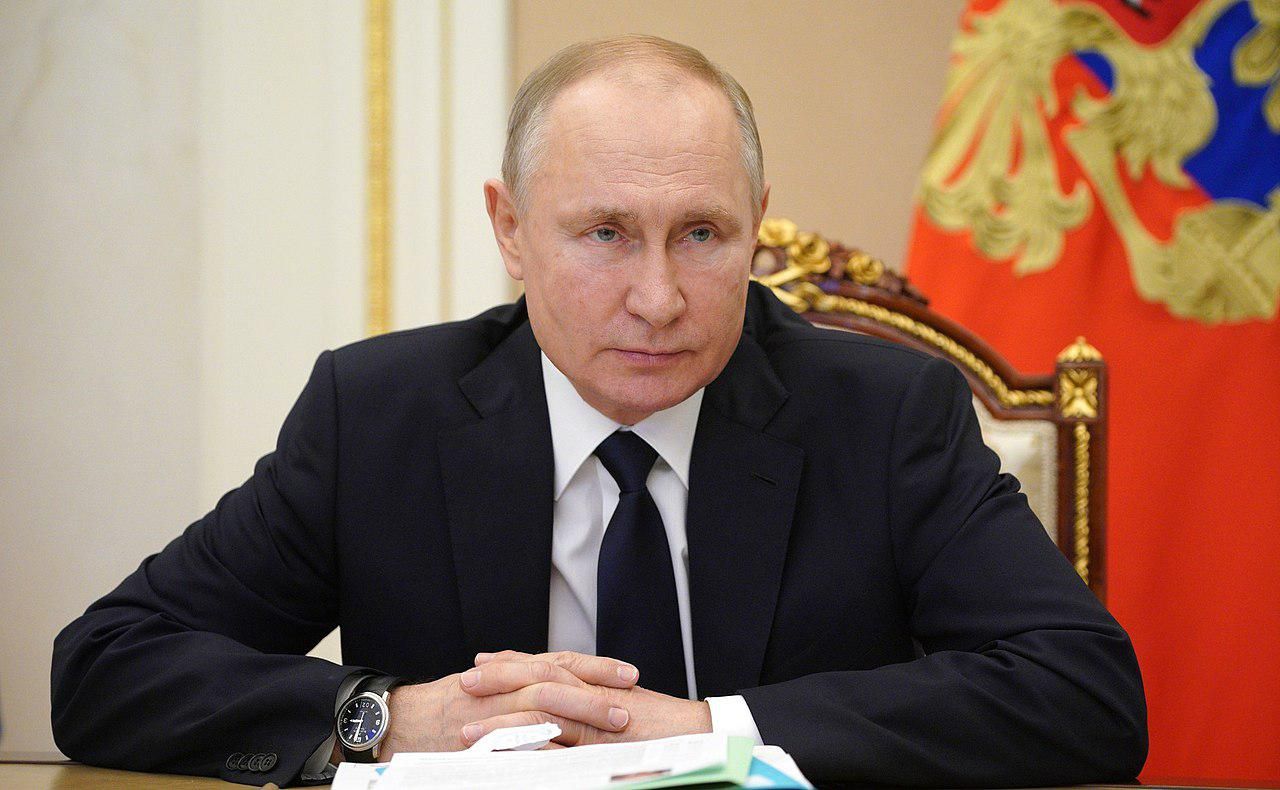
Russian President Vladimir Putin in April 2021, Wikimedia Commons
President Donald Trump has successfully garnered the favor of America’s wealthiest billionaires, from Tesla CEO Elon Musk and Meta CEO Mark Zuckerberg to Amazon CEO Jeff Bezos and Google CEO Sundar Pichai. Yet as a pair of scholars recently pointed out, when oligarchs make deals with would-be authoritarians, they ultimately get the worst end of the deal.
“The attendees at U.S. President Donald Trump’s second inauguration included a typical cast of government officials, legislators, and cabinet nominees,” wrote Christopher Hartwell and Tricia D. Olsen in the magazine Foreign Affairs on Tuesday. “What was not so typical was the crew of billionaires who also attended—and took center stage.” After ticking off the names of Zuckerberg, Bezos, Pinchai and Musk, Hartwell and Olsen observed that alliances between an aspiring authoritarian and oligarchs aren’t just bad for the general public “but also for the business elites who make it.” Because the dictator at the top of a hierarchy does not want to seem weak or dependent on others, they eventually feel compelled to reassert power at the expense of the oligarchs.
“By stripping the post-Soviet oligarchs of their assets, Putin could refill state coffers and distribute the extra spoils among his own new ruling elite, thereby creating a new oligarchy that was wholly dependent on his whims and desires,” Hartwell and Olsen wrote. “After the 2012 presidential election, which was marred by widespread allegations of fraud and mass protests against the regime, this system became hypercentralized and even more dependent on Putin. Fealty to Putin, rather than managerial expertise, became and remains the key criterion for success. The consequences of failing to adhere to this compact can be deadly. There seems to be nothing as dangerous to a high-profile Russian business executive as an open window.”
Indeed, after Russia invaded Ukraine in 2022, so many oligarchs began dying off that a Wikipedia page was written on the subject. Lukoil chair Ravil Maginov mysteriously fell to his death from a hospital window while the security cameras were not functioning; meat processing executive Pavel Antov fell from a hotel window in India; and overall “since the start of Russia’s war in Ukraine, dozens of members of Russia’s business elite have died under unusual circumstances.”
The good news for America, Hartwell and Olsen argued, is that the United States is still a democracy and not an autocracy like Russia or other oligarch-dominated countries like Saudi Arabia and Turkey. The bad news is that America is “experiencing steady democratic backsliding, a process marked by steep political polarization, the expansive use of executive power, and challenges to speech and dissent. This trend manifests in part in what has come to be known in the United States as ‘lawfare,’ when leaders use legal prosecution as political punishment against particular individuals or institutions they see as disloyal. Although such practices have grown in the United States in the past two decades, they have exploded under Trump.”
They added, “The president has launched widespread attacks on his political opponents, business leaders, and media outlets that he sees as too critical of his administration. Trump has on various occasions since 2017 called the media ‘the enemy of the people.’ His first administration frequently attacked Bezos, who also owns The Washington Post; Les Moonves, who served as chair of CBS News until 2018; and Bob Iger, CEO of the Walt Disney Company, which owns ABC News, for news coverage perceived as unfair to Trump.”
For these reasons, while the Foreign Affairs writers acknowledged that there is “a charitable view” of billionaires aligning with Trump “to hedge their bets during a routine change of power,” they are complicit in his creation of an authoritarian state capitalism by continuing to support him now. If those moral considerations do not move them, though, naked self-interest might do so.
“There is no doubt that Trump appreciates the overtures of business leaders and may even reward them in meaningful ways,” they wrote. “But authoritarian state capitalists are more concerned with enriching themselves and their ruling clique than helping friendly oligarchs. Such leaders tolerate private enterprise only as long as it does not interfere with their efforts to amass and maintain their own political and economic power.”
Ultimately they urged Americans to pressure our nation’s business leaders to see it as being in their financial and personal interests to preserve America’s democracy and free enterprise system, rather than allow it to devolve into a society where proximity to power determines wealth and personal safety.
“Everyone has an interest in seeing business leaders commit to democratic practices and institutions, no matter which party is in power,” they wrote. “The alternative is a political environment in which everyone has fewer rights and less freedom—including, sooner or later, the oligarchs. This is the real lesson of Russia, where the oligarchs are gone but the deleterious effects of their choices to support an unjust system remain.”
There are signs that at least some billionaires are speaking out against Trump. LVMH CEO Bernard Arnault, for example, recently criticized Trump by saying “ the world is now in a pretty serious crisis in the Middle East. Either it’ll be a world catastrophe with very serious and very negative economic impact—in which case, who can say how 2026 will unfold—or it will be resolved more rapidly in some shape or form that we all hope for, even if it doesn’t seem to be easy, in which case, business will recover and resume their normal course.”
Writing for The Nation, writer Elizabeth Spiers pointed out the irony that these same billionaires, despite profiting from an information-based economy, have embraced a definitively anti-intellectual ethos.
“As the historian Richard Hofstadter noted, a fierce anti-intellectual spirit has long animated American culture, but it has typically targeted the knowledge elite from below,” Spiers wrote. “What’s striking about today’s brand of anti-intellectualism is that it infuses the American knowledge elite; it stems from the bedrock conviction among tech oligarchs that they have mastered everything and have nothing left to learn. In this cloistered vision of tech-driven learning, they believe that deep intellectual work—the kind you do when you author a complex piece of music, for example—has little or no inherent value.”
Spiers concluded, “Their disdain for it has fueled their attacks on higher education, the humanities, and learning for its own sake, which they believe has no purpose beyond its inevitable digitization and monetization.”