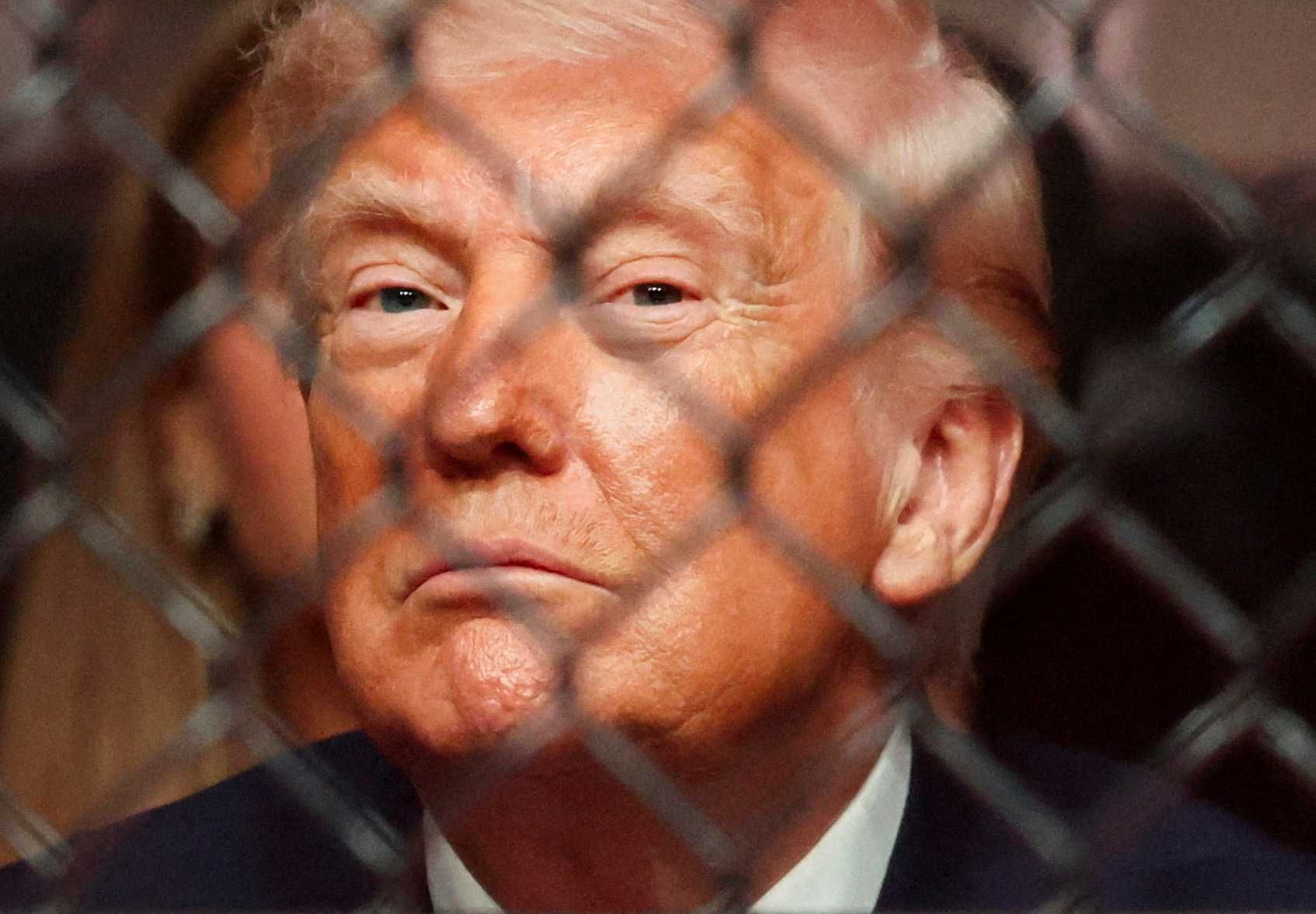
U.S. President Donald Trump watches a match during the UFC 327 event at Kaseya Center in Miami, Florida, U.S., April 11, 2026. REUTERS/Kevin Lamarque
On Thursday, a whistleblower from President Donald Trump’s first administration laid out the pattern of Russian collusion that has extended across both terms. According to Miles Taylor – who served as the Deputy Chief of Staff in Homeland Security and leaked White House secrets – Trump’s actions regarding Ukraine amount to “treason” worthy of impeachment.
As Taylor notes, this week has brought a flurry of controversy prompted by Trump’s actions regarding Russia and Ukraine. It began on Tuesday, when Russian ballistic missiles struck Ukraine without warnings that would usually come via U.S. satellites, killing and injuring dozens of Ukrainians. While American officials claimed the detection failed due to “bad weather,” Ukrainian officials said someone in the U.S. was “playing” with the system. Then the next day, Starshield – the military version of Elon Musk’s Starlink, which Ukrainian troops use to fly drones and intercept Russian attacks — was suddenly throttled without warning. Ukrainian President Zelenskyy was furious and warned that “people will die.” Musk surprised everyone by putting the blame on the White House, posting, “Any limits on speed or usage are decided by the U.S. military and ultimately POTUS.” The White House has not denied his claims.
“Are we to believe this was a coincidence?” asks Taylor. “Missile warnings and battlefield communications all coming down at the same time? Was it all ‘the weather’? Not even a fool would accept that conclusion. Look at last week, and you can surmise exactly what happened. And it may well be criminal.”
Days before, explains Taylor, Trump held a “suspicious” phone call with Russian President Vladimir Putin, after which he announced a deal to buy millions of tons of Russian diesel, breaking sanctions he himself signed into law mere weeks earlier. Even Republican Senators have warned that he broke the law by giving a financial gift to the U.S. adversary. On the same day, Trump’s envoys told Ukraine that if Kyiv didn’t stop striking Russian oil refineries, Washington would cut off intelligence. Then on Saturday, after Russian glide bombs killed 20 people in Ukraine, Trump said something that Putin “has been dreaming of, declaring, “It’s time for Ukraine to get a new president.” Finally, late Wednesday, FBI Director Kash Patel responded to reports that he’s planning to visit Moscow to meet with the FSB, the successor to the KGB, with the taunt, “From Russia, with Love…”
According to Taylor, “There are very serious questions here, with very serious implications for the Trump presidency. What did the president know, and when? What did Putin ask of Trump in that phone call? Did Donald Trump agree to give Putin a financial boost and buy his oil? Did Putin suggest it might help Trump in the midterms by lowering gas prices? Did Trump offer to weaken Ukraine’s defenses for Putin? Did Trump then personally order the Pentagon to restrict Ukraine’s satellite communications while Ukrainian cities were under attack? Did he order American agencies to sit on intelligence about incoming strikes? What, exactly, did the two men say to each other on Friday?”
As Taylor notes, Trump has actually already been impeached previously, in 2019, over this exact issue: withholding military support for Ukraine in order to extract a political benefit for himself in a “perfect phone call” with the Ukrainian leader. At the time, he froze foreign aid that was supposed to go to Ukraine in order to get leverage over them to help his re-election. Now he’s doing it again, though Taylor asserts the matter is “more serious” this time. “After a very suspicious phone call with Vladimir Putin,” writes Taylor, “Trump may have shut down early warning systems and battlefield communications — by literally switching them off while civilians slept in their apartments in Ukraine, in the crosshairs of Russia — in order to pressure Ukraine into a bogus ‘energy ceasefire’ in order to herald lower gas prices before the U.S. midterm elections.”
While this situation doesn’t precisely fit the Constitutional definition of treason, in Taylor’s estimation, “a president who puts his allies in mortal danger with favors to an enemy and for personal benefit has essentially done what treason describes. And impeachment doesn’t require a statute. Indeed, the words ‘high crimes and misdemeanors' were written to allow Congress to impeach a president for abuses of the public trust, and there’s no clearer abuse than a commander in chief using American intelligence as leverage against the people it was built to protect, on behalf of the dictator trying to kill them.” Trump has been impeached over such actions before. Now, writes Taylor, “The question our country must confront is whether the leader of the United States lowered the shield so that Putin could carry out murder and so that he could secure some political wins. In 2017, it took a special counsel to find out what Trump and Russia were doing together. In 2026, it might get blown open over an alleged lie about a weather report. The collusion is real.”