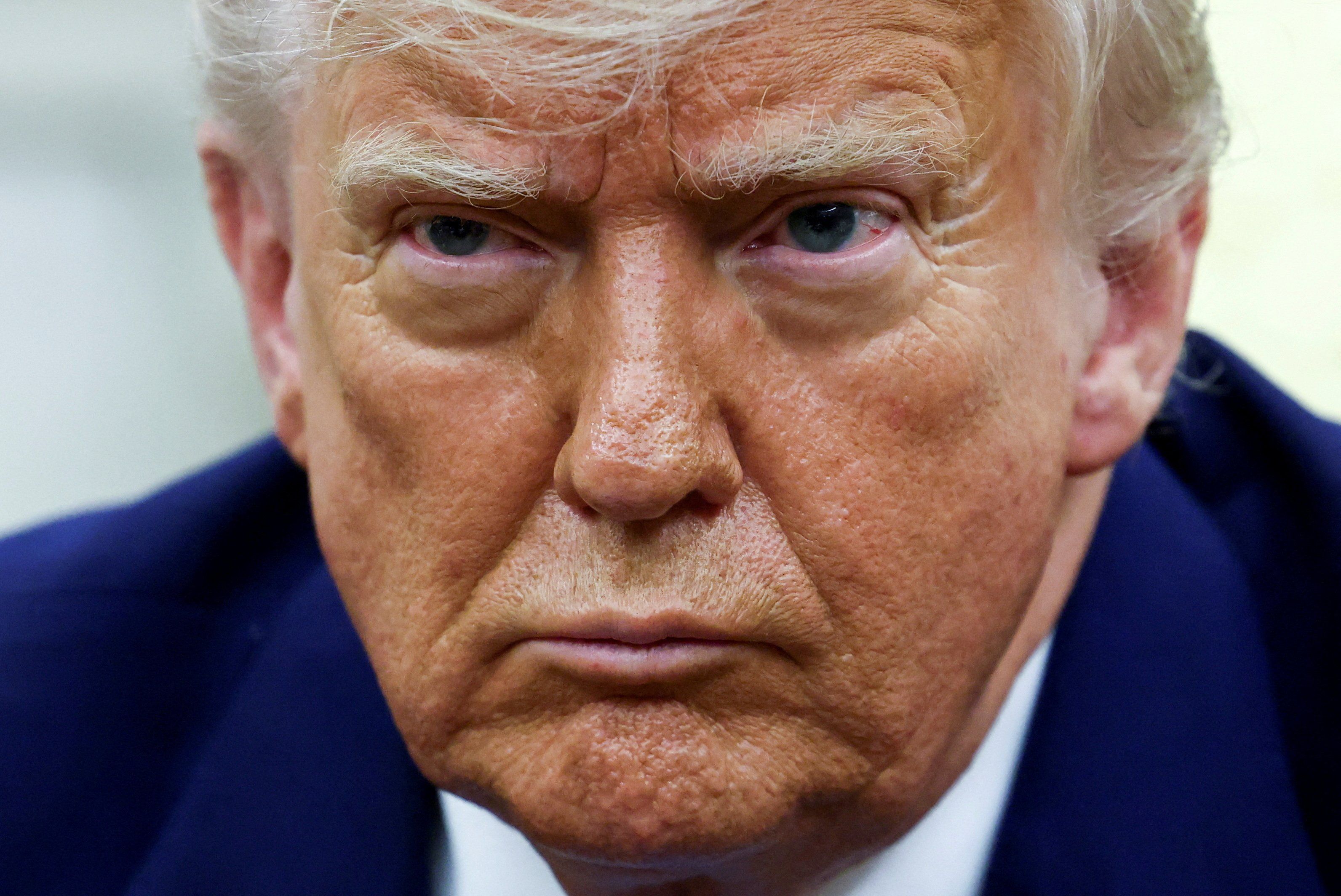
FILE PHOTO: U.S. President Donald Trump looks on as he meets South African President Cyril Ramaphosa in the Oval Office of the White House in Washington, D.C., U.S., May 21, 2025. REUTERS/Kevin Lamarque/File Photo
Donald Trump has unleashed a new form of retribution as his second term in office continues, with a new analysis from the New York Times examining how his supposed campaign against fraud has most heavily targeted his political enemies.
Writing for the Times on Monday, Washington-based reporter Tony Romm broke down the ways in which Trump has used accusations of fraud to target his perceived opponents, and how many of his policy decisions have revealed how little he actually cares about combating fraud. The subject came into focus for the president in December, Romm explained, when allegations of welfare fraud reemerged in Minnesota.
In fact, Minnesota had been made aware of the allegations several years ago and had already prosecuted them, leading to several convictions. Nevertheless, Trump used the renewed right-wing media focus on the story to accuse the state and its Democratic leadership of massive fraud, and used it to justify a historically massive immigration enforcement operation in the state over the last several weeks, which has terrorized the Twin Cities area and led to the deaths of two U.S. citizens at the hands of federal agents.
Trump moved to freeze $10 billion in federal child care funds for Minnesota in response to the allegations. He further threatened similar actions against California, whose Democratic Gov. Gavin Newsom has frequently made himself a thorn in the president's side. He also threatened to cut off public housing funds unless states handed over records about residents on food stamps.
"The White House later instructed nearly every federal agency to inventory other sources of money sent to more than a dozen states, including Colorado, California, New York and Virginia," Romm wrote.
All four of the states mentioned currently have Democratic governors and predominantly Democratic state legislatures. They also voted for Kamala Harris over Trump in the 2024 election, lending further evidence to the argument that the president is mostly interested in revenge against states that have not supported him politically.
In truth, Romm said that "a battery of public statements, letters, internal memos and court filings viewed by The New York Times" cast doubt on Trump's claim that his sole interest is combating fraud. He also laid out some of the other recent moves that conflict with the idea that the president has a genuine concern over targeting fraud cases.
"Instead, Mr. Trump has coupled the new politically charged scrutiny with steep cuts to the parts of government that historically try to ferret out fraud," Romm explained. "The president in his second term has tried to fire, defund or otherwise impede dozens of nonpartisan investigators, including those who have previously scrutinized his administration."
Romm continued: "He has also pardoned political allies who have been charged with fraud in programs that he now seeks to protect. Some of those pardons concern crimes that allegedly bilked Medicare and Medicaid, according to prosecutors’ court filings, which peg the possible losses to taxpayers into the hundreds of millions of dollars."
Rebecca Shea, the director of forensic audits and investigative service at the Government Accountability Office, told the Times that the U.S. loses around 3-7 percent of its annual spending to fraud. This figure, she explained, is essentially aligned with other countries, casting doubt on the notion that the U.S. is uniquely best by fraud.