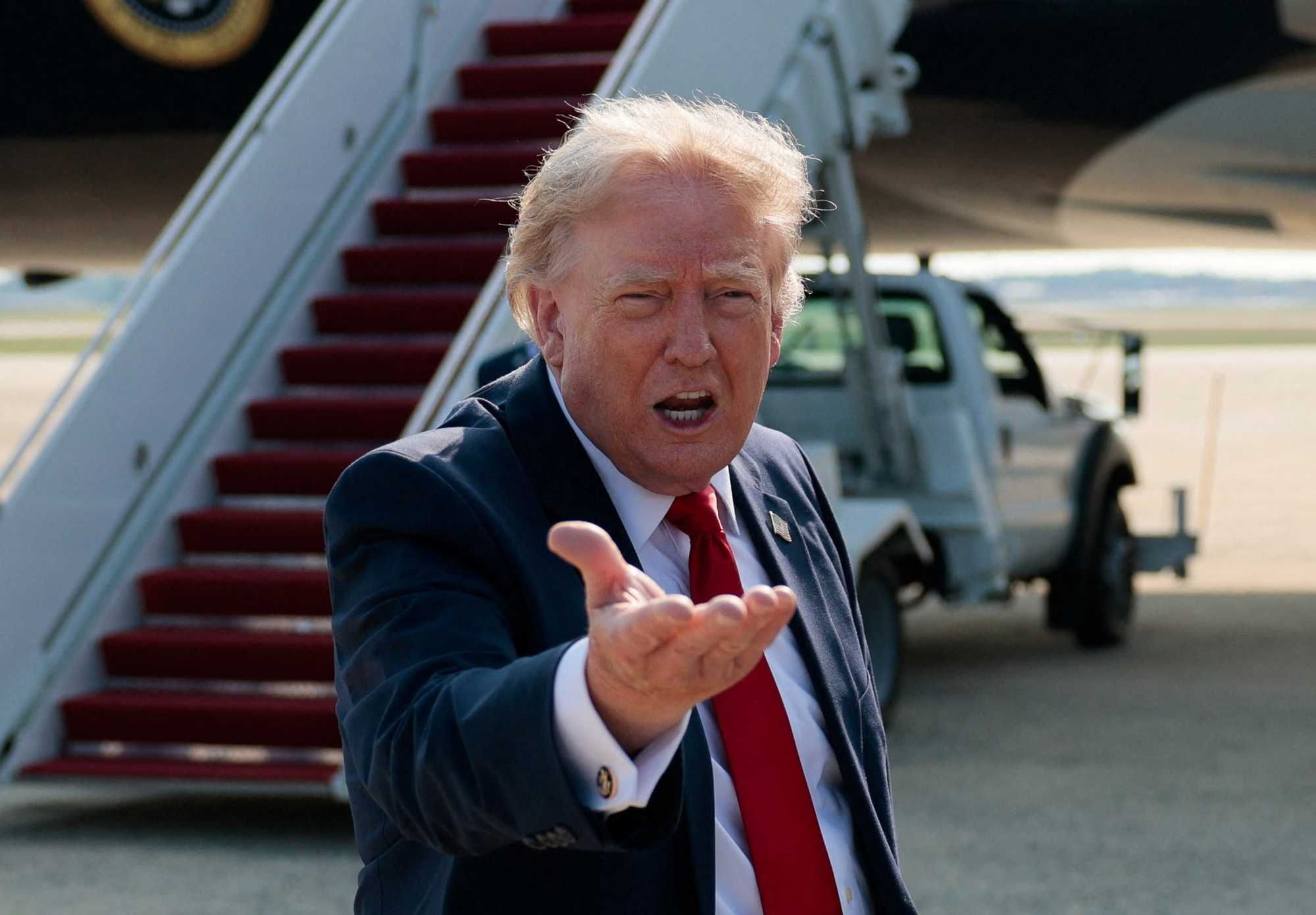
U.S. President Donald Trump gestures as he speaks with reporters before boarding the new Air Force One, a plane gifted by the Qatari government, at Joint Base Andrews, Maryland, U.S., July 1, 2026.
While President Donald Trump has been vocal about his desire for his party to nuke the filibuster and force through his sprawling voter ID bill, a number of Republican Senators are presenting a rare show of opposition, arguing that the move would mean “guaranteed death” for the GOP agenda. This is according to political reporter Savannah Behrmann, who writes in Roll Call of the “not-so-secret” society of Republican Senators openly pushing to maintain the filibuster.
“I’m going to make myself a T-shirt that says, 'No, I’m not interested in blowing up the filibuster,'" declared Senator Lisa Murkowski (R-AK). And Senator John Curtis (R-UT) was similarly firm on his position, writing in the Wall Street Journal, "Under no circumstance will I support any effort to end or alter the filibuster, as any party that does so wouldn’t be guaranteed survival. Their agenda would be guaranteed death come the next majority."
Proponents consider the filibuster vital for whichever party happens to be in the minority. Overcoming a filibuster requires a 60 vote majority, which has stymied a number of Trump’s most demanded legislative priorities, including his SAVE Act, which would impose wide-ranging changes on elections across the country. Were Republicans to “nuke” the filibuster by using a procedural maneuver that would allow them to pass bills with a simple majority of 51, it would also open the door for Democrats to do the same when they retake the majority. As a result, Republicans have been open about the fact that there aren’t enough of them who are willing to make such a move.
As Behrmann explains, “For Majority Leader John Thune, the equation is not new: The math isn’t mathing, and there has never been enough support in his conference to establish a new precedent and lower the 60-vote hurdle most bills must clear to advance to a simple majority threshold. Those numbers are hardly a secret, but some are reluctant to take a public stance when it means defying the party’s president. Sen. Kevin Cramer (R-ND) told Politico this summer that more Republicans oppose the so-called nuclear option than are willing to say so. ‘I regret that the other 25 or 30 people who oppose blowing up the filibuster don’t say it out loud like I do, because it leaves the impression that there are only four or five of us, just enough so that he doesn’t have 51,’ Cramer said.”
According to Behrmann, “The fight is not a new one. Both parties have tried to turn the Senate’s rules and practices to their advantage, with Democrats under Majority Leader Harry Reid ending the 60-vote threshold for most presidential nominees in 2013, and Republicans doing the same for Supreme Court nominees in 2017. But the filibuster for legislation has remained intact. In 2017, a bipartisan group of 61 senators, led in part by Susan Collins of Maine, penned a letter urging then-Leader Mitch McConnell to preserve it.”
“We are united in our determination to preserve the ability of Members to engage in extended debate when bills are on the Senate floor,” they wrote. Of that group, more than a dozen of the Republicans are still serving in the Senate today, including Thune.
“That must be a different form of math,” Thune said Wednesday of Trump’s insistence the majority leader has the votes to pass the SAVE America Act.