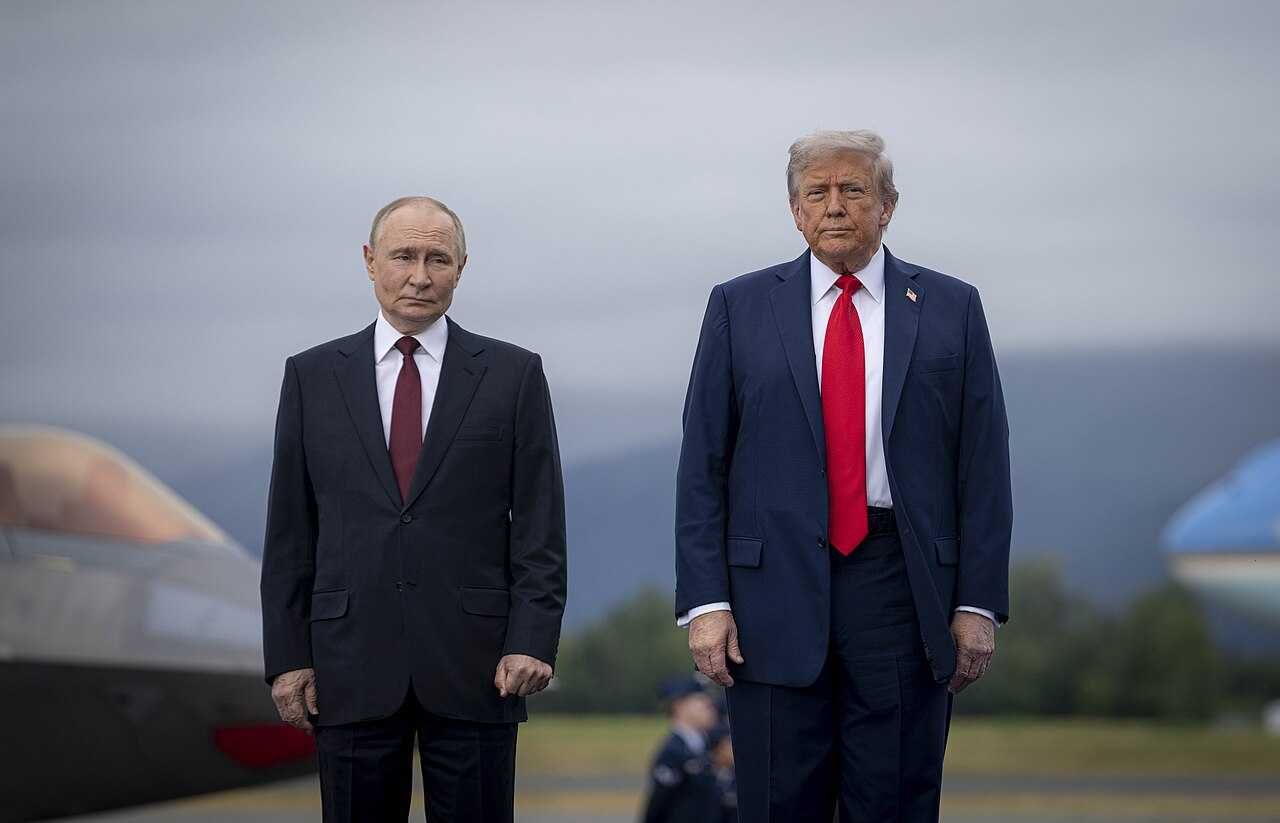
U.S. President Donald J. Trump with Russian President Vladimir Putin in Anchorage, Alaska, August 15, 2025 (DoD photo by Benjamin Applebaum/Wikimedia Commons)
On December 14–15, 2026, the Group of 20 Leaders’ Summit (G-20) will be held at U.S. President Donald Trump's resort in Doral, Florida near Miami. Trump invited Russian President Vladmir Putin to attend, but on Friday, September 25, a group of seven Republican senators joined Democrats in urging Trump to "reconsider" the invitation.
In a bipartisan letter to Trump, the seven Republican senators — Texas' John Cornyn, Mississippi's Roger Wicker, Kansas Jerry Moran, North Carolina's Thom Tillis, Utah's John Curtis, Oklahoma's Alan Armstrong and former Senate Majority Leader Mitch McConnell (R-Kentucky) — wrote, "Given President Putin's continued actions against the Ukrainian people and U.S. national security interests, we urge you to reconsider granting President Putin the stature and legitimacy to appear in the United States as a world leader at the G20 Leaders' Summit."
The Democratic senators who signed the letter included Rhode Island's Sheldon Whitehouse, Colorado's Michael Bennet, Virginia's Tim Kaine, Connecticut's Richard Blumenthal, Delaware's Chris Coons and Arizona's Ruben Gallego.
The senators also told Trump, "It is troubling that, despite being sanctioned, these individuals have been given access to participate in G20 forums hosted in the United States. The G20 is intended to foster international cooperation on critical issues including finance, trade and global economic stability. As Russia continues its war against Ukraine and refuses to agree to a just and lasting peace agreement, its government should not be afforded a business-as-usual treatment alongside other nations at G20 events."
The Hill's Helen Huiskes notes that the Republican senators who signed the letter to Trump "went beyond the usual Trump critics in the GOP."
"Their support on the letter, which urged Trump to rescind any such invitation to Putin and any other sanctioned Russian officials, demonstrates how Senate Republicans generally still support Ukraine in its war with Russia, and some have become more willing to push back on Trump amid his low approval rating," Huiskes reports. "The letter also cited the recently passed Russia-Iran sanctions bill, named for former Sen. Lindsey Graham (R-S.C.), who was one of the staunchest defenders of Ukraine in the Senate before his death in July. That bill increased sanctions on Russia, hoping to squeeze it economically as its aggression in Ukraine continues four years after invading that country."