New research shows Trump voters got a mental health boost — but Democrats paid the price
02 April
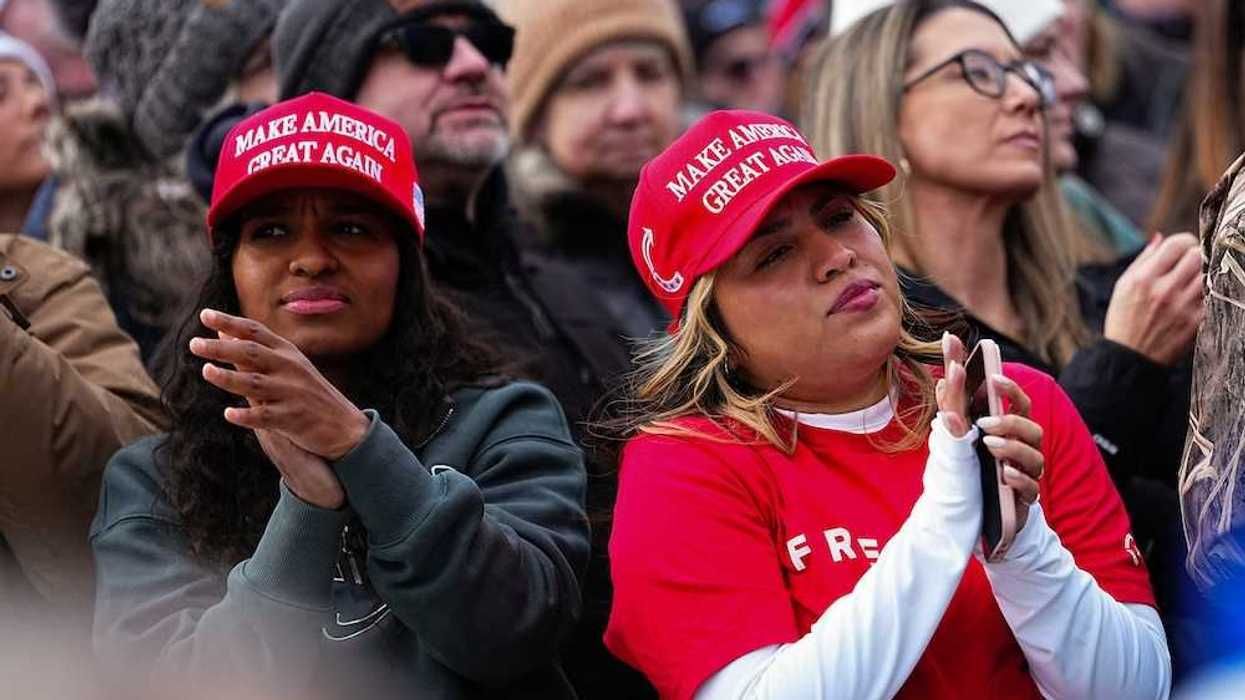
Women wearing MAGA hats in Washington, D.C., January 23, 2026. REUTERS/Aaron Schwartz
When President Donald Trump was reelected in 2024, he gave his supporters an immense psychological boon — but at the expense of the people who see Trump’s values as dangerous to their own.
At least that’s the result of a recent study by researchers Deborah J. Wu, Kyle F. Law, Stylianos Syropoulos, and Sylvia P. Perry in the journal Advances in Psychology. Analyzing the mental health of hundreds of Democrats and Republicans in the immediate aftermath of Trump’s second inauguration, the scientists quickly learned that mental wellness is closely linked to sensing one’s government shares your values.
"Across all five weekly waves (Feb–Mar 2025), Republicans reported higher life satisfaction and happiness than Democrats,” the authors wrote. Specifically they noted that "Republicans increased in well-being over time, whereas Democrats showed both linear and quadratic change, as initial decreases in well-being were followed by increases in well-being."
As a result, they concluded that "alignment with government actions may provide short-term psychological comfort, while opposition—though vital for democratic resilience—may carry psychological costs." Indeed, as a result of Trump’s re-inauguration “at all timepoints, Republicans reported greater life satisfaction over the past week, in comparison to Democrats"
Overall "these findings underscore how the psychological costs of political misfit may become especially salient in times of democratic decline,” the authors wrote. Reviewing their data, they concluded that “greater support for administration actions was associated with higher well-being, whereas greater support for oppositional actions was correlated with lower well-being."
Speaking to Psychology Post, Wu pointed out that “politics has become increasingly polarized in the United States, which can affect people’s well-being. Additionally, there is growing concern about democratic backsliding, which occurs when governments weaken democratic norms or institutions.”
This is not the first study to measure quantifiable neurological and psychological differences between Trump supporters and Trump opponents. In a Politics and the Life Sciences study titled “Differential brain activations between Democrats and Republicans when considering food purchases,” authors Amanda S. Bruce, John M. Crespi, Dermot J Hayes, Angelos Lagoudakis, Jayson L. Lusk, Darren M. Schreiber and Qianrong Wu used fMRI images to correctly trace people’s political leanings based on seemingly non-political choices like grocery shopping.
“While the food purchase decisions were not significantly different, we found that brain activation during decision-making differs according to the participant’s party affiliation,” the authors explained. “Models of partisanship based on left insula, ventromedial prefrontal cortex, precuneus, superior frontal gyrus, or premotor/supplementary motor area activations achieve better than expected accuracy.”
Similarly Trump supporters have recently embraced an actively anti-intellectual agenda, at least according to a recent report by The Nation’s Elizabeth Spiers.
“As the historian Richard Hofstadter noted, a fierce anti-intellectual spirit has long animated American culture, but it has typically targeted the knowledge elite from below,” Spiers, a digital media strategist and writer living in Brooklyn, wrote earlier in April. “What’s striking about today’s brand of anti-intellectualism is that it infuses the American knowledge elite; it stems from the bedrock conviction among tech oligarchs that they have mastered everything and have nothing left to learn. In this cloistered vision of tech-driven learning, they believe that deep intellectual work—the kind you do when you author a complex piece of music, for example—has little or no inherent value.”
Spiers concluded, “Their disdain for it has fueled their attacks on higher education, the humanities, and learning for its own sake, which they believe has no purpose beyond its inevitable digitization and monetization.”