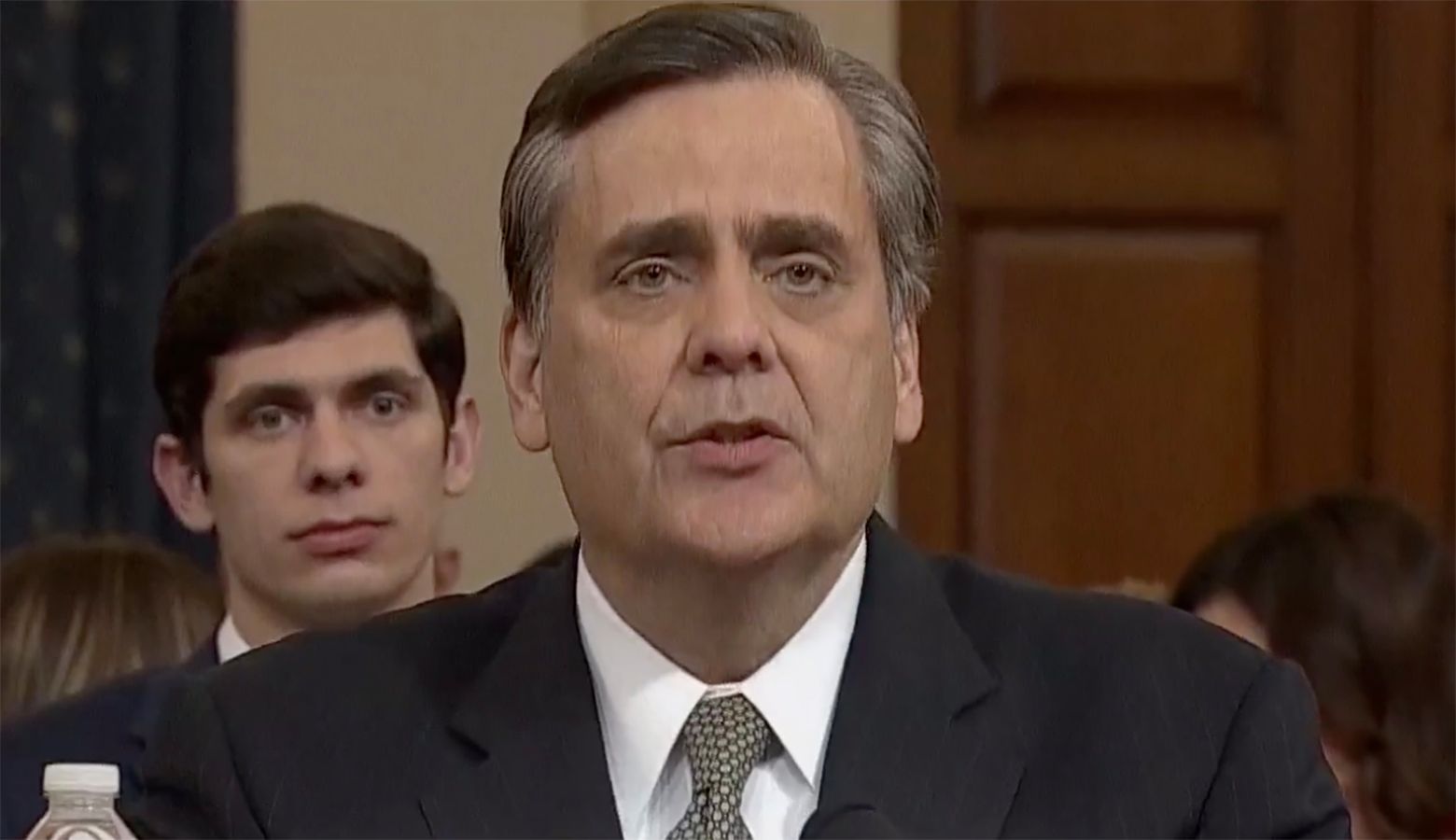
Attorney and legal analyst Jonathan Turley. Image via Screengrab.
A prominent conservative attorney and Fox News legal analyst warned President Donald Trump that his aggressive new press ban carries a "considerable risk," per Mediaite, as it is highly likely to be shot down by the Supreme Court.
Last week, Trump abruptly announced on Truth Social that he was banning MS NOW, CNN and Politico from the White House, accusing them of intentionally spreading "fake news" about him. In the immediate aftermath, numerous other news outlets condemned the decision and offered support for the three targeted outlets. On Monday, the entire White House press pool announced that it would not be covering presidential events in response to the ban, amounting to a boycott of the White House by the major news networks, ABC, CBS, NBC and Fox.
The three targeted outlets also launched a lawsuit against the Trump administration, accusing it of flagrant First Amendment violations. MS NOW legal analyst Andrew Weissmann said that this would not be a "close case," calling it a "slam dunk" and a plain example of unconstitutional conduct.
Over on the typically Trump-friendly Fox News, meanwhile, prominent conservative legal analyst Jonathan Turley offered a similar take on the case, warning that if the president did not reverse course, his ban would almost certainly end up getting struck down by the Supreme Court. This is due to the significant legal precedent created by the 1977 case of Sherill v. Knight,
"One of the most influential cases is called Sherrill, from 1977 in the D.C. Circuit," Turley detailed. "And they emphasized you cannot engage in viewpoint discrimination, that once you allow media in, you can’t deny that access arbitrarily. The White House seems to be ready to challenge Sherrill, which would require them to go all the way to the Supreme Court. That’s a considerable risk."
He continued: "This is a president that gained a lot of ground for his successor presidents, in cases like Trump v. Slaughter was a huge win for presidential power. He could be giving back some territory with this one. These courts have emphasized, even the ones that favored the White House, that it can’t be done arbitrarily. You can’t engage in viewpoint discrimination. Here, that seems to be the case in spades. You have the president saying, 'I don’t like this coverage.'"
Legal scholar James Sample also argued during a Monday MS NOW appearance that Trump was making the networks' argument easy, given the how explicitly he has stated that he imposed the new ban because of negative press coverage, and all the times over the years he has attacked the free press on simliar grounds.