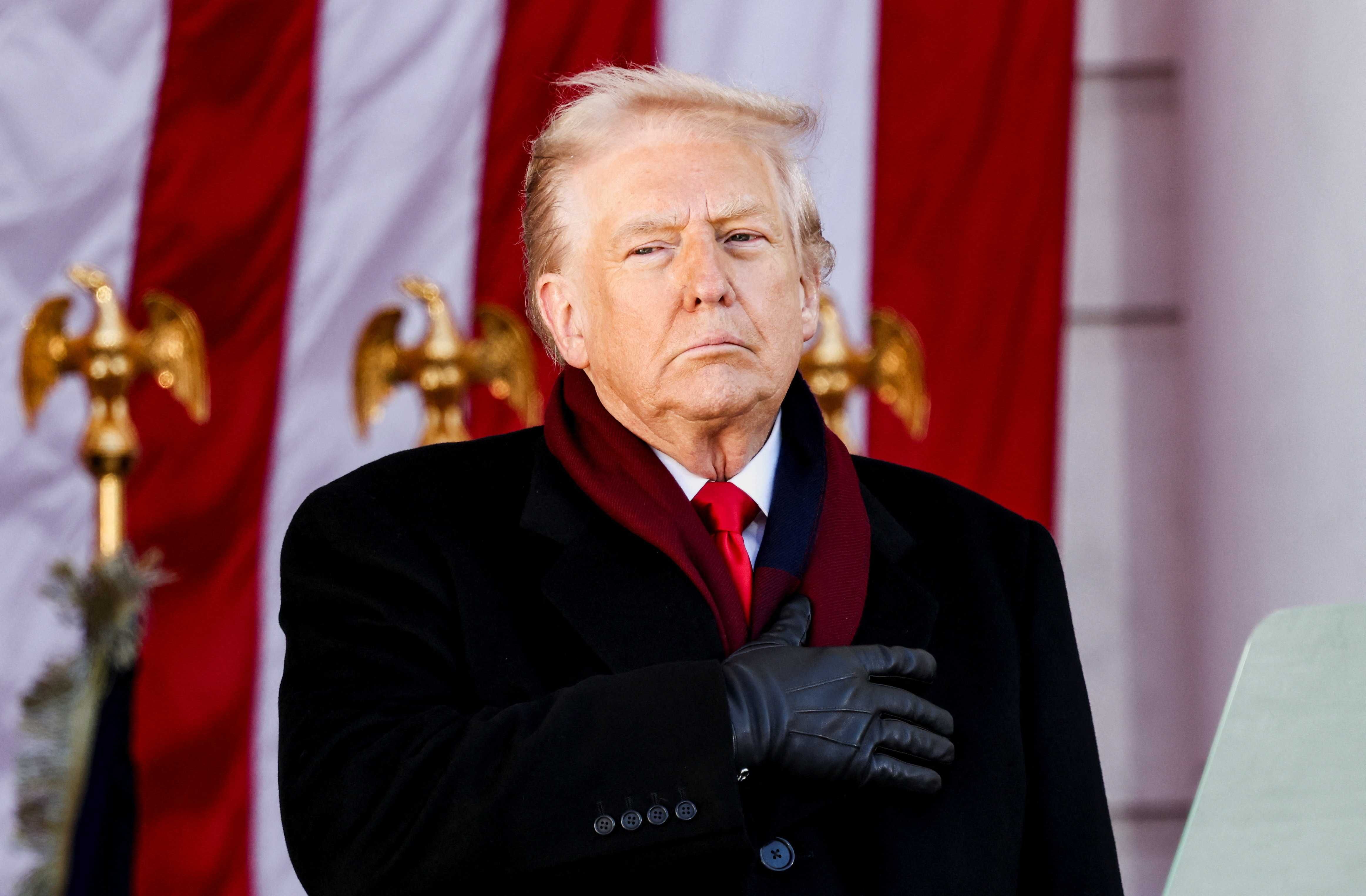
U.S. President Donald Trump places a hand over his heart during a Veterans Day ceremony at Arlington National Cemetery in Arlington, Virginia, U.S., November 11, 2025.
In yet another would-be power move, the Trump administration has rescinded spending a billion dollars already approved by Congress – towards assuring to protect undocumented immigrants and unaccompanied children in court.
Using a process known as “pocket recission,” Donald Trump’s office of management and budget has refused to spend the money, insisting that there is no problem worth spending on because the administration has reduced illegal immigration to zero.
“These funds previously went to pro-illegal immigration programs and Non-Governmental Organizations that provided services to refugees, asylees, and other non-citizens and put unaccompanied children in harm’s way,” the White House explained. The decrease in border crossings meant funding toward these programs became excessive, warranting their recission.
Trump’s bureaucratic move, less flashy than some of his recent projects, sounds as if it is based on contempt for any positive help for young, unaccompanied migrants whom he is seeking to arrest, detain and deport as quickly as possible, so there are obvious policy questions here. There seem to be an unending supply of border agent grabs of young, unaccompanied migrants whose treatment at the hands of border guards consistently reflect formalized cruelty, lack of representation and minimal health and education standards.
But whether justified or not on substance, once again we are forced to view this action on the continuum of the slide towards total control of government and a stomping on Constitutional balance-of-power concerns. In that context, the “pocket recission” takes on a different meaning. Even to the extent that stepping on Congress’ powers of the purse are close legal questions, this one happens to violate the time limits established for such procedures. The only way to see Trump’s desire to usurp Congress’ role is through his authoritarian bent.
Even Senate Republicans, including Sen. Susan Collins, R-Me., was calling the move “unlawful,” and vowing Senate action to stop it. It also seems silly. With Republicans in charge of both houses of Congress, Trump should be able to get a congressional vote to achieve what he wants in spending.
But as with declaring war or not with Iran but allowing U.S. troops to participate in conflict without a Congressional vote, this Congress is moribund by choice – underscoring some of the voter anger about failures to act about high prices, tariffs, turns against international allies and the excesses of deportation.
Other cuts of funds being sought by Trump reflect his anti-DEI agenda. OMB wants to forgo spending on HHS gender-affirming care research, minority business development and the Department of Justice’s Community Relations Services, which the White House said promoted identity-conscious law enforcement practices. The administration described these initiatives as “wasteful and harmful.”
Trump last used the same tactic in 2025 to cut roughly $5 billion in congressionally approved funding. The Supreme Court voted at the time to allow the Trump administration to keep the money that was set to expire the following week.
Terry H. Schwadron retired as a senior editor at The New York Times, Deputy Managing Editor at The Los Angeles Times and leadership jobs at The Providence (RI) Journal-Bulletin. He was part of a Pulitzer Gold Medal team in Los Angeles, and his team part of several Pulitzers in New York.