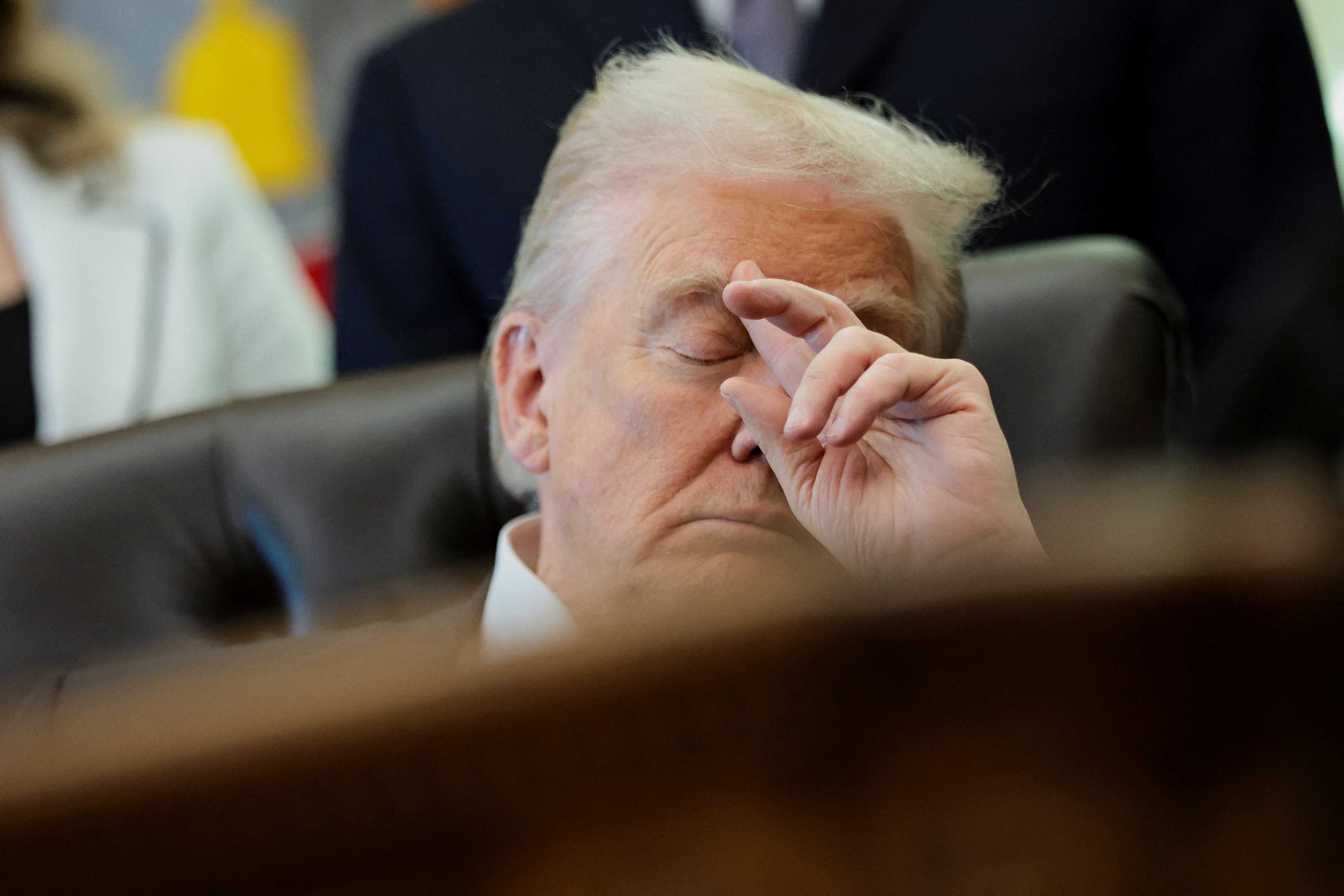
President Donald Trump attends an event in the Oval Office at the White House in Washington, D.C.
When President Barack Obama passed the Affordable Care Act, opponents accused the new bill of including “death panels.” Now President Donald Trump is including measures that by the same logic could also be considered death panels — and, according to a conservative commentator, those same critics are quiet.
“A new regulatory proposal from the Trump administration, first reported by Maya Goldman in Axios, would instruct hospitals to record end-of-life preferences in patient electronic health records—and then, potentially, include compliance as one of the factors for adjusting Medicare’s ‘value-based’ payments in the future,” opined The Bulwark’s Jonathan Cohn on Sunday. “‘The goal of this measure is to establish advance care planning as a normalized, routine part of care regardless of health status and age,’ the proposal says, according to the Axios report.”
Cohn added, “On the merits, encouraging end-of-life planning makes as much sense in 2026 as it did back in 2009—which is to say, it makes a lot of sense. Only about one-third of American adults under the age of 60 currently have written versions of such arrangements, according to Pew, even though studies suggest the vast majority would prefer to have these conversations in advance.”
Yet Cohn noted that when Obama adviser Dr. Ezekiel Emanuel advocated similar policies during the Affordable Care Act debate, he was viciously attacked by conservatives for backing so-called death panels.
“Emanuel was the object of repeated personal attacks in 2009, with some critics calling him ‘Doctor Death,’” Cohn wrote. “I asked if Trump’s embrace of the proposal means that the title now belongs to Mehmet Oz, the celebrity physician who is also administrator of the Center for Medicare and Medicaid Services (CMS). ‘Not at all,’ Emanuel responded. ‘I respect the fact that he’s trying to figure out how he can facilitate and incentivize these conversations. He’s a docto,r and he understands the kind of incentive structure out there. And I think it’s pretty bold of him.’”
Cohn closed with the observation, “That is a lot more magnanimity than Emanuel’s critics showed him back in the day. It’s also a reminder of what trying to govern in good faith looks like—a reminder that is all too necessary now, for reasons Oz made clear when he recently made news in another way.”
In December, Trump’s Republican Party continued to struggle in Congress to figure out if, and if so how, to extend Obamacare subsidies, after during the previous month a bill that would have extended subsidies fell apart reportedly due to House Republicans feeling left out of the process.