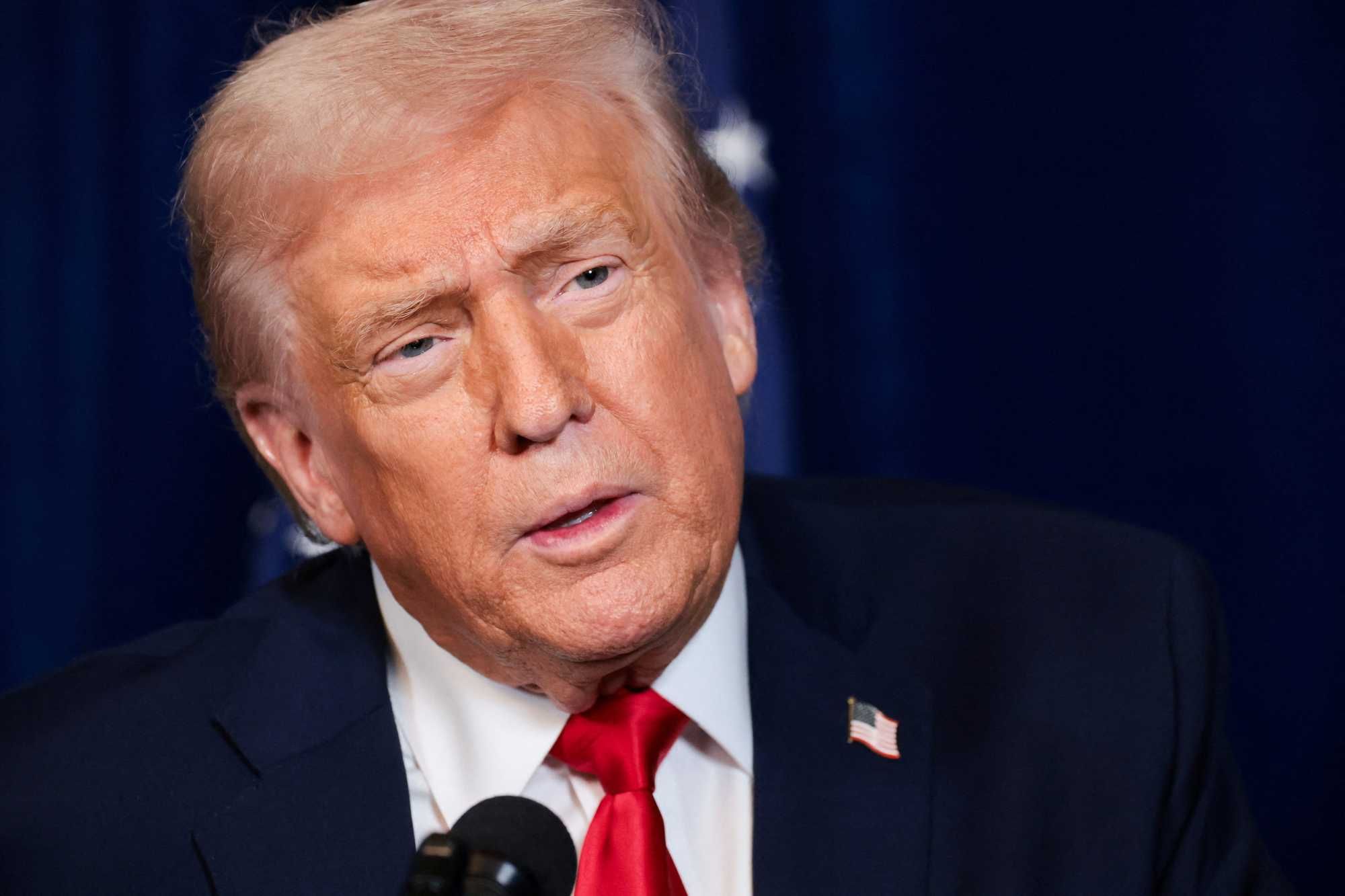
U.S. President Donald Trump speaks during a press conference with Israeli Prime Minister Benjamin Netanyahu (not pictured) after meeting at Trump’s Mar-a-Lago club in Palm Beach, Florida, U.S., December 29, 2025. REUTERS/Jonathan Ernst
U.S. President Donald Trump speaks during a press conference with Israeli Prime Minister Benjamin Netanyahu (not pictured) after meeting at Trump’s Mar-a-Lago club in Palm Beach, Florida, U.S., December 29, 2025. REUTERS/Jonathan Ernst
In August, President Donald Trump blatantly defied U.S. Supreme Court precedent when he issued an executive order declaring that burning the American flag is a crime punishable by one year in prison. The High Court, in the landmark 1989 Texas v. Johnson decision, ruled 5-4 that burning the flag is constitutionally protected speech. And conservative Ronald Reagan-appointed Justices Anthony Kennedy and Antonin Scalia made it clear that while they considered flag-burning repugnant, the First Amendment was designed to protect free speech in general — including ideas they strongly disagreed with.
Free speech attorney Nora Benavidez is vehemently critical of Trump's executive order in an op-ed published by the New York Times on December 31. But she argues that Trump's flag-burning order is only the tip of the iceberg when it comes to his relentless assault on the First Amendment.
"Since returning to office," Benavidez observes, "Mr. Trump and his administration have tried to undermine the First Amendment, suppress information that he and his supporters don't like and hamstring parts of the academic, legal and private sectors through lawsuits and coercion — to flood the zone, as his ally, Steve Bannon, might say. Some examples are well-known, such as when ABC briefly took Jimmy Kimmel off the air after Brendan Carr, the chairman of the Federal Communications Commission, objected to a reference in one of Mr. Kimmel's monologues about the killing of Charlie Kirk."
Benavidez adds, "Other examples received less attention, but by my count, this year there were about 200 instances of administration attempts at censorship, nearly all of which I outline in a new report."
The attorney, who serves as senior counsel for the organization Free Speech, notes that Trump is using "several recurring modes of attack" against the First Amendment.
"The president has tried to cow the press," Benavidez warns. "His administration banned Associated Press reporters from certain parts of the White House and Air Force One because the outlet uses 'Gulf of Mexico' rather than the term Mr. Trump prefers, 'Gulf of America'…. The administration has used immigration status to try to suppress political speech…. It seems almost no one is beyond the scope of administration efforts to muzzle views or decisions that conflict with Mr. Trump's agenda: After Federal District Court Judge James Boasberg ruled against the administration in a case involving the deportation of Venezuelans to El Salvador, Mr. Trump called for the judge to be impeached…. As part of the administration's war on so-called wokeness, it has identified hundreds of words, with the intent of curtailing their use."
Benavidez continues, "Mr. Trump issued an executive order directing staff members at national parks and museums to get rid of content that, he says, portrays America 'in a negative light'…. Unquestionably, more and more Americans are rejecting his overreach. But constitutional rights and democratic norms don’t disappear all at once; they erode slowly. The next three years will require a vigilant defense of free speech and open debate."
Nora Benavidez's full New York Times op-ed is available at this link (subscription required).