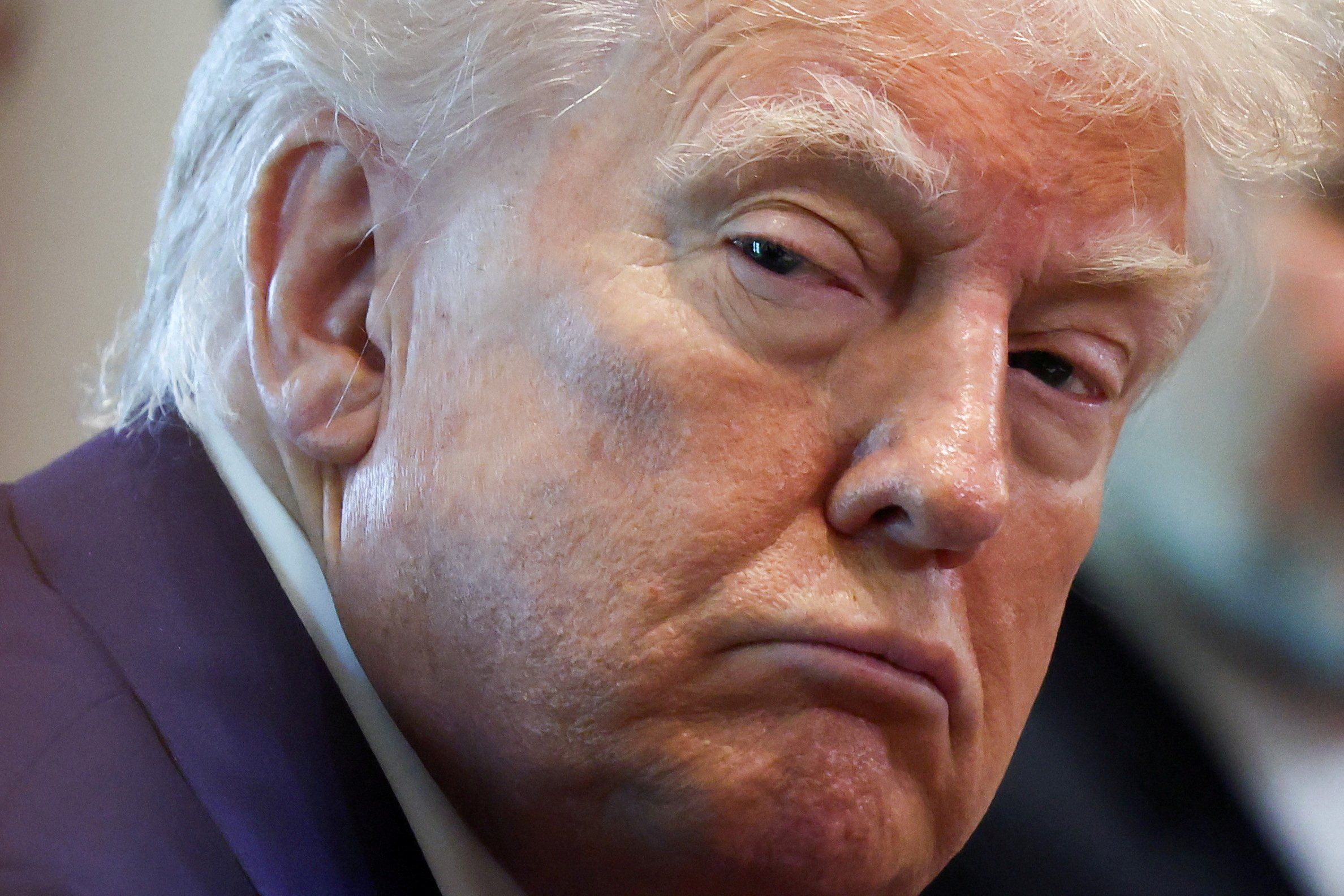
U.S. President Donald Trump holds a cabinet meeting at the White House in Washington, D.C., U.S., April 30, 2025. REUTERS/Evelyn Hockstein
On Friday, Elon Musk’s SpaceX launched its initial public offering on the Nasdaq, but according to Nobel-winning economist Paul Krugman, it amounts to little more than a “shell game” as the world’s richest person — who also happens to be President Donald Trump’s top donor — gambles with American financial security to prop up his “Ponzi scheme.”
As Krugman notes, Musk has a long and storied career riddled with big promises that don’t deliver. The economist provides a list of such game-changing advancements, like Hyperloop, the Boring tunneling company, fully self-driving Teslas, and a colony on Mars, all of which the tech mogul declared would exist by 2025. Krugman admits that a handful of Musk’s projects have been successful — like Starlink and aspects of Tesla — but notes that “these achievements weren’t enough to make Musk the world’s richest man.”
Instead, writes Krugman, his wealth has “historically rested mainly on self-fulfilling faith — investors believing in Musk’s genius have piled into stocks in Musk-controlled companies, and the rising value of these companies has enhanced his reputation for genius. We have a term for enterprises that look successful because they keep drawing in new investors and keep drawing in new investors because they look successful. They’re called Ponzi schemes. And Elon Musk is basically a human Ponzi scheme.”
And then, says Krugman, came the SpaceX IPO, which “makes it clearer than ever that Musk’s greatest skill isn’t developing futuristic products. It’s his mastery of financial shell games and his ability to leverage insider influence, especially his influence with the Trump administration.”
According to Krugman, that shell game is betrayed by SpaceX’s astronomical valuation, which experts have called an “insane” “trainwreck.” As Krugman notes, the company is debuting at a record "$1.77 trillion valuation for a company that had revenues of only $18.7 billion last year and lost money,” which “is premised partly on the assumption that retail investors will buy in, not because they have made any rational assessment of SpaceX as a business, but because they believe that they are buying stakes in Elon Musk’s genius.”
Also unusual is the decision by major stock indexes to change their rules so that SpaceX could be admitted quickly. As Krugman explains, “Historically, the major indexes have waited at least a year after a company’s IPO before considering its inclusion in their market measures, to give the stock time to ‘mature’. The bending of the rules for SpaceX shows that Musk is again exerting his ability to co-opt and corrupt key institutions.”
Perhaps most alarming of all, asserts Krugman, is the fact that retirement and mutual funds will be used to prop up this fund, linking American financial security to the success or failure of SpaceX.
“The immense human Ponzi scheme that is Elon Musk will eventually collapse,” Krugman concludes, “but traditional Ponzi schemes only exploit investors who choose to participate. This time much of the money propping up Musk’s scam will come from ordinary Americans who have in effect been forced to buy in. Approximately 52 percent of mutual fund assets are now invested in index or index-based funds, and over 50 percent of American households are invested in mutual funds. Thanks to the collusion between Musk and Wall Street, enabled by the perception that the Trump administration has Musk’s back, many if not most of these small investors will be dragged, willy-nilly, into fueling the Musk juggernaut.”