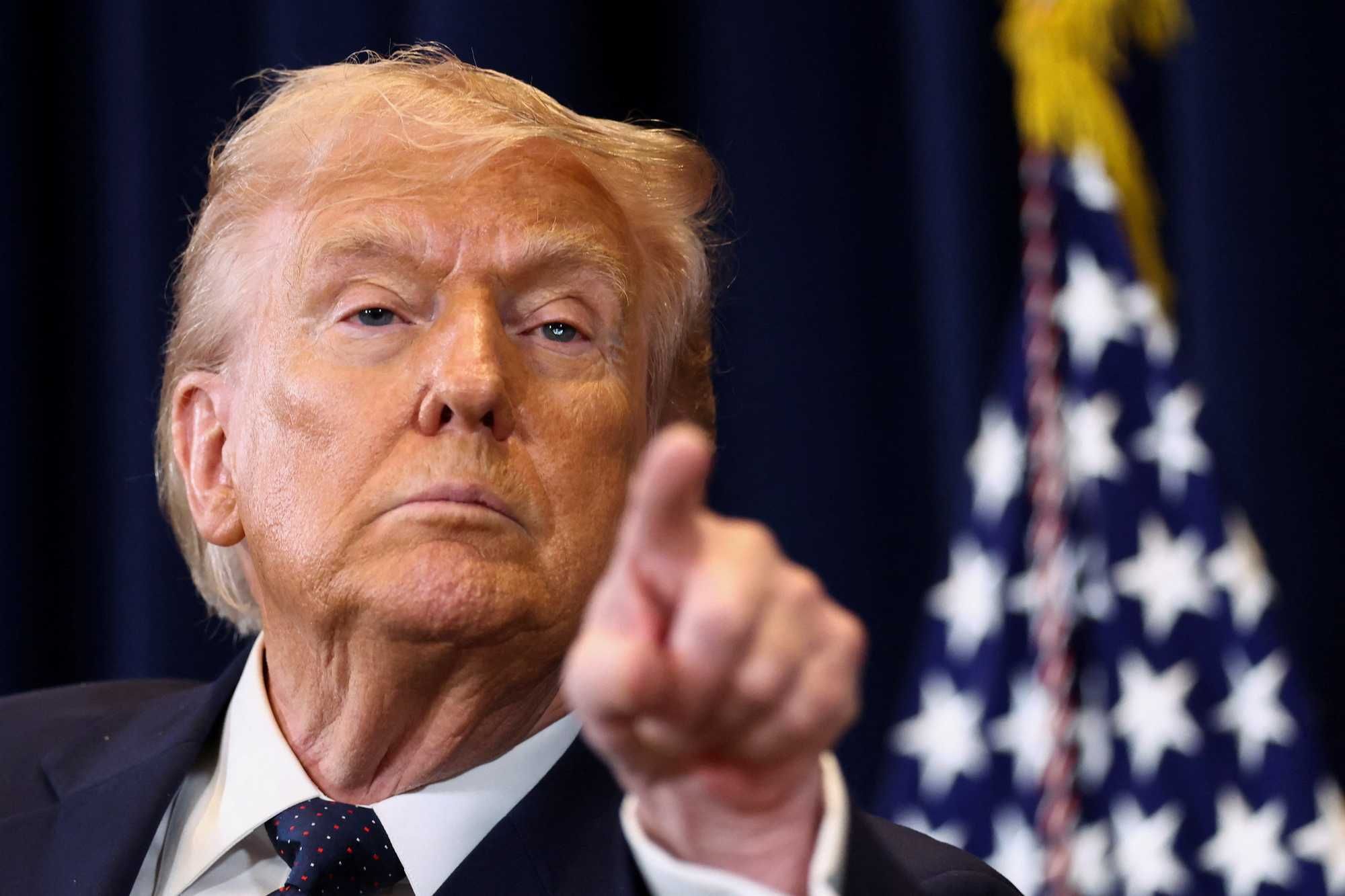
U.S. President Donald Trump takes a question as he speaks during a press conference at Trump National Doral Miami in Miami, Florida, U.S., March 9, 2026. REUTERS/Kevin Lamarque
I think we have to accept the truth. We are going to pay, and we are going to continue to pay, for the president’s war of choice against Iran. Such are the consequences of politics. Maybe Americans will take their democracy seriously next time.
If Donald Trump walks away from this war, things won’t go back to normal. Over the weekend, the AP confirmed reporting from elsewhere that Iran has established a tribute system through the Strait of Hormuz. It is charging as much as $2 million for safe passage of each oil tanker, payable in Chinese currency (yuan). That “toll,” as it’s being called, will be passed on to consumers.
But if Donald Trump escalates the war, things will also not go back to normal. Reportssuggest that he’s thinking about invading Kharg Island, Iran’s main oil depot. The idea may be to take it and use it to negotiate terms of a ceasefire, but no one really knows.
In any case, escalation will not restore the flow of oil through the strait. All Iran has to do is sink a few tankers, as former Secretary of Defense James Mattis said, with “anti-ship cruise missiles that could be fired off the back of a pickup truck that can go 100.”
Sink a few tankers that are worth about $100 million each and scare off anyone who’s willing to insure them. That means oil slows to a trickle, prices keep going up and we all look on in despair as our incomes are drained away. (Bloombergreported over the weekend that the price of gas might be the least of our concerns as we may not be able to find any gas to pay more for.)
Walking away from the war would also do nothing to stop Israel from continuing to invade Iran’s allies or from attacking Iran. It would do nothing to stop Iran from attacking neighboring US-allied Gulf states in retaliation for Israel’s continued assault. As long as there’s conflict, insurers won’t insure, and if insurers won’t insure, expect to see oil climb to $200 a barrel, according toBloomberg, which puts the average price of gas at around $8.
To recap, if Trump walks away, we pay. If he escalates, we pay. We pay for the toll or we pay for the scarcity. (Or we can’t find any gas to pay more for.) Again, Americans could have taken their democracy seriously when deciding whether to elect a convicted felon who already screwed up the first time he was president. But we as a people did not do that. The consequence is that we pay.
Meanwhile, the president we elected keeps lying about the end of the war in the hopes that traders will believe him and keep down the price of oil. He has done this repeatedly, and the question has been: how long are investors going to trust the gap between what Trump is saying about the war and what’s actually happening?
To find the answer to that and more, I got in touch with Patrick Watson, a senior economic analyst for Mauldin Economics. I have turned to him often whenever I need answers on the state of the economy. I asked Patrick if Trump’s war is reorganizing the world. He said yes – if the war does not come to an end soon.
That “requires re-opening the strait, which means Iran has to be either defeated or convinced to stop threatening ships,” he said.
What happens if this war doesn't end and the oil shipments do not return to normal? Five-dollars-a-gallon gas permanently?
“Permanently” is a strong word. Oil and oil-derived fuel prices will stay elevated until either the supply interruption eases or demand drops enough to restore balance. Those are both slow processes, but they will happen.
The problem is that the longer this war drags on, the longer it will take to repair the infrastructure that’s damaged or destroyed. The oil industry was already reluctant to invest in new drilling because it can see renewable energy growing so fast. With the rest of the world producing oil at close to full capacity, it could be a long time before we get much help on the supply side.
Demand is harder to assess. Recessions typically reduce fuel demand as people travel less, companies ship less stuff around and so on. To the extent this war reduces global economic growth, we could see supply and demand come back into balance over a year or two. But that would be doing it the hard way.
Donald Trump is lying to ease market fears. That’s very clear. But for how long will investors choose to believe the president?
I talk to Republican business owners and investors all the time. Off the record, many will say they don’t especially like Trump, nor do they believe everything he says, but they still choose him over any Democrat. The economic term for this is “ordinal preference.” You can call it “choose your poison.” They think Trump, for all his problems, is less poisonous than the alternative. So they keep supporting him even when they don’t believe him.
Of course, the problem with this is there’s no bottom. No matter what Trump does, the response is “the Democrats would do worse.” That means they can’t abandon him. They may grumble but that’s as far as it goes. It’s a permission structure to excuse anything. Maybe at some point, they’ll lose enough money to reconsider. But I don’t think we are near that point.
Inflation is already high due to Trump's tariffs. Some say the manufacturing and agriculture sectors are already in a recession. How long would it take for higher than normal gas prices to push the rest of the economy into a recession?
Inflation leads to recession when prices get high enough to reduce aggregate demand. In an energy shock, that would mean people are spending so much more on gasoline that they have to reduce other spending. They eat out less often, so restaurants lose business. They keep the old car a year longer instead of buying a new one. All those little decisions add up.
The wrinkle this time is that today’s economy is far less energy-intensive than it used to be. Gasoline is more expensive, yes, but as a percentage of the typical household’s spending, the higher price may not change their behavior. The danger will come when the fuel prices show up in other things.
Food production and distribution require a lot of fuel, for example. Airline tickets are another example. But the big companies hedge their expenses, locking in prices months or years in advance. So this is another slow process. It depends on how the war unfolds, but I think recession is still some time away.
Most attention is on gas prices, but fertilizer is another issue. Much of it goes through the Strait of Hormuz. What happens if supply is throttled? What can be done if the war continues?
The war is affecting more than oil and gas exports. The Gulf countries are also unable to ship things like sulfuric acid, which is necessary for refining copper, or the helium that’s used in microchip production and MRI machines. These are much smaller markets than oil, but they’re critical in certain sectors.
Fertilizer is a problem, because you need natural gas to produce ammonia. The Haber-Bosch process that enables this literally revolutionized global agriculture a century ago. This war is now incinerating our supply of the key component. Worse, a lot of the other capacity is in Russia and China. In time, fertilizer production could shift to places with more secure natural gas supplies. But fertilizer prices will probably rise a lot in the meanwhile, and it will flow through to food prices.
Trump has reorganized the world but doesn't know it, right?
It could turn out that way if Gulf shipping stays frozen. Other governments and businesses have to work around this disruption. If Trump forces them to adjust to new ways, they may not go back to the old ones. That will have effects far beyond energy. Averting this requires re-opening the strait, which means Iran has to be either defeated or convinced to stop threatening ships. That’s a very high standard because ships don’t sail without insurance, and insurers don’t write coverage in active war zones.
Maybe it’s not the best analogy but I compare this to the Vietnam War. Back then, all our carpet bombings didn’t compel surrender because the Viet Cong could simply retreat into their tunnels and pop up somewhere else. Similarly, the IRGC has little missile and drone units spread over thousands of square miles. They don’t have to sink any ships; occasional near misses are enough to stop the flow. Removing this threat will be tough. Also worth noting that most of those ships are going to Asia, not the US. That’s where the economy will suffer first. It will spread globally, though, unless this somehow ends soon.