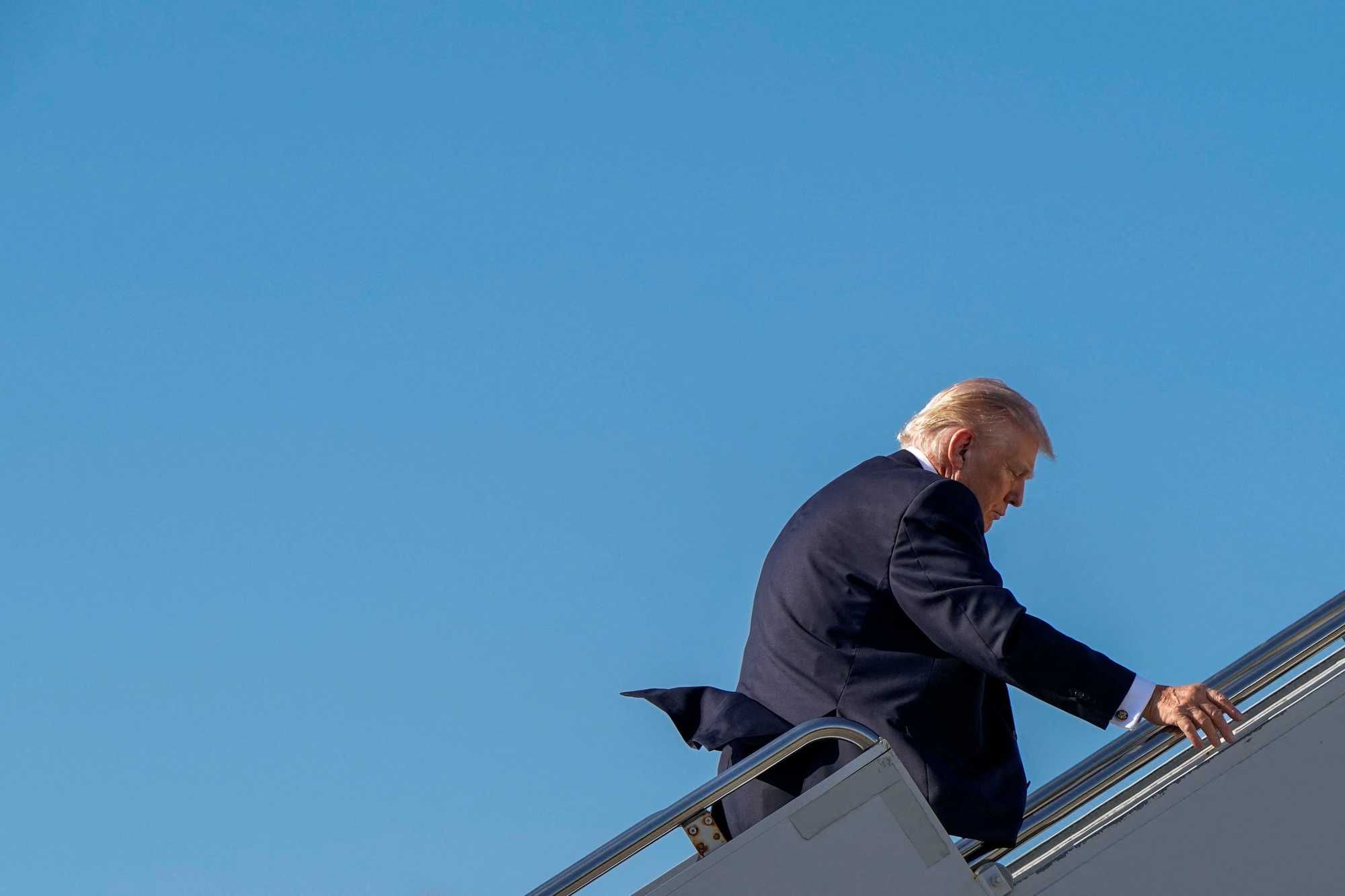
President Donald Trump boards Air Force One at Palm Beach International Airport in West Palm Beach, Florida, March 1, 2026. REUTERS/Elizabeth Frantz
The U.S. Navy was instrumental in helping build the modern, according to one military analyst, but now, President Donald Trump's disastrous war in Iran has exposed its "gradual decline."
Robert D. Kaplan is an analyst and writer focused on the U.S. military and foreign affairs, and on Friday, he published a new piece for the New York Times, warning that "America no longer rules the waves," and breaking down how the current situation has exposed the Navy's ongoing "decline."
"The U.S. Navy is in decline relative to its own history and to the growth of the Chinese Navy, and has surrendered the control of the world’s vital choke points that it had at the beginning of the 21st century," Kaplan wrote. "The South China Sea, through which up to 40 percent of global maritime trade passes, in addition to oil and natural gas, is now dominated by China. The Strait of Bab-el-Mandeb, the crucial transit point out of the Red Sea, is harassed by the Yemen-based Shiite Houthis."
He continued: "Now we can add the Strait of Hormuz to the list. Just 21 nautical miles wide at its narrowest, the strait offers oil tankers and other large vessels only a limited path through. Iran’s Islamic revolutionary regime, aided by a coastline of mountains and coves, has managed to effectively shut down the waterway with drones, speedboats and mines. American warships may be able to enforce a blockade, but the Navy still can’t open the Strait. And even then, this concentration of U.S. ships in the region is robbing the Navy of assets it should be using to patrol and project power in the Pacific. Whereas in the past the United States could cover all its bases or choke points, now in an age of gradual decline it has to make choices."
Kaplan further urged that the U.S Navy should be expanded, or the consequences "could be disastrous for the whole world," with "Free trade, global capital flows and migration — the root of America’s worldwide power," becoming more and more stifled. The "bluster" about American naval supremacy and military supremacy will do little to fix the situation.
"Our Navy may appear dominant at the moment, especially amid President Trump’s and Defense Secretary Pete Hegseth’s bluster and proposals for more ships. But don’t be fooled," Kaplan wrote. "Though the final outcome of the Iran war is still unknown, even if America wins, it loses. The conflict is part of a process of being militarily and economically distracted while China and Russia threaten the global system."
Beyond just military conflicts, Kaplan argued that a dominant U.S. Navy is a necessity for the "relatively unimpeded intercontinental trade and commerce" that helps fuel "economic prosperity," which in turn helps to build a more "table, humane world." For all of that, he asserted, there must be "secure waterways."