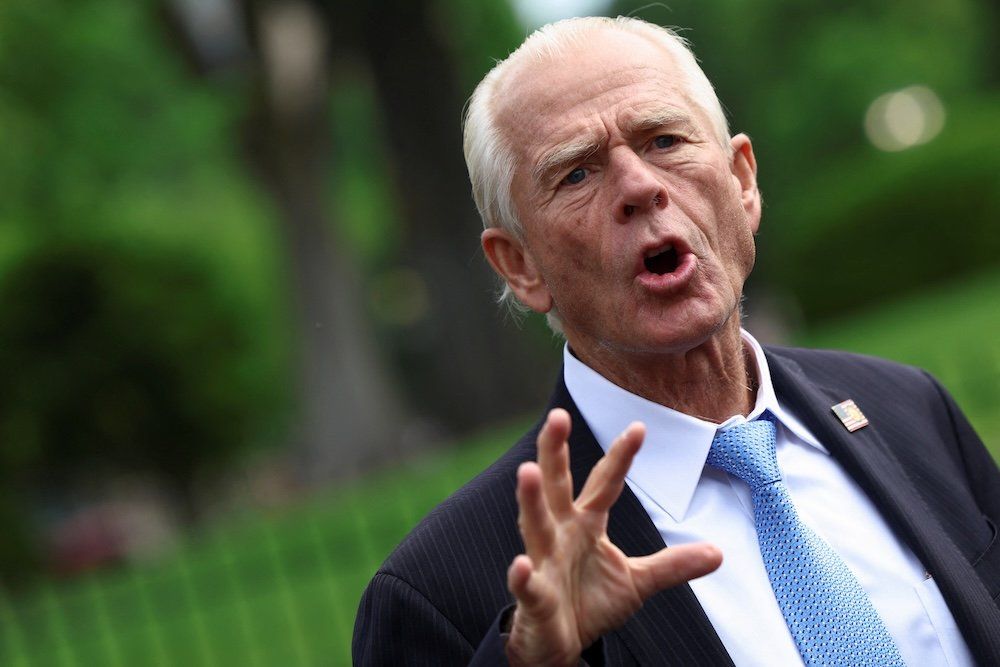
Peter Navarro
One of President Donald Trump’s top economist advisers defended the administration’s handouts to rare earth elements corporations — and, speaking exclusively with AlterNet, two top economists tore apart the economist’s logic.
“China is using its control over the supply chain for rare-earth and other critical minerals to dominate global commerce and project state power—and the world is finally waking up to the danger,” Peter Navarro, who served as Senior Counselor to the President for Trade and Manufacturing, wrote for The Wall Street Journal on Tuesday.
Navarro added, “For decades, Beijing has pursued industrial dominance through state subsidies, currency manipulation, intellectual-property theft, forced technology transfer, state-directed overcapacity, blocked market access, dumping, forced labor and lax environmental standards. Its economic aggression has advanced across industries—steel and aluminum, shipbuilding, solar panels, batteries, pharmaceuticals, medical supplies, telecommunications equipment, drones, robots, machine tools and advanced electronics.”
The conservative economist then described China’s recent investments in rare earth exploration and development as a dangerous economic escalation, and accused them of deliberately stagnating mineral access to other countries through a strategy of “starve, not strangle.” From there, he advocated America’s Defense Department providing assistance to rare earth element companies.
“Consider the Pentagon-guided effort involving ReElement Technologies, Vulcan Elements and key leaders in the defense industrial base,” Navarro wrote. “The Pentagon has supported Vulcan and ReElement construction projects with hundreds of millions of dollars in investments. The Pentagon on Monday announced an additional $25 million investment in ReElement ‘to expand domestic refining capacity for rare earth elements and other defense-critical minerals.’”
Comparing the Pentagon’s work with rare earth companies with their various business collaborations during the COVID-19 pandemic, Navarro admitted that “critical-minerals supply chains are far more complex than ventilators. Yet the industrial lesson is the same: When government identifies the strategic gap, removes obstacles and matches innovators with industrial partners, America can move quickly.”
Overall, Navarro characterized China’s rare earth elements policy as an attempt to “bully the West” but claimed that it has failed because it has instead managed to “encourage the free world’s decoupling from the Chinese economy.”
He concluded his argument by saying, “China built its leverage by making the world believe it was the sole supplier. America’s task is to work with our free-world allies to make sure there is an alternative—cleaner, cheaper and faster. America’s formula is to back breakthrough technologies, pair small innovators with large industrial partners and scale China-free strategic supply chains at the Pentagon’s ‘speed of relevance’—fast enough to gain a competitive advantage.”
Speaking exclusively with AlterNet, Dr. Richard Wolff — economist emeritus at the University of Massachusetts Amherst — characterized Navarro’s argument as part and parcel of his larger anti-China agenda.
“Peter Navarro has a lifelong history of being hostile to everything that the Chinese economy has accomplished,” Wolff told AlterNet. “I'm not surprised in the slightest that he would find some way to comfort everybody about the fact that the Chinese are able, by virtue of the spectacular economic growth they have achieved in the last 40 years — every one of which, the rate of growth of China has exceeded that of the United States — to do this. The result of that was that the United States tried at every turn to slow down, to complicate, to make difficult China's growth. And what the Chinese were looking for is a way to push back and to stop the United States from doing that. The control of the rare earths, which they didn't use to limit the way they do now, is a way for them to push back.”
He added that China did this not out of preference, but “because there are very few options for them to do that. So yes, you can berate them all you want, but in the end, it is a decision of the United States not to sit down with China and work out how you cohabit on a planet when you are the two leading economies. The effort of the United States has been to hold back and limit China, and that has led the Chinese to have to defend themselves. And the rare earths issue is just part of that story.”
Wolff concluded, “I can assure Mr. Navarro — and if he weren't so anti-Chinese in his orientation, he would've figured this out — that there are many ways the Chinese can push back. If they can't use rare earths, if America can produce them, they will find other ways. The problem here is not rare earths, and the problem here is not, quote unquote, a ‘Chinese chokehold.’ The problem is an adversarial relationship, when the only rational way to deal with the spectacular growth of China is to sit down and work out cohabitation arrangements.”
Dr. Robert J. Shapiro, a former economic adviser to Democratic presidential candidates and presidents including Bill Clinton and Barack Obama, was also skeptical of Navarro’s arguments.
“Rare earth minerals can be found around the world,” Shapiro told AlterNet. “We've heard that rare earth minerals were part of the justification for Trump's fantasy of seizing Greenland — although there are a lot of rarer minerals there, they're under, you know, a hundred feet [of ice]. There are rare earth minerals in the United States, in Africa, in Asia. It's kind of similar to oil: there's plenty of oil in the world. The issue is how much it takes to extract it. The same is true of rare earth minerals.”
He added, “The attempt to make this into a national security issue — that's simply, what should we call it, the cover story. Whatever it is that they're proposing to do is something they want to do. The only real issue in securing sufficient rare earth minerals is the cost — how much are you willing to pay. So, to the extent that he is trying to make a national security argument, what is it he's actually defending?”
Shapiro concluded, “The pertinent issue here is not whether we're going to be able to get rare earth minerals — of course we are. We can get them from a hundred different sources around the world. The issue is how much it costs. And the fact that Peter Navarro wants to defend the crony capitalism of this administration, in which they give huge contracts paid for by taxpayers to their friends, or to companies in which they're invested — this is an attempt to cloak the ongoing corruption of this administration in national security. As with almost everything Peter Navarro speaks about, the argument fails.”
The Trump administration has previously indicated that it views rare earths as a lucrative industry and a major geopolitical chess piece. A company partially owned by Trump’s sons, Dominari Securities, struck a major deal for tungsten projects in Kazakhstan.