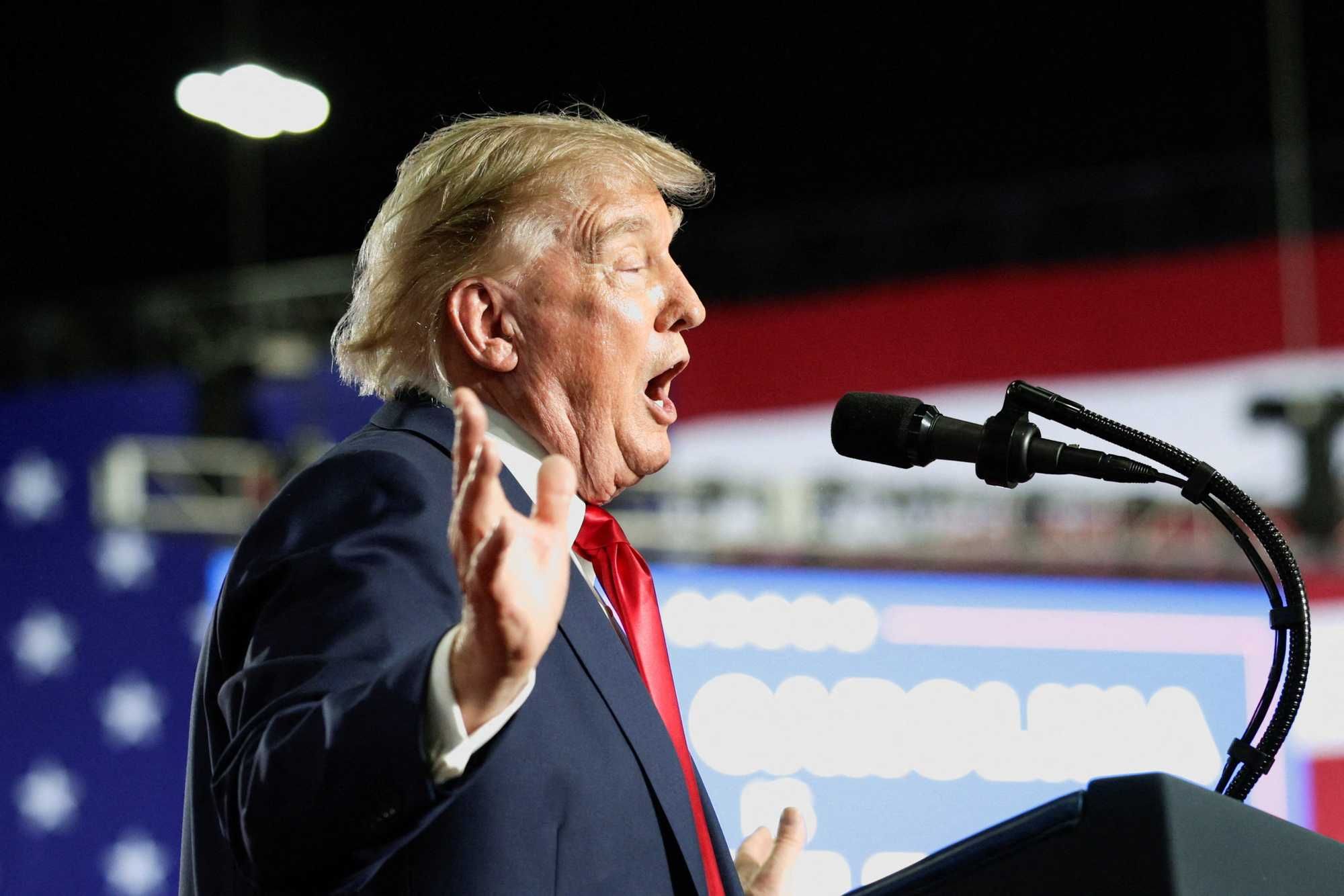
U.S. President Donald Trump gestures as he speaks during a campaign rally for U.S. Senator Darline Graham (R-SC) at the Myrtle Beach Convention Center in Myrtle Beach, South Carolina, U.S., August 21, 2026. REUTERS/Evan Vucci
Last week, the U.S. reached an alarming new milestone when the national debt surpassed $40 trillion. In the days that followed, the Trump administration voiced a solution that a leading budget economist has declared a “fantastic story” that is “virtually impossible.”
“It’s been a problem for 35 years,” Trump told reporters Friday when asked about the debt. “And what we have now … is we have tremendous growth. And the way you take care of debt is with growth, and we have tremendous growth. We’ve never had growth like we have right now.” Treasury Secretary Scott Bessent agreed on CNBC, saying, “There’s nothing magic about the $40 trillion number. And we can grow our way out of that.”
It’s a “fantastic story,” says Kent Smetters, Boettner Professor of economics and public policy at the Wharton School at the University of Pennsylvania, who spoke with Fortune Magazine about the administration’s suggestion. “Unfortunately,” writes Fortune, “Professor Smetters — the faculty director of a fiscal analysis tool called the Penn Wharton Budget Model — says the plan is also ‘pretty clearly’ not feasible. He explained in an interview with Fortune: ‘People often get the causality kind of opposite. They think more growth, less of a debt problem, and in reality, it’s just the opposite … We deal with the debt issue in order to try to aid economic growth, not vice versa.’”
According to Fortune, the White House has proven a number of other “fantastic” solutions that haven’t panned out. As Fortune explains, “Originally, President Trump had suggested that tariffs would pay down the national debt (the plan was quickly nixed by a Supreme Court ruling ordering the administration to repay approximately $100 billion in revenues that the justices deemed illegal). Trump later suggested a ‘golden visa’ strategy — selling rich immigrants visas at $5 million each — could pay down the national debt. The policies were novel, but economists broadly welcomed action by the Trump Administration on the fiscal picture.”
Now, however, a bond market “reckoning” looms. According to Fortune, “The risk premium demanded by investors for holding the 30-year Treasury rose to over 5.3 percent in recent days, prompting U.S. Treasury Secretary Scott Bessent to deploy $4 billion or more in unscheduled buybacks.” And if the U.S. proves unable to pay its debt, it could result in a worst-case scenario: a default crisis.
“Despite the flaws in the growth plan, policymakers will be aware they need some response on debt questions in the run-up to midterms,” notes Fortune. “Indeed, new research from the nonpartisan budget think tank the Peterson Foundation, conducted by the Democratic firm Global Strategy Group and the Republican firm North Star Opinion Research, found that only 10 percent of voters said the debt issue will not impact their ballot decision later this year.”
According to the Foundation’s CEO Michael Peterson, “With the midterm elections approaching, voters are making it clear that they want candidates with a decisive plan to address our unsustainable budget and debt.”