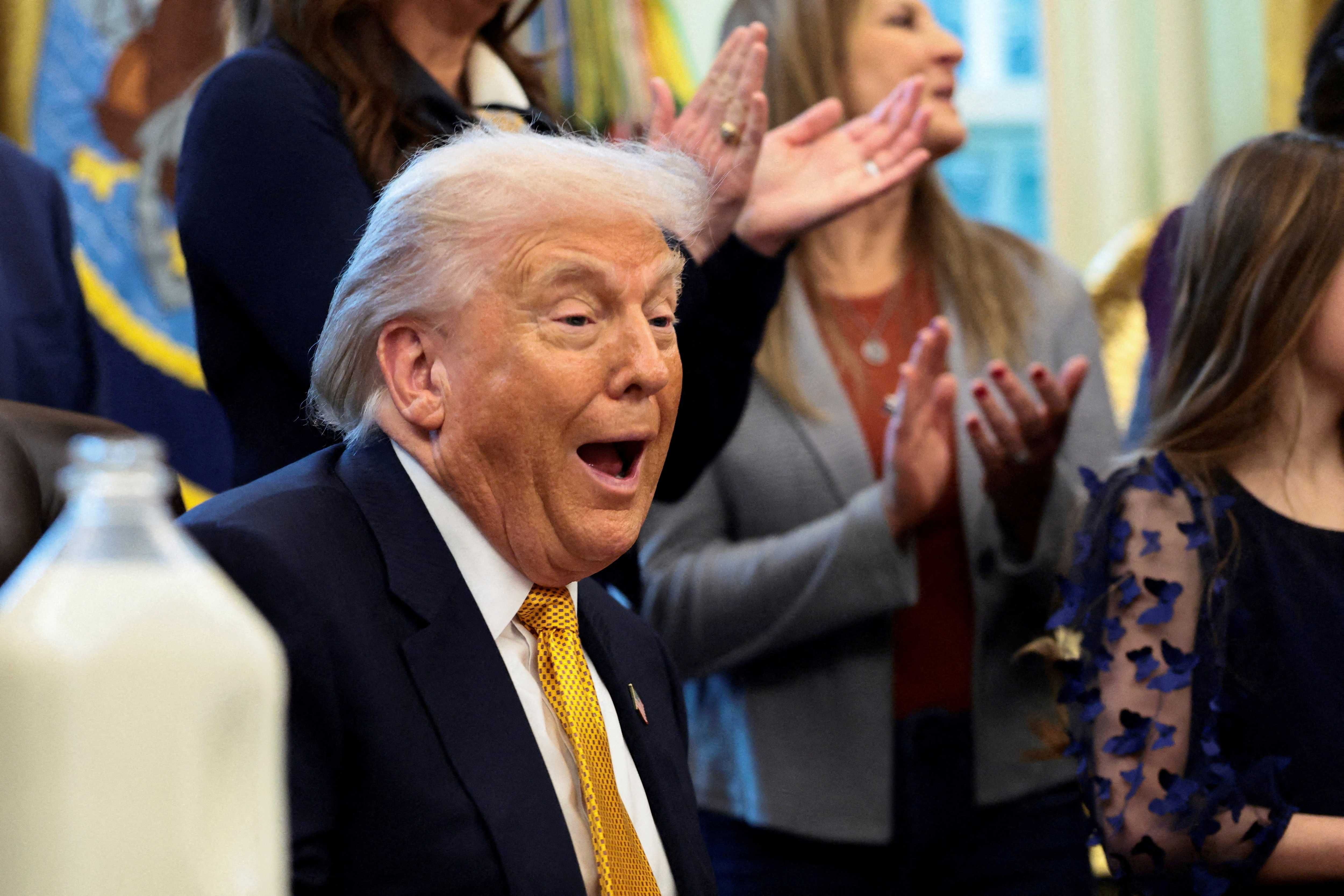
U.S. President Donald Trump reacts as he participates in a signing ceremony in the Oval Office at the White House in Washington, D.C., U.S., January 14, 2026. REUTERS Evelyn Hockst
President Donald Trump has made it clear that he will try to rig the 2026 midterm elections to make sure Democrats don't reclaim one or both chambers of Congress.
He has suggested everything from sending law enforcement to polling places to outright seizing ballots, from declaring a national emergency to strong-arming Congress into not accepting results that benefit the Democrats. He has already tried to suppress mail-in ballots and succeeded, in some cases, in forcing states to hand over voter rolls. On a grassroots level, he and his MAGA movement have installed supporters in key positions to deny election results that are favorable to the Democrats.
Instead of simply doing his best to govern well and convince voters to retain Republicans on the basis of his record, Trump is focusing on issues that benefit him personally despite voters overwhelmingly disagreeing with him — building a White House ballroom, renaming the Kennedy Center after himself, promoting AI data centers, waging a trade war against Canada, continuing a literal war against Iran. It seems, for all intents and purposes, that Trump believes he doesn't need to win votes legitimately because he can abuse his power by "nationalizing elections" (which the Constitution prohibits) and thereby prevailing that way.
Against these efforts, Trump's opponents can only hope that Democrats are effective in planning against each of those efforts, as well as use the pre-election polls to call out results that are clearly fishy. Yet will these efforts work?
To learn more, AlterNet spoke with Dr. Christopher Wlezien, a professor of government at the University of Texas at Austin who specializes in public opinion, polling, elections and research methodology.
The following interview has been lightly edited for clarity, context and length.
ROZSA: I'm going to start with what is, to me, the most obvious question. Based on your understanding of the attempts President Trump has made to meddle with the midterm elections — from potentially sending law enforcement to the polls, to suppressing mail-in ballots, to acquiring information about voters from compliant states, to saying he'll file lawsuits in key districts and Senate races where he loses — do you think it's plausible that Democrats could win one or both seats, one or both chambers of Congress, yet Trump could steal them back for the Republicans?
WLEZIEN: Well, yeah, there are other things too — the redistricting efforts that he didn't really undertake himself, but that he stimulated. So he's pretty close to a full laundry list. What does that mean to me? It means he's concerned about losing. He's accomplishing some of these things — the redistricting, to some degree, though probably not as much as he'd have liked. He probably didn't fully anticipate the countervailing forces that would occur, although the courts have stemmed some of that.
He's lost on other stuff — the mail-in voting is the clearest case. At least on the surface, he seems to be following the rulings. So when he loses, he gets upset, goes on Truth Social and posts, and does things like what we saw with the Kennedy Center. He doesn't have that lever with elections, though — the problem for him is that elections are basically run at the state and local level. That's what this whole court case was about, in one sense: who gets to control mail-in voting, who gets to regulate it in the absence of congressional action? It's still in the hands of the states. Will that always be the case? I'm not guaranteeing you that. [laughs] Does that help, or no?
ROZSA: My question specifically is: could he succeed in stealing the election through any one of the methods I mentioned, or through methods I didn't list?
WLEZIEN: I don't foresee that. I guess it ultimately depends on what happens with the results in the states — whether they're confirmed at the state level, whether people are seated in Congress. So I guess there's a possibility, but I don't think it's a strong likelihood, and he'd have to rely on other people to do it. I don't see how he could do it directly. But there's death and taxes and everything else, I guess. [laughs] And this is one of the other things.
ROZSA: My concern is that he has placed people in positions of power in local and state governments who are believers in his "big lie," who will therefore be compliant in whatever nonsense explanations he comes up with to flip races he actually lost.
WLEZIEN: Well, we'll see. We'll have to see how that plays out. It's pretty clear you hear a lot of rhetorical support for him — obviously in the White House, and the cabinet, those who are left. But down at the state level, a lot of people running in primary elections are going to be with him. How long, and to what degree, isn't clear to me. When you talk about them being "true believers," I'm not absolutely sure we have strong evidence of that in most of these cases.
We'll just have to see how it plays out. I'm not trying to be Pollyannish about it — it's just a big step. Big steps can happen, but it's a big step.
ROZSA: Now I want to go to the issue of polls, because on the one hand, polls can be helpful in preventing cheating by giving experts a realistic barometer of what was anticipated in a given election — if there's too much of a difference between what was anticipated and the actual result, it creates a plausible case for cheating. On the other hand, polls can be wrong. [laughs]
WLEZIEN: Right.
ROZSA: If you look at both older and more recent cases — polls incorrectly thought Dewey would defeat Truman, polls incorrectly thought Clinton would defeat Trump, and more recently polls incorrectly thought El-Sayed would crush Stevens, when he only won by a smaller margin — to what extent can polls be reliably used as a basis for accurately determining an election's legitimacy?
WLEZIEN: Yeah, so some of this is a little deceiving. Most of the national polls were a bit off on Clinton and Trump, but Clinton did win the popular vote, so that part was right — the errors weren't ideal, but that's the tricky bit: in close elections like we've had lately, even small errors can lead you in the wrong direction. Going back further in history, there are other issues at play. I'm not trying to build an ad hoc excuse for that.
But basically, my own research on polling indicates it hasn't gotten worse — if anything, it may have gotten a little better. Despite all the changes in response rates, technology, and weighting, it seems like polls are holding up pretty well. But "polls get it right again" isn't a headline — it's not a good lead, so we don't hear a lot about that. I used to forecast elections myself, and I never heard about it when I got it right, which was pretty much every time [laughs] — except when things weren't quite right, and then people were like, "What happened to you?" [laughs] It's the same with polling generally: the news pays a lot of attention to the cases where they miss.
That said, polls have always had error, and there is something going on with Trump supporters specifically — the polling on them has gotten a little better, though I can't tell you exactly why, because I don't know exactly what pollsters are doing under the hood. Somehow they're weighting things differently, reaching Trump voters they were previously underrepresenting. But they're still coming up a bit short — even in 2024, the very late polls were basically fifty-fifty, and he ended up a little ahead on election day.
It is interesting, because we use things like polls when we talk about elections in other countries too — there was clearly something wrong in Venezuela, for example. The question is whether we'd see a big enough difference in the polls to really say something, and which polls we'd even be looking at. With Congress, there are a lot of races involved in picking a chamber — are we looking at the generic ballot ("which party would you vote for in your House election")? In most House districts we don't have good polls at all.
So it's really hard to match those generic-ballot numbers up against results. You don't expect a 55-45 split in a poll a week out to be 55-45 on election day. I don't know if that helps.
ROZSA: It does, quite a bit. I now want to ask you a question based on an interview response I got from Kyle Kondik [the managing editor of the University of Virginia Center for Politics’ nonpartisan polling and elections newsletter Sabato’s Crystal Ball]. Are you familiar with Kondik?
WLEZIEN: Yeah, I'm familiar, a little bit.
ROZSA: He writes for Sabato's Crystal Ball. I asked him: historically, how have midterms played out under presidents with approval ratings similar to Trump's, and what does that history actually tell us versus what people assume it tells us? His response was: "Generally speaking, a president who is this unpopular should see his party lose a lot of ground in Congress. That said, Joe Biden also had poor approval in 2022, but Republicans didn't do all that well — they flipped the House, but not the Senate. However, the Republican lead in the generic ballot was not as large as the Democratic lead is now." What do you think of his analysis?
WLEZIEN: I've done a good amount of work in this space, and Kyle has too — we've both seen the same data, and that's pretty much spot on. My read on Trump's approval right now is that it's below where Biden's was. But there's also the nationalization of elections, and redistricting, which I think has made it harder to get much swing in seats — unless there's a really big wave. If there's a big wave, it eventually gets deep into the seats, but it's not clear we're going to have that kind of wave this time. It's pretty clear that in 2022 we had the Dobbs decision.
It doesn't look like we have something like that coming down the pike, or over the summer the way we did back then. That's part of what dampened the "balancing" effect — that's the term I use — that we normally see in a midterm. The hard, smoking-gun evidence for that is hard to find, but it looks plausible. We don't seem to have something like that happening now, and we also have fewer competitive districts in play at the margins.
ROZSA: Now I want to ask about whether the midterms can be rigged through methods other than what I've already described. Let me rephrase: you've heard me describe the various things Trump is trying to do to rig the midterms, and it sounds like you're skeptical that could actually happen. What if, hypothetically, the Democrats prevail in all of these races despite Trump seizing ballot boxes, despite Trump using law enforcement at the polls, despite Trump using voter databases to purge certain voters, despite Trump appointing election deniers to key positions at the grassroots level, despite Trump filing frivolous lawsuits — I've listed five things Trump has already suggested he'd do. I'll add a sixth: despite Trump declaring a national emergency. Let's say Trump does all or some of those six things, and despite all of that, the Democrats are still able to flip one or both houses.
ROZSA: Then there's the possibility that Trump has Speaker of the House Mike Johnson and Senate Majority Leader John Thune simply refuse to recognize the results. That's a seventh possibility —
WLEZIEN: No — I raised that myself earlier, if you recall.
ROZSA: Yeah.
WLEZIEN: Yes. That's possible — like I said, that's possible. I mean, how would I know? I'm not in the room. Just like everything else you've described, he'd be relying on other people to act as his agents. Will they do that? We'll have to wait and see. He does tend to push things as far as he can, but he also, often, respects court decisions — with mail-in voting, is he going to proceed with that executive action? Looks like not. And how do I know for sure whether he'll do that?
ROZSA: My question is, as a pollster — someone who's an expert in gauging public opinion — to what extent do you think Trump could rig the midterms and get away with it in the court of public opinion? I'm not just talking about —
WLEZIEN: Oh — the court of public opinion? What do you mean, "get away with it in the court of public opinion"?
ROZSA: Right now — do you think the average American would just allow Republicans to retain control of Congress when the Democrats legitimately won? Or do you think, based on your understanding of polls, there would be a persistent and vicious backlash to Trump having done that?
WLEZIEN: My guess is there would be a backlash — there's already a backlash to what he's doing. A number of people attribute his current plight in the electorate to the Iran war and oil prices, but his approval rating was already pretty low at the end of last year, [laughs] before that happened. People were responding to other things he was doing. Should he do this, sure, he'd expect an additional backlash. There's a floor here, though — even Nixon had about 25% approval when he left office. So I wouldn't be surprised if it dropped, but stayed around 30 to 32 to 34.
I'm not sure exactly where it is now — I'm guessing somewhere around 36, 37. So sure, it would drop. But the problem is it's not really in the hands of the electorate. We can express disapproval, and when we get another chance to vote we can punish or reward people accordingly, but in between, we don't have a lot of options. We could rise up, but that's messy. So I'm not sure — sure, the court of public opinion is already disapproving of what he's doing —
ROZSA: All right, that's —
WLEZIEN: — part of the reason he's trying to influence what happens in November. He can say all he wants about polls and people loving him, but his behavior isn't reflective of him taking his own words very seriously. [laughs]
ROZSA: Well, now I need to go back to my earlier question about polls and their reliability. To what extent should the American people trust polls?
WLEZIEN: Well, it depends — what do you mean? They're never perfect, and they're more informative about some things than others. Do you mean pre-election polls specifically?
ROZSA: Yes — or, to what extent should we base our assessment of the legitimacy of the midterm elections on how closely they correspond to the polls?
WLEZIEN: Yeah, that goes back to what I was saying — it's really hard. What are we supposed to be comparing to what? I'd be really surprised if the Democrats don't win the popular vote in a couple months. But let's say they win it, but not by much — I'm not sure what we're supposed to expect based on the polls. If the Republicans won 60-40, that would be alarming.
But we have to keep in mind that some of these states are run by Republican, pro-Trump officials, and others aren't. If we see what we saw in 2024 — a bunch of arrows pointing in a red direction pretty much everywhere — there's less reason for concern. If instead we see a lot of arrows this time pointing blue — some bigger than others, of course, but mostly pointing in the same direction — then I'm less concerned. It's really hard to keep track of everything going on; we have states, counties, cities, and other actors involved in all these elections. It's a substantially federalized, decentralized country when it comes to elections — which is part of what Trump has run into when he goes to the courts trying to get involved with the states too.