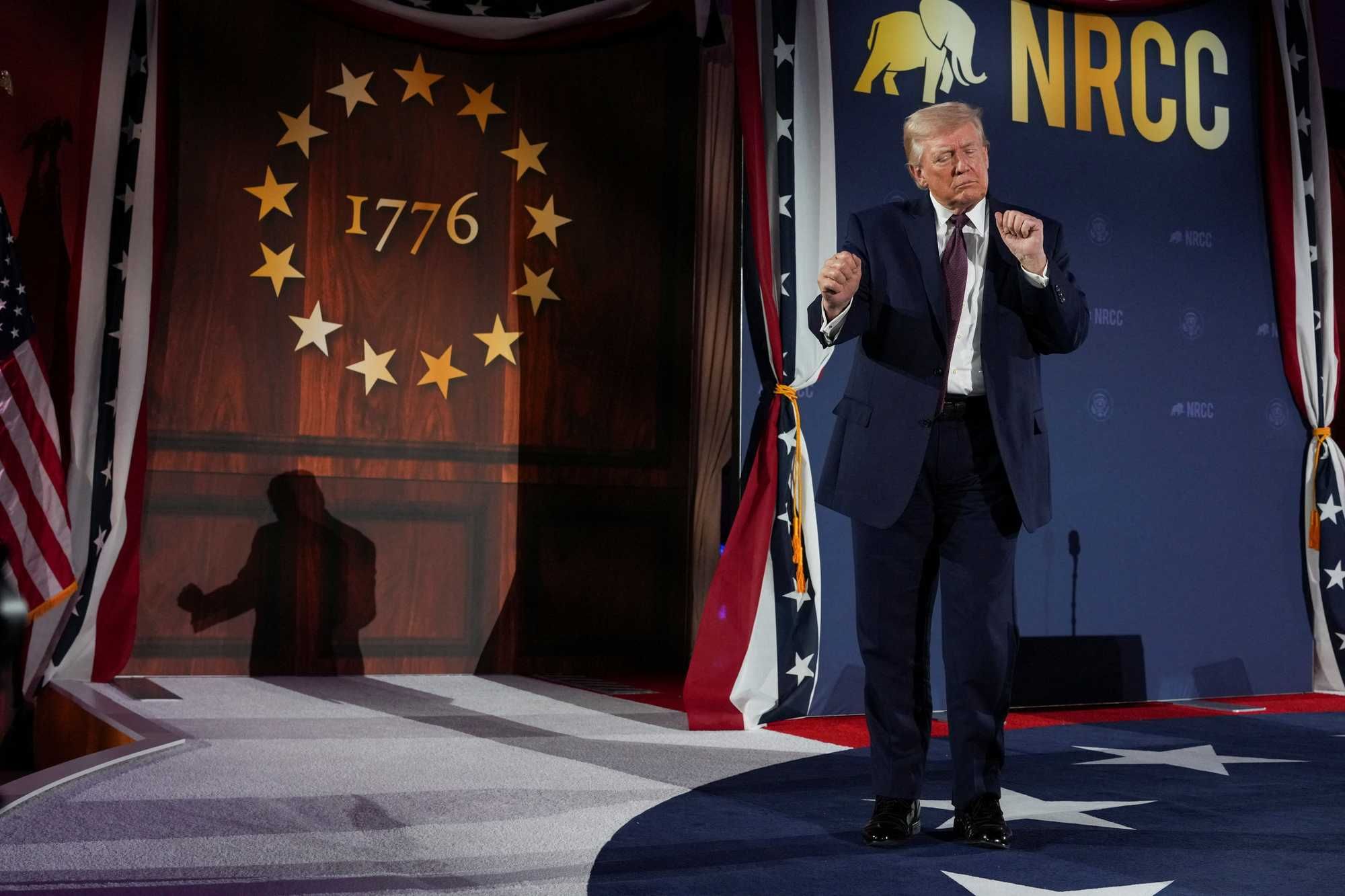
President Donald Trump dances during the National Republican Congressional Committee (NRCC) annual fundraising dinner in Washington, D.C., March 25, 2026. REUTERS/Ken Cedeno
President Donald Trump's influence has left "striking" changes for the GOP, according to one GOP insider who recently spoke with the New York Times, leaving the party with major challenges to overcome in the near future.
Liam Donovan is a Republican strategist and the president of the Targeted Victory consultancy firm. On Friday, the Times published an interview in which he broke down the new challenges facing the GOP, revealing how some of them have been shaped by Trump and explaining why the GOP might not be ditching him, even as his war in Iran grows increasingly unpopular.
Despite high-profile signs that major MAGA Republicans and devoted supporters are breaking with Trump on Iran, numerous polls have still found majority support for the war among conservative voters. When pressed about what the party should do about this discrepancy, Donovan said that the party understands Trump's "profound" connection with its voters and does not see much upside yet to breaking with him.
"I don’t think congressional Republicans need to look at polls to tell them what they’ve lived through over the past decade: This president has a profound connection with his (and their) voters, and there has yet to be an example of public opposition to the president paying electoral dividends," Donovan said. "In the Trump era, you’ve ended up with a model of representation who acts more like a delegate than a trustee — a proxy, not someone applying judgment."
When pressed about whether that sort of unity was a good thing, or if it might prevent the party from reaching a wider coalition, Donovan added, "His success has solved a number of Republicans’ problems, like winning the presidency, and his singular power has unified them in ways that have delivered major legislative victories, but the real answer won’t be clear until the party decides whom it should turn to next, and to what end."
That relationship with voters, he explained, also represents the GOP's most "striking" shift under Trump, given that he has built a huge base of voters who only show up to vote for him, which presents a massive challenge when he is no longer able to run for office.
"The most striking aspect of the coalition realignment that Trump has accelerated is that Republicans are now the party most reliant on low-propensity voters," Donovan explained. "It’s the structural reason Democrats have had the kind of success we have seen in elections over the past 15 months. It’s not merely the presence of Trump, though obviously that matters, but it’s also the scale of the election. It’s a real concern for 2026, but it’s also a long-term issue that the party needs to grapple with and incorporate into its understanding of its interests, that the more people who vote, the better it is for the GOP."
Elsewhere in the interview, he also touched on the immediate challenges for the GOP, as it grapples with "an electoral hangover" from 2024, in the face of a Democratic Party energized by major defeats that year.
"A great presidential cycle like the one Republicans had in 2024 is a double-edged sword," he said. "It’s fun to win elections, it’s exhilarating to control the levers of power, but there’s inevitably an electoral hangover. And the silver lining to losing across the board as Democrats did is that the desperation of the experience is inherently motivating and mobilizing. It was always going to be a challenge for Republicans to reconstitute the coalition that elected the president without him on the ballot."