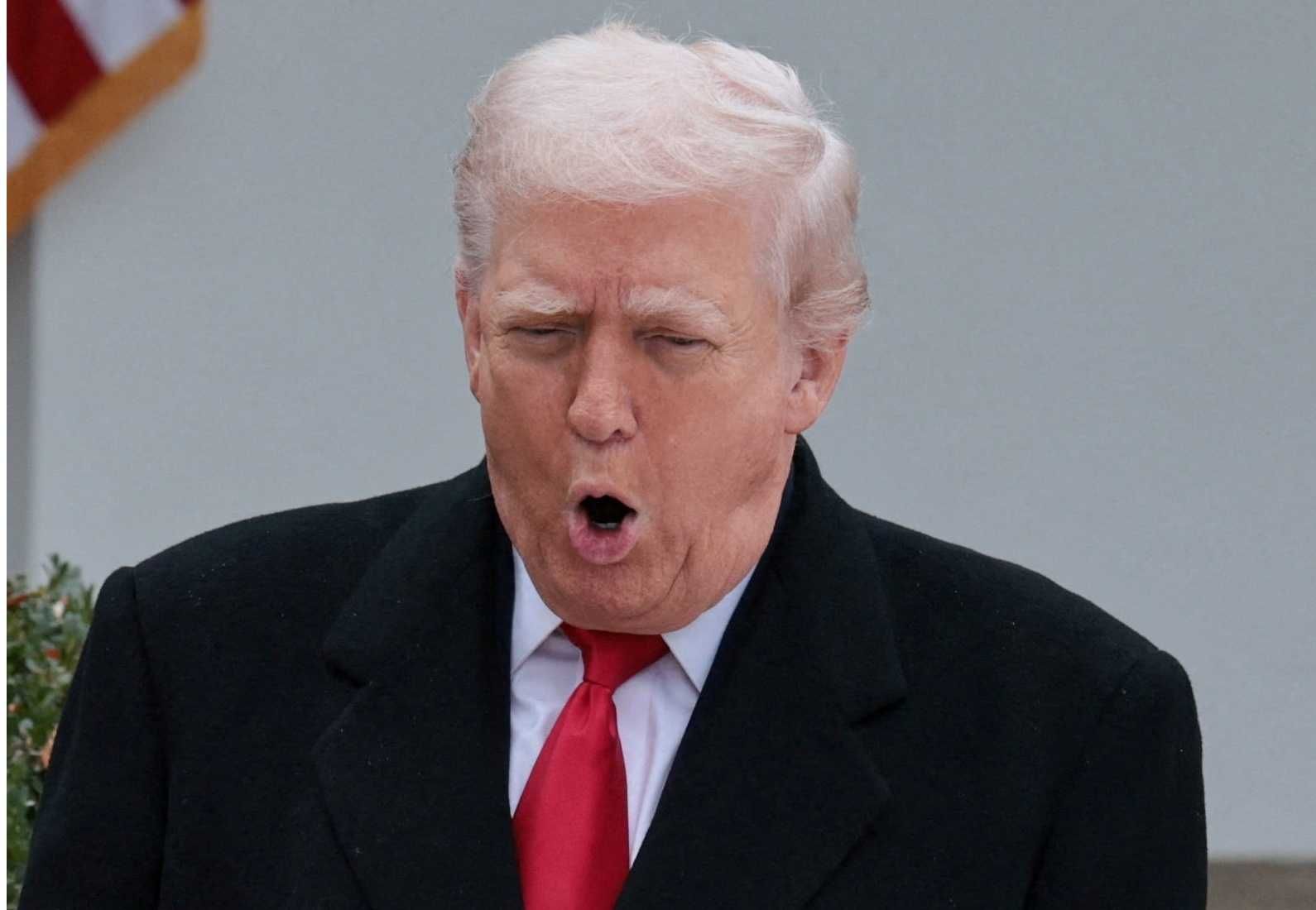
U.S. President Donald Trump speaks in the Rose Garden at the White House in Washington, D.C., U.S., November 25, 2025. REUTERS Nathan Howard
President Donald Trump's losses in the 2026 midterm elections were, literally, unlike anything seen in the 20th century, at least according to one expert.
Political scientist Dr. Allan Lichtman, American University professor and author of the American politics books like "Great American Presidents" and "Ten Keys to Presidential Greatness," spoke with AlterNet on Wednesday about the magnitude of Republicans' defeat on Tuesday night. Despite planning on contesting the election results through myriad means in the lead-up to Election Day, Trump didn't even try a coup like he did after losing the 2020 presidential election, instead saying he hopes to work with the Democrats as it becomes unavoidable that they have retaken both the Senate and House. There are even reports that the administration admits Trump's war against Iran, which has been both a military and economic disaster, played a critical role in their loss, one so overwhelming that they have essentially decided it would be impossible to successfully overturn it.
So what happened? According to Lichtman, a midterm election unlike any seen in the 21st century.
The following transcript has been lightly edited for clarity, context and length.
The historical significance of the 2026 midterms.
Matthew Rozsa: Can you place the events of last night in a historical context, in terms of power shifts between the two parties throughout American history?
Allan Lichtman: Yes. One comparison that immediately comes to mind is the power shift in 1994, when for the first time in decades, the Republican Party took back both the House and the Senate, with major gains in both chambers. In fact, the gain in the Senate this time, which is at least seven seats, was exceeded only by the 1994 elections.
Matthew Rozsa: I would like to bring up the 1894 midterm elections. That was during President Grover Cleveland’s second term. Cleveland, as you know as well as I do, was one of only two presidents to serve non-consecutive terms, the other, of course, being Donald Trump. And in 1894, like 2026, this president’s second non-consecutive term was marred by a terrible economy, and it caused people to register their discontent in large numbers at the ballot box for the opposing party, which happened to be the Republicans. What do you think of that analogy?
Allan Lichtman: Oh, I think the analogy is apt. That was a big rout for Grover Cleveland and his Democratic Party. And interestingly, it presaged what was a long-term Republican sweep of American politics. The only Democratic president after Grover Cleveland and before Franklin Roosevelt was, of course, Woodrow Wilson. It was an even bigger rout than we saw this time. The distinction I would draw, though, is that in 1894, it was almost entirely due to the Great Depression of the 1890s, the worst depression that the nation had experienced before the Great Depression of the 1930s. The rout in 2026, of course, was to a significant extent based upon the sour economy, but there was more involved here. The unpopular war was a factor unto itself, independent of its effect on the economy. Typically, we have a rally-around-the-flag effect early in a war, even in Iraq and Vietnam.
It didn’t happen here. Right from the start, the American people disapproved of this war, which never had any kind of authorization from Congress, and they continued to disapprove in very large numbers. The other two things that I found really striking—
Matthew Rozsa: I’m sorry, I need to interject, but please put a pin in what you found striking. I’m going to return to that in a moment. In 1934, as you just mentioned, America was in another terrible Great Depression, and yet the incumbent party, led by President Franklin Roosevelt, managed to do extraordinarily well in those midterms. So even though 40 years separated Cleveland’s 1894 midterms and Roosevelt’s 1934 midterms, Roosevelt managed to do well in his midterms because, in my opinion, he took a proactive approach in addressing his Great Depression that people felt genuinely improved the hardships that they faced, and Cleveland failed to do the same thing. Therefore, my point is that having a bad economy does not in and of itself doom you. What do you say to that observation?
Allan Lichtman: Well, having a bad economy almost always dooms you if you are responsible, and in the eyes of the American people held responsible, for the bad economy.
Matthew Rozsa: So what happened with Roosevelt in 1934, then?
Allan Lichtman: The bad economy of the 1890s was clearly associated with Grover Cleveland and his failure to adopt any kind of policies to deal with it. He was an old-fashioned Democrat who believed in states’ rights, limited government, hard money. We didn’t get the transition to the more activist Democratic Party until the administrations of Woodrow Wilson and Franklin Roosevelt. The Great Depression of the 1930s was not associated with Franklin Roosevelt. It was associated with Herbert Hoover, the previous failed Republican, who lost in a landslide to FDR in 1932, largely because of the Great Depression. During the Great Depression, people talked about Hoovervilles, the shantytowns that grew up around our great cities. And you’re absolutely right. Franklin Roosevelt gave people hope in two ways. Number one, by seizing the policy initiative through his New Deal programs of relief and reform, and then through weaving a narrative of hope.
You can’t underestimate the way in which FDR’s ability to communicate with the American people boosted his presidency and made 1934 a ratification rather than a rejection of his presidency. It was much more a rejection of Herbert Hoover, and the Democrats made that clear in their 1934 campaign.
Two striking things about the 2026 midterms.
Matthew Rozsa: Now, I want you to go back to what you were saying, the two striking things about 2026.
Allan Lichtman: Yes. Things I really have never seen before. How democracy and corruption have risen to be major voting issues to the American people, rising almost to the level of inflation and the economy. People have awakened, and this is important, you didn’t see this in 1894. People have awakened to the fact that Trump is an authoritarian-inclined president who poses a clear and present danger to the survival of our democracy. This is a president who has said, “I can do anything I want as president,” totally smashing the foundations of our republic, which is a balance of power among the three branches of government, with no single branch able to govern unilaterally. Then the other thing that Americans have become much more aware of, more so than really since the Watergate scandal, although this is a little different, is the amount of graft: how, despite immense conflicts of interest, the president has used his political office to enrich himself and enrich his family.
These are the kind of issues that you don’t typically see, but that are truly striking in this midterm contest. And of course, you put it all together and you have the abysmally low approval ratings of the president, in the 30% range. In my pre-election interviews, I pointed out that historically, when a president has approval ratings as low as Trump’s, on average the White House party loses 40 House seats and six Senate seats, and that’s pretty close to what we’re going to see this time.
Matthew Rozsa: I want to go back to the juxtaposition between 1894, 1994 and 2026. One key difference, which you brought up, was that after the 1894 midterms, there was a milestone presidential election, the one between William McKinley and William Jennings Bryan, which ushered in a generation of Republican political dominance that lasted until the Great Depression of the 1930s. By contrast, the 1994 midterms did not usher in an era of Republican dominance. Democrats won the popular vote in every presidential election between 1992 and 2020, except in 2004. They had control of Congress for long stretches. It was more of a period where the parties would hand power back and forth between themselves than a period where one dominated. What do you think is going to happen in 2026? Will it be closer to 1894? Will the Democrats of 2028 emerge like a phoenix from the ashes, much as the Republicans did in 1896? Or is this going to be a squandered opportunity, like the Republicans after 1994?
Allan Lichtman: The Republicans definitely squandered their opportunity after 1994 by vastly overreaching and overestimating what they could do with control of Congress in contrast to a Democratic president. And they were never really able to adopt a significant legislative agenda or craft an effective, compelling message to challenge the administration of Bill Clinton, who also very cleverly adopted certain Republican themes, such as welfare reform, in his 1996 campaign. Republicans also fell into the trap, particularly after the Oklahoma City bombing, of being associated with far-right extremism. Therefore, whether or not these opportunities of 2026 will be squandered will depend very much on what the Democrats do over the next two years, and obviously the kind of candidate they’re able to nominate in 2028. A couple of things about presidential nominations. These results taint the Republican nomination, because all the front-runners, J.D. Vance, the vice president, Marco Rubio, the secretary of state, Donald Trump Jr., the presidential son, are all so closely associated with a failed Trump administration that they’re really going to have trouble establishing something new.
Remember, after 1994, you had a sitting president running again in Bill Clinton. After 2026, you have an open seat, and open seats are always bad news for the party controlling the White House. A lot will depend upon the Democrats not overreaching, not seeming to be too far to the left, and developing some really compelling themes, which they’ve been very deficient about going into 2028. So the opportunities, given the open seat, are much greater for the Democrats than they were for the Republicans in 1996 going up against Bill Clinton. I also will tell you, emerging from these elections is my dark horse favorite for the Democratic nomination, and that is Senator Jon Ossoff of Georgia, who won a huge victory in a swing state.
This guy is articulate, he’s smart, he’s not tainted by being too far to the right or too far to the left. He knows how to get under the skin of Republicans, and he doesn’t have the baggage that some of the Democratic front-runners have, like Governor Newsom of California or former Vice President—
Matthew Rozsa: Have you read the Kevin Phillips and H. Wayne Morgan biographies of President William McKinley?
Allan Lichtman: I read H. Wayne Morgan’s many years ago, absolutely. Kevin Phillips also wrote a great one.
Matthew Rozsa: McKinley was able to cause a long-term realignment. Do you think Jon Ossoff has those McKinley-esque qualities?
Allan Lichtman: I’m not sure he has McKinley-esque qualities. McKinley was really important for establishing the new era of an aggressive, imperialistic American policy abroad, and of course for a successful war, unlike the war in Iran: the Spanish-American War of 1898. I see Ossoff more in the mold of some of the great Democratic presidents, like John F. Kennedy, who had charisma, was really smart and could articulate Democratic principles in a way that would resonate with ordinary people. I actually saw John F. Kennedy campaign in 1960 when I was 13 years old, and we were a tough New York audience, and he blew us away.