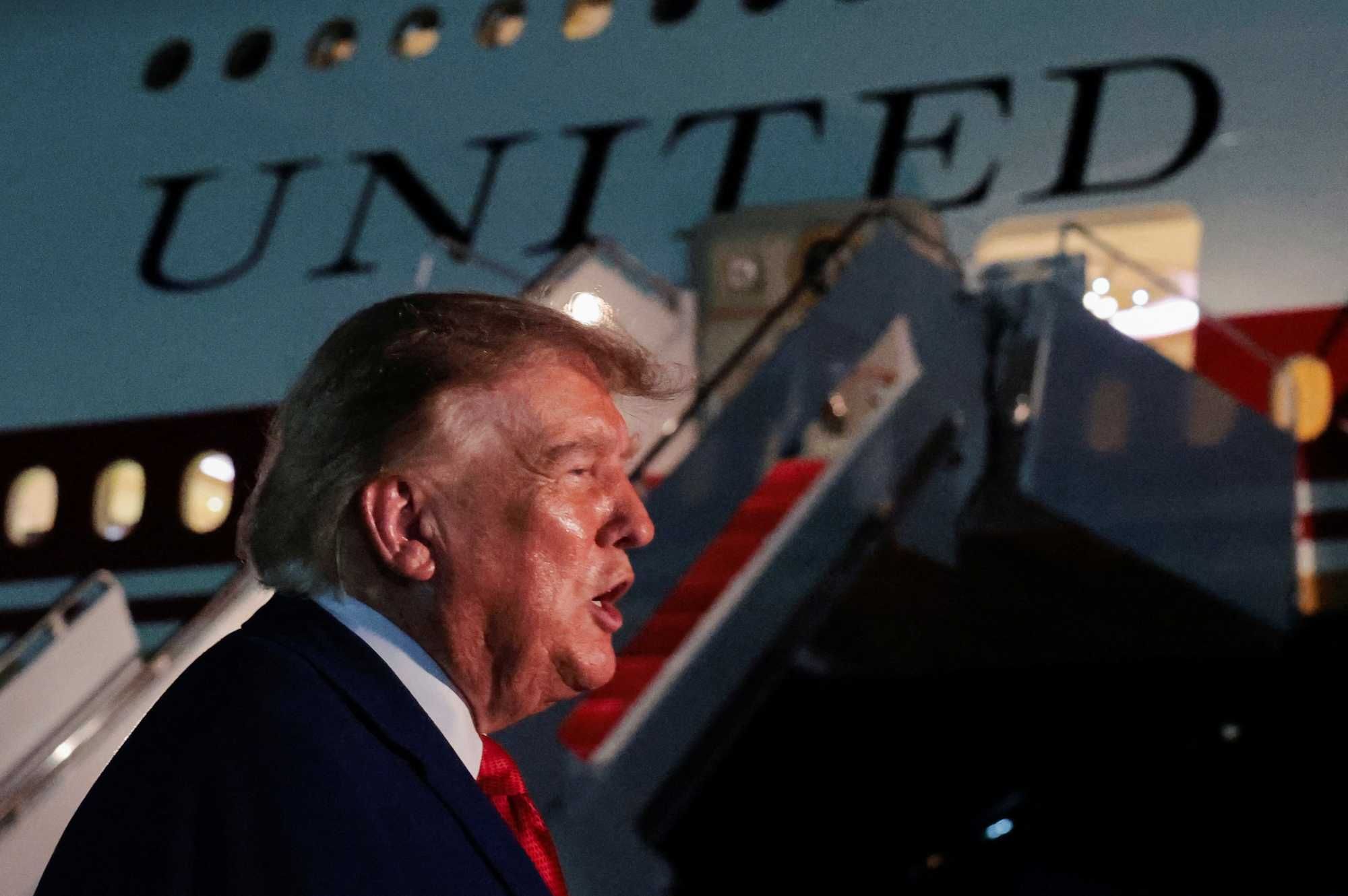
U.S. President Donald Trump speaks to members of the media after disembarking Air Force One at Joint Base Andrews, Maryland, U.S., August 11, 2026.
f Trump wants Republicans to win this fall, all he has to do is endorse Medicare For All and call it a Republican policy.
After all, conservatives across Europe are generally quite happy with their national healthcare systems and definitely don’t want them going away or to be replaced by for-profit insurance companies.
When I did did my show from Denmark’s Danish Radio’s studios, I interviewed multiple conservative politicians and to a person their response to my question, “Do you want to get rid of your healthcare system?” was, “Are you nuts?”
This may not even be all that radical by today’s Republican standards: after all, Trump’s embraced the purely communist idea of the federal government taking control of the means of production and distribution — the textbook definition of communism — by having our government take stock in over 30 companies over the past 18 months.
Odds are high, though, that he won’t go anywhere near MFA, mainly because the trillion-dollar healthcare industry gives hundreds of millions of dollars every year to mostly Republican politicians (thanks to five corrupt Republicans on the Supreme Court).
But the times are changing and, as we’re seeing with progressive primary victories by Medicare For All advocates across the country, people who didn’t just support it, but ran on it. American voters may now be ready for Democrats to again throw their weight behind the plan like Harry Truman and Jack Kennedy did.
There are two reasons for this.
I’ve written at length about the cycles of history, both in my books and the Hartmann Report: Strauss and Howe documented 80-year cycles that have repeated themselves since the founding of our republic.
There’s a financial crisis, followed by a war, followed by a revolution within America that leads to a Great Leap Forward (to borrow from Mao) in progressive policy.
— In 1771, for example, there was a worldwide depression that provoked the East India Company to get the then-biggest tax cut in history from Britain’s government; it led straight to the Boston Tea Party and the American Revolution.
— Eighty years later, the Panic of 1856 helped set the stage for the Civil War which, when resolved, led to the end of chattel slavery (other than for convicted criminals).
— Eighty years after that, the Republican Great Depression led straight to World War II, followed by the fulfillment of FDR’s New Deal and the creation of the American middle class.
— And today we’re eighty-one years out from the end of WWII, which is causing a lot of observers to note that we’re ripe for another “revolution” after being battered by 45 years of the Reagan Revolution.
Along a similar vein, Peter Turchin writes about a cycle he identifies with his “Cliodynamics” system, where roughly every 40 years control of the country transfers back-and-forth between conservatives and progressives, all the way back to 1776.
But setting aside the calendar part of this (which is fascinating in its own right), I believe there’s a bigger factor we can see in these sometimes-revolutionary changes to the American political landscape: crises.
— The 1773 Tea Act and Boston Ports Act (among others) inflicted a crisis on the early colonists; creating the United States was their reaction to it.
— The attack on America by a few hundred Confederate oligarch families and the army they’d raised created a crisis for Abraham Lincoln and our government; ending slavery and writing the 13th, 14th, and 15th Amendments into our Constitution expanding the rights of all Americans was the result.
— And the Republican Great Depression that started in 1929 was arguably the biggest economic crisis the American republic had ever faced, leading straight to World War II and FDR’s New Deal that legalized unions, created Social Security and the minimum wage, and built the world’s first more-than-50%-of-the-population middle class.
But outside of those 80-year cycles, President Lyndon Johnson’s Great Society programs — civil rights, voting rights, Medicare, Medicaid, food stamps, housing support, Pell grants, etc. — were passed in the wake of the crisis created by the assassination of JFK. Johnson relied heavily on the memory of President Kennedy to push through those bills, saying that they’d complete the memory and legacy of his predecessor.
Today, America is facing another crisis that I believe is every bit as dangerous and threatening to our republic as were the Tea Act, the Civil War, the Republican Great Depression, and the death of President Kennedy. Trump’s presidency threatens to literally end democracy in America, the exact goal of the Confederate oligarchs 165 years ago.
He’s not only grifted billions for himself and his corrupt family, and handed other billions to the morbidly rich who surround and support him, but has now identified people who don’t agree with his idea of “traditional American values” as terrorists, throwing one man in prison for 40 years for simply moving a box of progressive literature from one home to another.
He’s openly plotting to rig this fall’s election and installing election deniers in key positions around the country to insure that the 2028 presidential election will be neither fair nor free.
He’s started a foreign war that’s exploded inflation and destabilized the entire Middle East.
And since JD Vance said recently that his proudest accomplishment was blocking US military aid to Ukraine, his and Trump’s fealty to Putin have further destabilized Europe.
Thus, we’re now again at an economic and political crisis point that’s not that different from those that provoked the America Revolution, Reconstruction, the New Deal, and the Great Society.
That’s why any Democratic candidate who runs primarily on putting into place Medicare For All will probably win in 2028 and will be positioned to be this generation’s Jefferson, Lincoln, FDR, or LBJ. And it represents a strong opportunity for candidates running in this year’s midterms.
Every other democracy in the world has Medicare For All or its equivalent, as do most other countries that aren’t yet democracies or where democracy has backslid as you can see from this map that’s all over the internet right now.
The guy who brought Medicare to Canada, Saskatchewan Premier Tommy Douglas known as the Father of Canadian Medicare, was voted “The Greatest Canadian” in a nationwide CBC poll nearly two decades after his death.
Giving everybody affordable healthcare is popular everywhere in the world, and this time the scare-mongering by the billionaires, the health insurance industry, and their bought-and-paid-for Republican shills won’t work.
While President Harry Truman was the first to specifically call for healthcare for all Americans (it was implied in FDR’s Second Bill of Rights), President Kennedy also campaigned for it:
Polling also backs up this idea that Medicare For All is possible now. KFF (formerly Kaiser Family Foundation) found that 77% of Democrats today support “a national Medicare-for-all health plan”; overall public support is 56%.
An NBC News/Wall Street Journal poll found 67% of Democrats supported Medicare for All. And a 2026 Reuters/Ipsos poll found that 71% of Democrats said universal health care is “an essential Democratic policy position.”
FDR’s new Deal and LBJ’s Great Society both came about as the result of national crisis pushing down opposition to their plans while encouraging an embrace of reform and new progressive programs.
This is one of those unique moments in history. We’re right on top of both Strauss and Howe’s 80 year cycles, Turchin’s 40 year cycle, and an American crisis right up there with the severity of the JFK assassination.
Thus, we’re at one of those moments again, with the Trump presidency having created a series of national crises, that the first Democratic candidate for president who actually runs on Medicare for All (and those calling for it now in races for the House and Senate) will have the best chances of winning and bringing America fully into the 21st century.