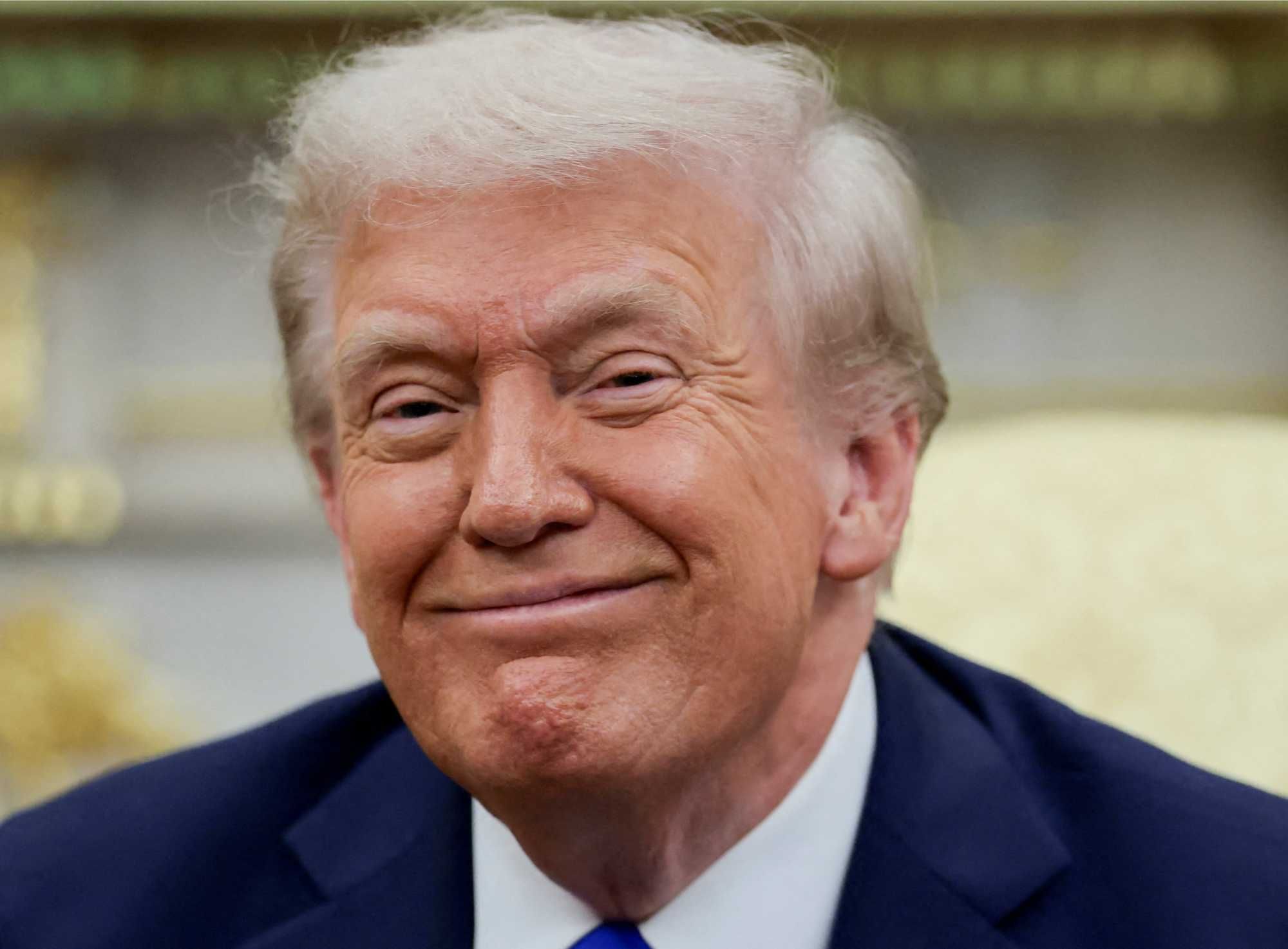
U.S. President Donald Trump reacts as he and Canada's Prime Minister Mark Carney (not pictured) meet in the Oval Office at the White House in Washington, D.C., U.S., October 7, 2025. REUTERS
Presidential historian Tim Naftali delivered terrifying news about President Donald Trump in the wake of his unconstitutional ban on certain news media organizations that he branded “fake news.”
Speaking to CNN anchor Kasie Hunt Saturday morning, Naftali was at a loss after watching a 2020 exchange between Trump and CBS ’60 Minutes’ anchor Leslie Stahl, wherein Trump did not deny labeling news as “fake” to undermine their brutally honest coverage of him.
“The media is fake, and frankly, if I didn't have social media, I'd have no way of getting out my voice,” Trump told Stahl.
“Do you know what you told me a long time ago? When I asked why you keep saying ‘fake media?’ Yeah, you said to me, ‘I say that because I need to discredit you so that when you say negative things about me, no one will believe you,’” Stahl recounted to his face.
Again, Trump did not deny what he’d told Stahl. “I don't have to discredit you,” he said instead.
“But that's what you told me,” Stahl insisted.
“You discredited yourself,” Trump said.
Tim, that speaks volumes about the president's thinking,” said Hunt, after the video.
“Listen to the president,” urged Naftali, “because the president reveals almost everything about how he understands the freedom of speech. He has revealed a lot in his comments recently. He's made it clear that he believes that he alone, not the Republican Party, not the executive branch writ large, but he alone can determine what's truthful and that the American people shouldn't hear.”
“That is beyond narcissistic,” said Naftali, blasting the president for daring to try to break First Amendment guardrails for the press. Even Richard Nixon — who despised the press — did not go so far, he said.
“Richard Nixon is his own tragic and troubled story. But one thing about Richard Nixon was that Nixon believed in the constitutional institutions of this country,” said Naftali. “… When push came to shove in the summer of 1974, and the supreme court said, Mr. President, you're going to have to reveal turn over the tapes as part of our legal system, the president thought about it. He wasn't happy at all, and he knew this meant the end of his presidency. But in the end, what did he do? He gave the tapes, as demanded by the Supreme Court.”
“So Nixon understood there were actual red lines. One of the reasons why he was so secretive was that he knew he was acting wrong. He had a sense of shame. He knew his enemies list was wrong. He knew you shouldn't use the IRS against journalists or anyone else. He knew that was wrong. He tried to do it secretly. He tried to go around,” Naftali argued. “We have a president now who doesn't seem to know right from wrong when it comes to our Constitution. He speaks as if he doesn't believe in the basic concepts that Richard Nixon understood were the American constitutional way.”