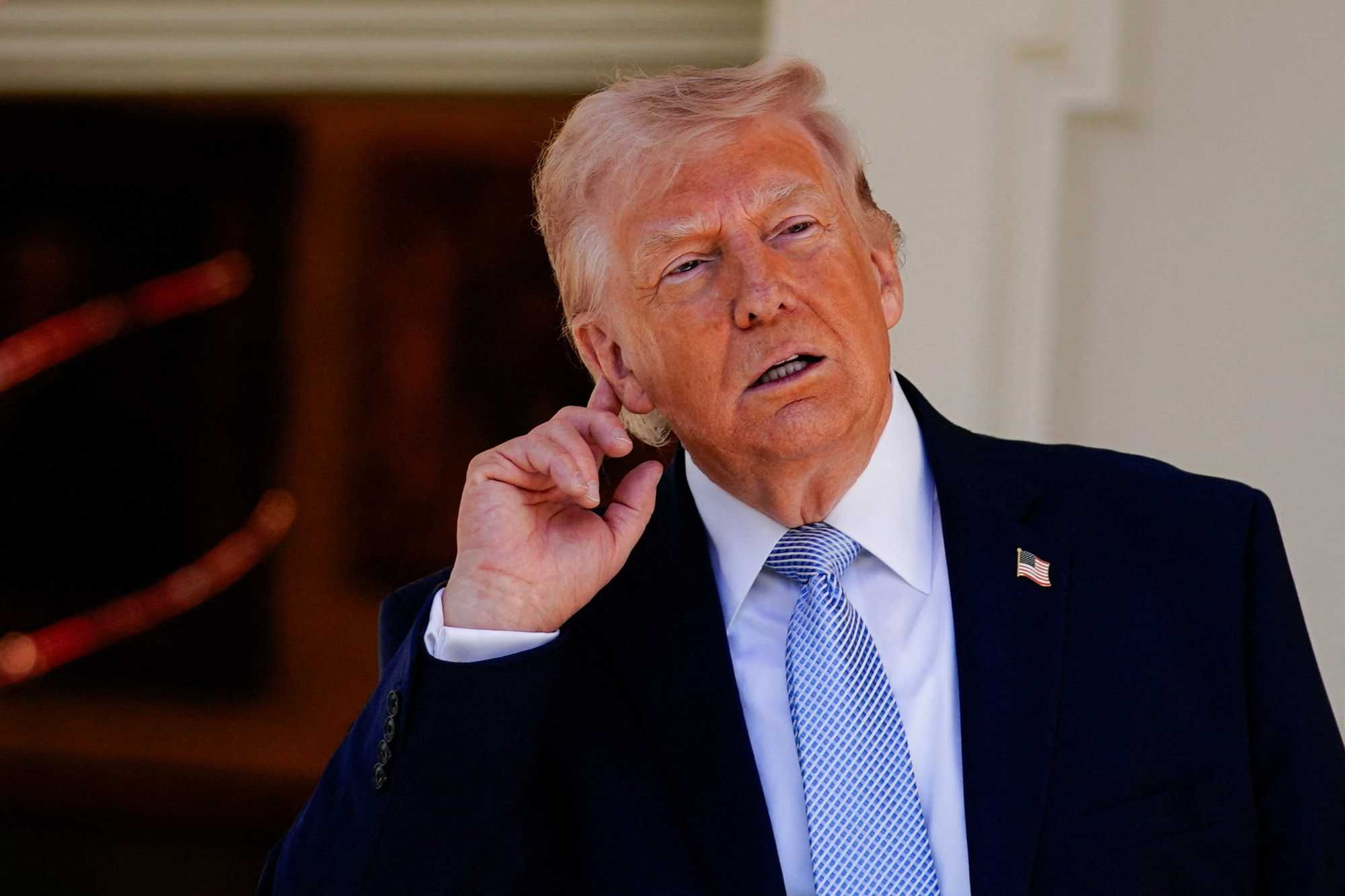
President Donald Trump gestures as he heads back to the Oval Office on the day of the 2026 White House Easter Egg Roll, in Washington, D.C., April 6, 2026. REUTERS/Nathan Howard
Just days after President Donald Trump doubled down on his AI advocacy by pushing to rename it “super intelligence,” CBS News released an alarming report detailing cybercriminals' use of artificial intelligence in ransomware attacks.
Trump’s push to rebrand AI is part of a broader effort to cast the rapidly evolving technology in a more favorable light. However, experts and lawmakers have repeatedly raised alarms about AI’s potential risks, citing serious security concerns for businesses, vulnerable individuals, and government agencies. CBS’ report appears to align with the latter.
The latest findings are from the 2026 Ransomware Risk Report by cybersecurity firm Semperis. The survey polled 1,200 IT and security professionals across nine countries and eight industry sectors, resulting in the discovery of just how susceptible victims are to such attacks.
The findings paint a grim picture that extends beyond the cyberattack and its aftermath. One-third of surveyed victims reported psychological or physical threats against employees, while 14% said employees or their family members were forced to change jobs, relocate offices, or move homes because of ransomware threats. More than half of those surveyed experienced more than one successful attack.
Chris Inglis, who served as White House National Cyber Director under former President Joe Biden, believes AI amplifies these types of attacks, expanding their reach and potential impact. "AI actually increases the capacity, scope, and scale of attackers in understanding what perhaps might be the weaknesses in your system or perhaps increases the sophistication of their approach to you if they're trying to get you to do something you shouldn't do, which gives them an advantage, lets them in," Inglis said in an interview about the report.
The attacks are not new, but AI seemingly allows easier access and makes it more difficult to convict or identify the perpetrators. Tomer Bar, Semperis’ associate vice president of security research, warns that AI could help ransomware developers create more sophisticated malicious code, accelerate development and complicate investigations. "We're starting to see more attacks with more rapid development, and attribution of these attacks will be more difficult for law enforcement," Bar says in the report.
Companies are the biggest targets, with some of their own internal AI systems working against them. Courtney Guss, Semperis’s associate vice president of crisis management, warns that autonomous AI agents can introduce security vulnerabilities and gain access to certain company information. "If your company is adopting AI agents, you should consider that at some point, those agents will try to compromise your identity systems — even if that action isn't meant to be malicious," Guss writes in the report.