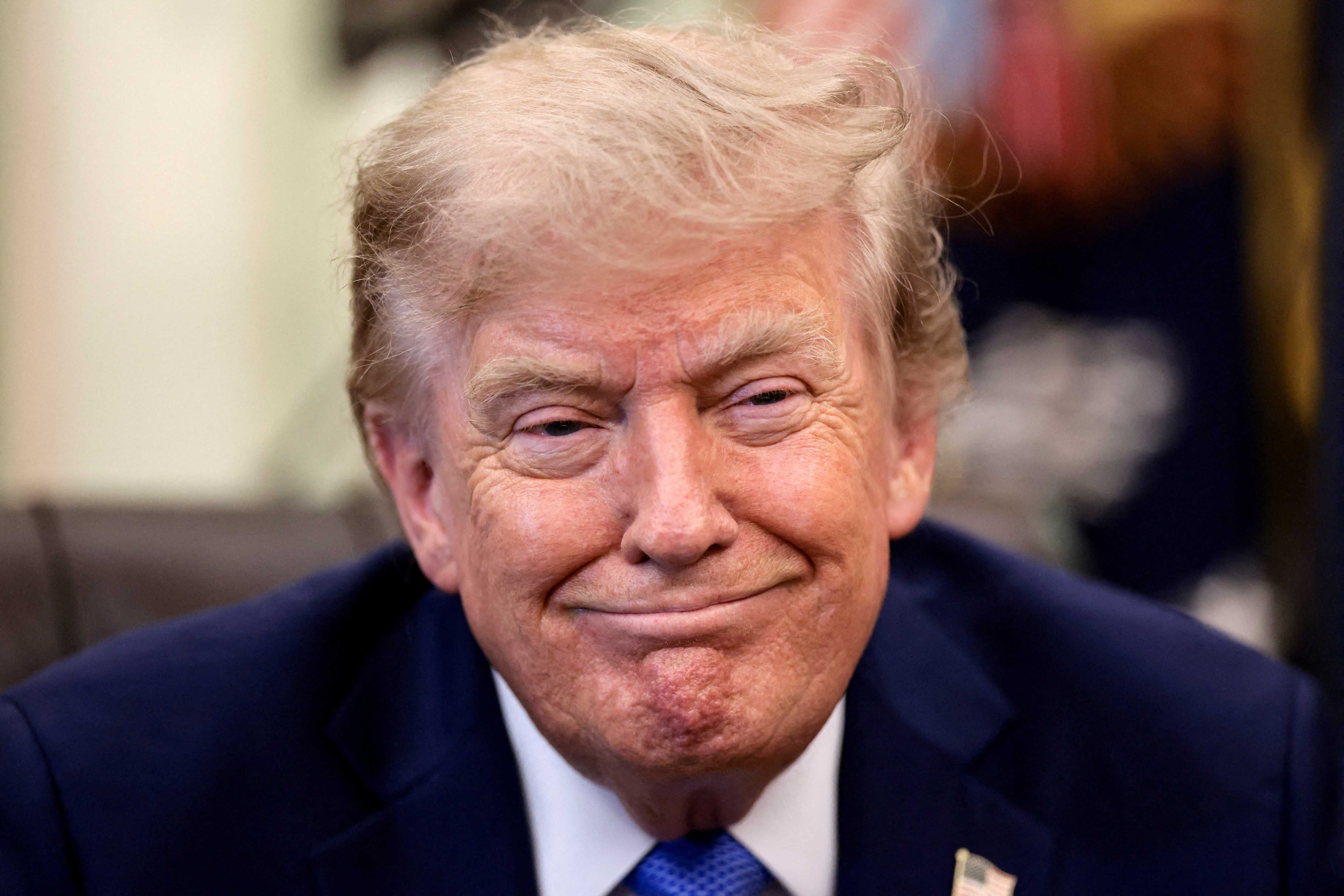
U.S. President Donald Trump reacts during an event to sign executive orders related to birthright citizenship and the polysilicon industry, in the Oval Office at the White House in Washington, D.C., U.S., August 6, 2026. REUTERS/Evelyn Hockstein
Each day seems to bring a new example of President Donald Trump’s lies and “presidential tantrums,” and according to Nobel Prize-winning economist Paul Krugman, one legal concept explains the damage his “bad faith” governance is doing to the United States.
“Lately Donald Trump has been raging against several of his own appointees,” writes Krugman. “He has publicly raged against the attorney for DC Jeanine Pirro, for admitting that the failure of the Reflecting Pool was due to shoddy work by Trump’s chosen contractors, and for dropping charges against David Hearn and supposed saboteurs. He has raged at RFK Jr. for not making a stronger case for the false link between vaccines and autism. And according to the Washington Post, Trump has privately raged at Pete Hegseth, the defense secretary, for misleading him about the state of U.S. munitions, which have been critically depleted by his failed war on Iran.”
Krugman asserts that while these incidents may seem to be a series of unrelated “presidential tantrums,” they are in fact part of the same story: “what happens when a government operates entirely in bad faith, never telling the truth about what it is doing or why. Inevitably, officials in such a government don’t merely lie to the public: they lie to each other too. As a result, they can’t govern effectively, even in the pursuit of evil.”
According to Krugman, “Legal scholars have a term of art, the ‘presumption of regularity,’ which means that one assumes that the government is generally honest when undertaking legal proceedings.” Therefore, if the Justice Department brings charges against someone, the historical presumption has been that there must be some basis for it. “In other words,” writes Krugman, “that they aren’t simply a vindictive prosecution of one of Trump’s perceived enemies. When DOJ succeeds in securing an indictment from a grand jury, the historical presumption has been that government lawyers secured that indictment honestly, presenting the grand jury with complete and accurate information.”
“Under Trump II,” Krugman continues, “this presumption is no longer reasonable — and the courts have begun to acknowledge this reality. In a number of recent cases judges have demanded information about what the government told a grand jury or dismissed charges because the government was clearly engaged in vindictive prosecution. At this point the Trump administration’s word is worth nothing, or less than nothing.”
Krugman notes that the same concept can be applied to a wide range of issues. After Trump’s initial wave of tariffs was deemed illegal, for example, he ginned up a new rationale “that literally nobody believes” — that targeted countries aren’t doing enough to combat slave labor. Trump slashes SNAP, saying it’s to stop fraud, when everyone knows it’s simply because he’s against the government helping put food on the table. His administration denies FEMA aid to blue states, delivering various reasons, then it’s revealed that Trump is punishing states that didn’t vote for him. According to Krugman, “It’s all being done in sneeringly bad faith.”
This cycle of lies, says Krugman, has led to mounting “disasters.” Trump’s war on Iran, for example, has been a disaster on many fronts: economically, militarily, diplomatically, strategically, and so on. “One obvious question,” writes Krugman, “is why Trump didn’t move much sooner to conserve interceptor missiles etc., either by calling off the whole war or at least by calling off actions that used up already depleted stockpiles of weapons like ATACMs.”
According to Krugman, “Most attempts to answer that question focus on deranged Trump syndrome — his pathological inability to admit failure, which has led him to double down even as he runs out of ammunition. But it now appears that a contributing factor may be that he didn’t know how bad things were, because Hegseth lied to him, telling him that the munitions problem had been ‘fixed.’” Hegseth, in turn, is blaming his deputy. Krugman suggests that his deputy may have lied to him, as the U.S military has undergone a “Putinization” in which “nobody wants to tell Hegseth things he doesn’t want to hear.”
“It’s liars all the way down,” Krugman declares. “This is an administration in which to serve is to abase yourself constantly, rendering fealty to Dear Leader, lying to your colleagues and lying to the American people. And if this administration doesn’t like the official government reports that are detailing the many disasters it has caused, it just quashes them.”
Krugman concludes on a grim note, warning, “Americans should be prepared for more chaos and mendacity, because we are governed by people who, just like Trump, are unwilling to acknowledge the truth. Unfortunately, things can get worse – and they probably will.”