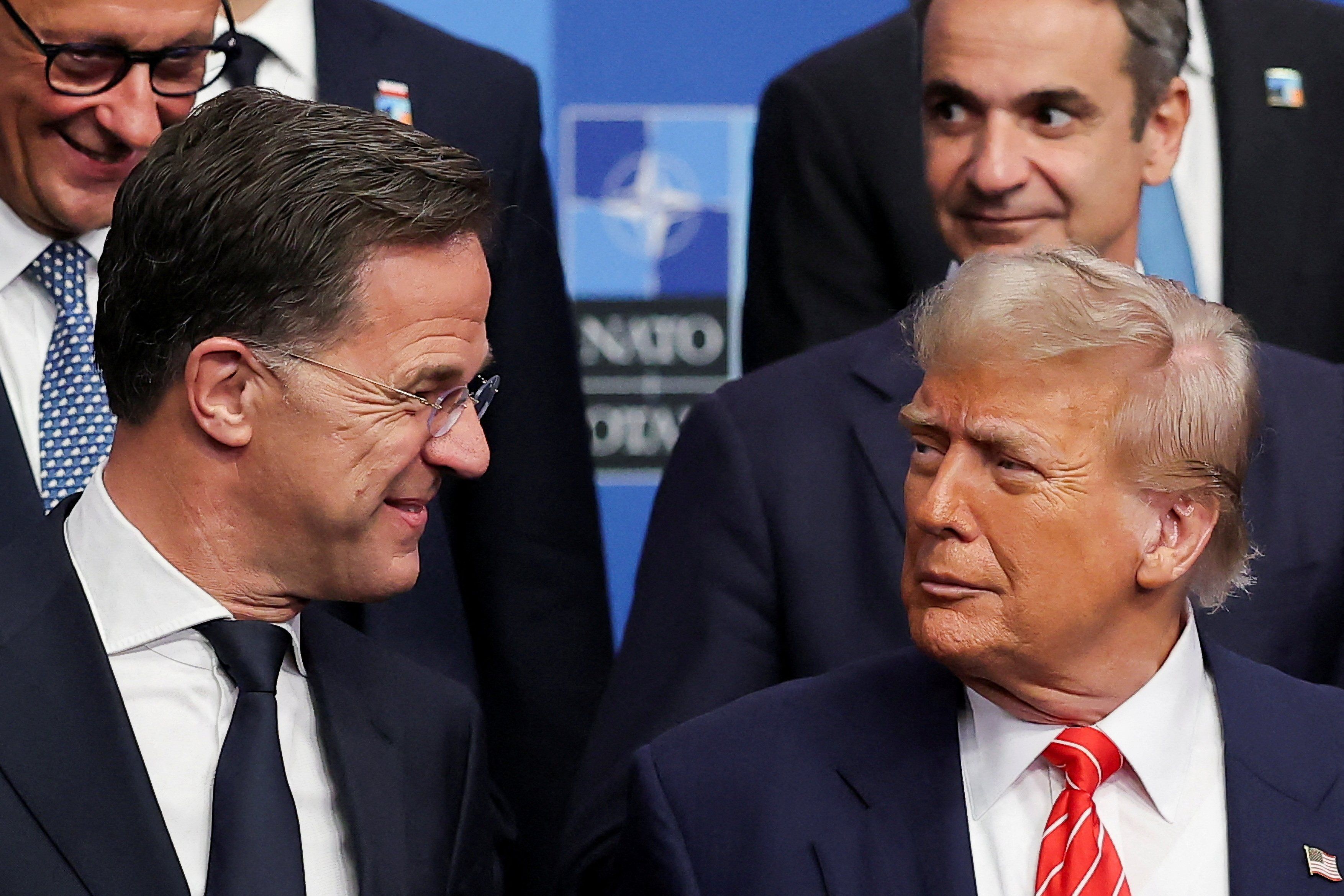
U.S. President Donald Trump, German Chancellor Friedrich Merz, NATO Secretary General Mark Rutte in The Hague, Netherlands June 25, 2025. REUTERS/Christian Hartmann/Pool/File Photo
President Donald Trump faces a post-presidential life of investigations, depositions and hearings. So writes Matt Ford in The New Republic, who claims that “the president has deeply underestimated his legal and political peril.”
Trump faces a future that he's seen before. His first term was followed by criminal prosecutions from the Manhattan district attorney’s office, indictments from special counsel Jack Smith, and challenges over the 2020 election results. But after his second term expires, he may also face legal peril from international courts for his actions in Venezuela and Iran.
Trump has signaled some awareness of his precarious perch. At a gathering of House Republicans at the Kennedy Center in January, he told the assembled, “You got to win the midterms, because if we don’t win the midterms, it’s just going to be—I mean, they’ll find a reason to impeach me,” Trump told the lawmakers. “I’ll get impeached.”
Yet impeachment may be the least of Trump’s worries. Ford argues that the nation’s political system must use “every tool possible to achieve a measure of justice. This will involve not only impeachment, but also civil lawsuits, professional sanctions, restrictive acts of Congress, and the enforcement of international law against Trump administration officials by long-standing American allies.”
This time around, though, the legal landscape Trump faces is much less favorable for prosecutors eager for revenge.
“During Trump’s first term, Justice Department guidelines forbade prosecutions of sitting presidents, delaying any potential proceedings until after his term ended," Ford writes. "This time, prosecutors will also have to contend with Trump v. United States. The Supreme Court’s landmark ruling on 'presidential immunity' in 2024 fundamentally changed the executive branch and how it operates within the American constitutional order.”
Chief Justice John Roberts’s opinion laid out the scope of presidential immunity in that ruling. Only if something is an unofficial act does immunity not apply. “And if a former president’s official acts are routinely subjected to scrutiny in criminal prosecutions, the independence of the Executive Branch may be significantly undermined," Ford notes.
To the court’s liberals, Ford writes, the dangers were obvious. Justice Sonia Sotomayor believed that it would now be impossible to prosecute a former president for assassinating his political rivals or taking bribes. “Even if these nightmare scenarios never play out, and I pray they never do, the damage has been done,” Sotomayor wrote in her dissent. “The relationship between the President and the people he serves has shifted irrevocably. In every use of official power, the President is now a king above the law.”
If American institutions fail to hold the Trump administration accountable, other countries might be able to fill the gap, Ford writes. “Because of alleged international law violations, the former president and his subordinates could also face heightened difficulties — and potential criminal charges — if they travel overseas in the future.”
The administration’s unlawful military strikes against alleged drug boats in the Caribbean and eastern Pacific have opened the door to criminal charges overseas, Ford notes. The wars against Iran and Venezuela could bring more such charges.
While the mechanisms of accountability are important, “the spirit that drives them is just as vital,” Ford concludes. "A jail cell may not await Trump. But after another four years of defiling the republic, there will be no post-presidential peace for him or his top associates.”