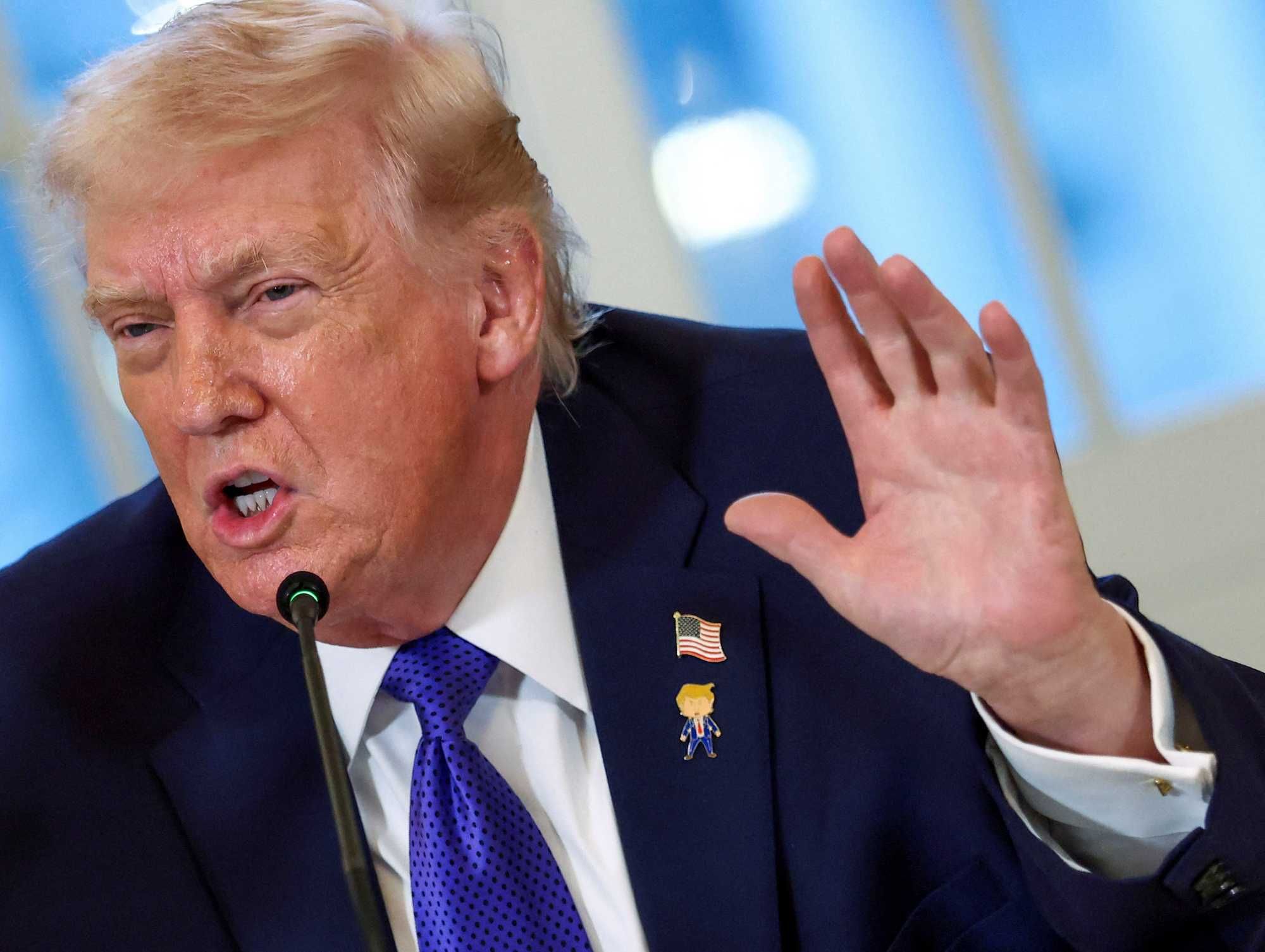
President Donald Trump speaks during a meeting at the White House in Washington, D.C., 2026. REUTERS/Kevin Lamarque
The administration of President Donald Trump has been successful in chilling the willingness of any firm to take on causes adverse to the administration.
That’s the opinion of Deborah Pearlstein, the director of Princeton University’s Law and Public Policy program. She expressed that view in an interview with Slate on the ramifications of the recent Department of Justice flip-flop on pursuing prior Trump executive orders aimed at several law firms and attorneys.
In those orders dating to last year, Trump targeted law firms and individuals that work with his opponents and causes he doesn’t support. The EO imposition of sanctions threatened to hamper legal business and deny access to federal buildings.
Four separate trial court judges ruled against the administration on the executive orders. But some law firms decided that litigating the matter wasn’t worth it, and offered up millions in pro-bono work to appease the administration.
The DOJ is still pursuing its defense of the executive orders after a brief flip-flop in which it indicated it was not going to appeal the trial court rulings.
No matter the outcome of that litigation, the underlying goal has already been realized, Pearlstein argues.
“The goal of chilling the willingness of any firm to take on causes adverse to the administration has been achieved, and then some,” Peralstein said, citing reporting and studies done so far.
“That’s one of the really important broader lessons in countering authoritarianism," Peralstein continued. "You need a whole toolbox full of tools, and litigation is an incredibly important tool for some purposes, but it doesn’t work for everything. It is entirely possible to win the litigation battle and lose the authoritarian war, and in this particular fight, that’s the direction we’re headed."
Pearlstein said the administration’s desire to enforce its executive orders is a “textbook authoritarian playbook for would-be authoritarians to try to attack any independent institutional source of power that might challenge the authoritarian’s ability to carry out his will. The same reason why the White House and the administration wanted to target major universities, media companies, and the same way they have worked to make deals with major industry that they care about.”
The fallout of the situation will impact such issues as the availability of representation to challenge administration initiatives, Pearlstein added.