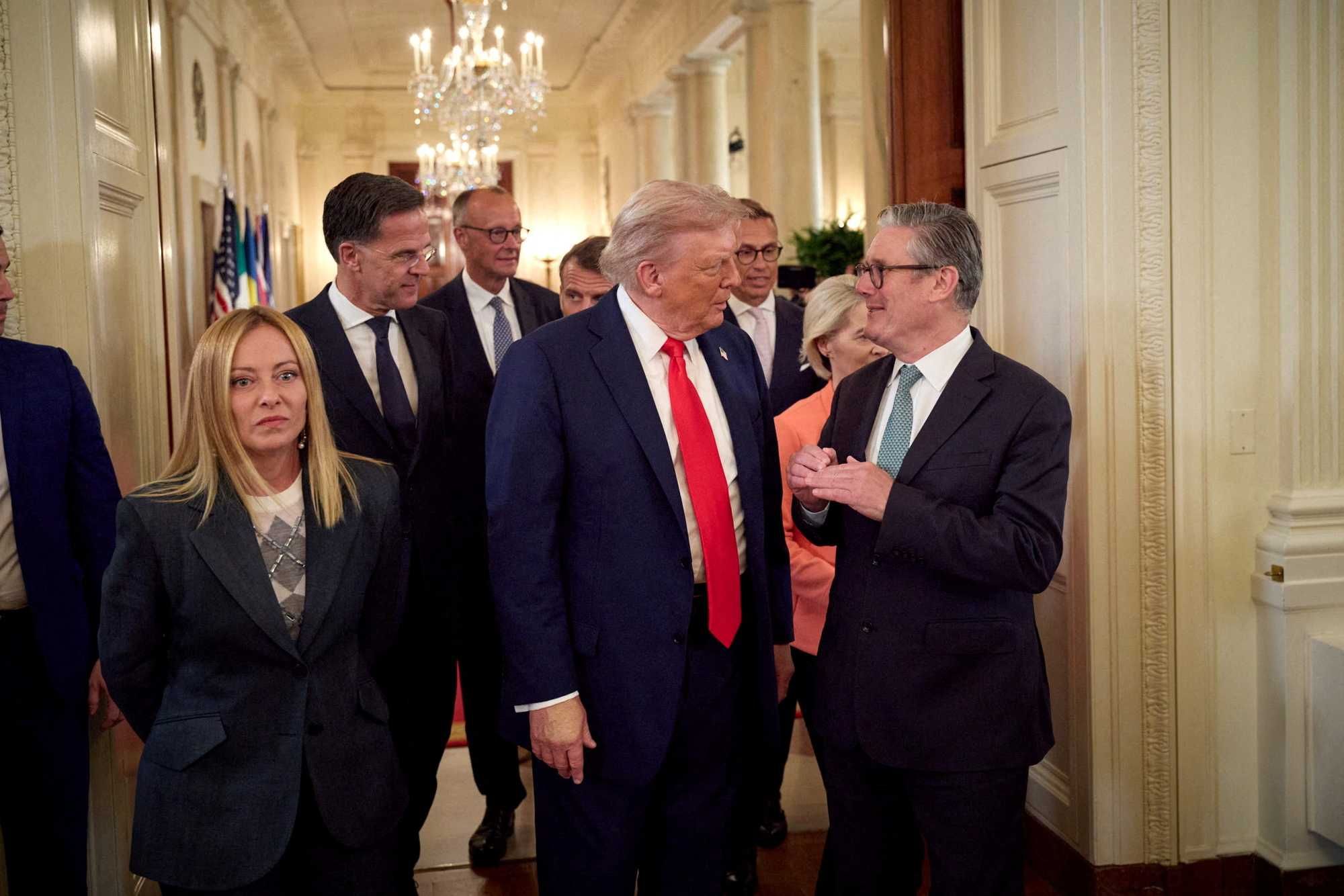
When U.S. President Donald Trump returned to the White House almost 14 months ago on January 20, 2025, his foreign policy was a major departure from that of his predecessor Joe Biden — who feared that Trump would withdraw the United States from the North Atlantic Treaty Organization (NATO) if he became president again.
Biden was an aggressive champion of NATO during his four years as president, applauding Sweden and Finland for deciding to join the alliance. Trump, in contrast, hasn't pulled the U.S. out of NATO as Biden feared but has much worse relations with longtime NATO members — from calling for Canada to become "the 51st state" to wanting to annex Greenland, a colony of founding NATO member Denmark.
In articles published by the conservative website The Bulwark on Tuesday morning, March 17, journalists William Kristol and Andrew Egger lament that Trump is burning bridges left and right and going out of his way to alienate longtime U.S. allies.
In his article, Never Trump conservative Bill Kristol argues, "One advantage the United States has had in our 21st Century competition with China is this: We have friends and allies, while China has customers and clients. Donald Trump has been doing his best to blunt that edge. Unfortunately, he seems to be succeeding. We're not in great shape with allied governments…. But it turns out we're not doing too well with their publics either, which suggests future governments of those nations may not be any more inclined to work with us."
The conservative journalist continues, "A (Politico) poll conducted last month in Canada, the United Kingdom, Germany, and France showed a startling degree of public alienation from the United States in those historic allies. By itself, that might not mean much. Some degree of anti-Americanism on the part of Europeans and Canadians has been around for a long time. But it's not just that they're unhappy with the United States. They're now inclined to prefer to cast their lot with our primary competitor than with us."
Kristol adds, "When asked, 'Is it better to depend on China, or on the U.S. under Donald Trump?,' China was the choice."
Kristol notes that the Politico poll was taken "before the Iran war," adding, "Presumably, the results would be worse today. And they could well get worse over the next three years."
Meanwhile, Egger, in his article, observes a pattern with Trump: angrily berating and insulting longtime U.S. allies, then complaining when they won't do exactly what he wants. The "Trump doctrine," according to Egger, treats friendship as a one-way street.
"Three days after Operation Epic Fury began," Egger explains, "Trump posted on Truth Social that he had ordered his government and his military to guarantee the safety of all maritime traffic in the strait…. Four days after that, Trump fired off a post against U.K. Prime Minister Keir Starmer, who was considering sending two aircraft carriers to support U.S. forces in the region. Trump, piqued Starmer hadn't sent them sooner, told him not to bother: 'That's OK, Prime Minister Starmer, we don't need them any longer—But we will remember,' he wrote. 'We don’t need people that join Wars after we've already won!' One week later — this past weekend — it seemed finally to occur to Trump that the United States could not keep the Strait (of Hormuz) open singlehandedly."
Egger adds, "He therefore turned on a dime and once more began threatening repercussions for countries that didn't send ships to help out, including America's (erstwhile?) European allies — and China…. Unsurprisingly, our (still, despite everything, we hope) allies weren't too impressed, and nobody is leaping to volunteer to lend a hand. 'This is not our war,' German Defense Minister Boris Pistorius said Monday."