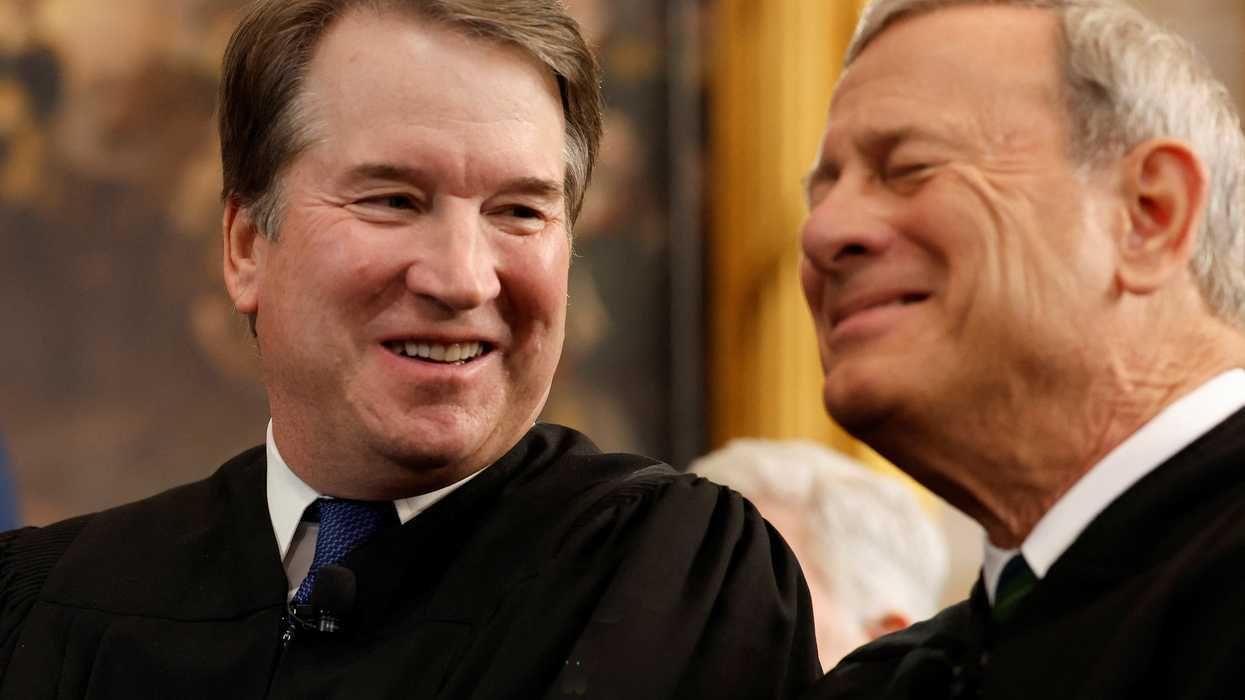
U.S. Supreme Court Justice John Roberts with Justice Brett Kavanaugh. Chip Somodevilla/Pool via REUTERS
Although President Donald Trump has had his share of victories with the U.S. Supreme Court, he has had some major disappointments as well. The Roberts Court struck down Trump's executive order calling for an end to birthright citizenship, which five of the justices upheld as protected by the U.S. Constitution's 14th Amendment. And the High Court ruled against Trump's ability to unilaterally impose tariffs by executive order without Congress' input.
Libertarian journalist Damon Root, in Reason, offers some reasons why Trump is, at times, striking out with a Supreme Court where conservative GOP appointees have a 6-3 supermajority.
"President Donald Trump seemingly did everything he could over the past year to push the U.S. Supreme Court into upholding his agenda," Root explains. "Trump lobbied the justices, bullied them with vituperative social media posts, and even took the unprecedented step of attending oral arguments in person as a sitting president. Yet none of it worked. When it came to the blockbuster cases that Trump repeatedly told us mattered the most to him — tariffs and birthright citizenship — Trump lost."
Root continues, "To understand why he lost, it's helpful to distinguish between the Roberts Court, named after John Roberts, the conservative chief justice who (often) commands it, and what we might call the Trump Court, named after the increasingly disgruntled president who, despite his best efforts, has never quite managed to remake the lofty judicial tribunal in his own MAGA image."
In the tariffs case, Root observes, Trump "wanted unilateral executive control over something that the Constitution simply does not place in the hands of the president."
"Once upon a time, when Joe Biden was president — or earlier, when Barack Obama was president — Republicans were vocally opposed to that sort of executive overreach," Root notes. "But then Trump came along, and most of the GOP abandoned its previous position or just kept quiet. The chief justice, however, did not abandon his previous position. To his credit, Roberts ruled against Trump's unilateral tariff scheme for the same legal reasons why he ruled against Biden's unilateral student debt cancellation scheme…. A similar thing happened in the birthright citizenship case."
Root adds, "At issue there was something that conservatives and Republicans claim to value: the original meaning of the U.S. Constitution. Yet Trump wanted the Supreme Court to adopt a legal theory that would have done a grave injustice to the text and history of the Constitution. Once again, however, and once again to his credit, the chief justice declined Trump's unconstitutional invitation. To be clear, the Roberts Court is a conservative Court, which also explains why plenty of other important cases came out in the Trump administration's favor, or came out in favor of legal causes that are associated with the broader conservative legal movement, such as gun rights."