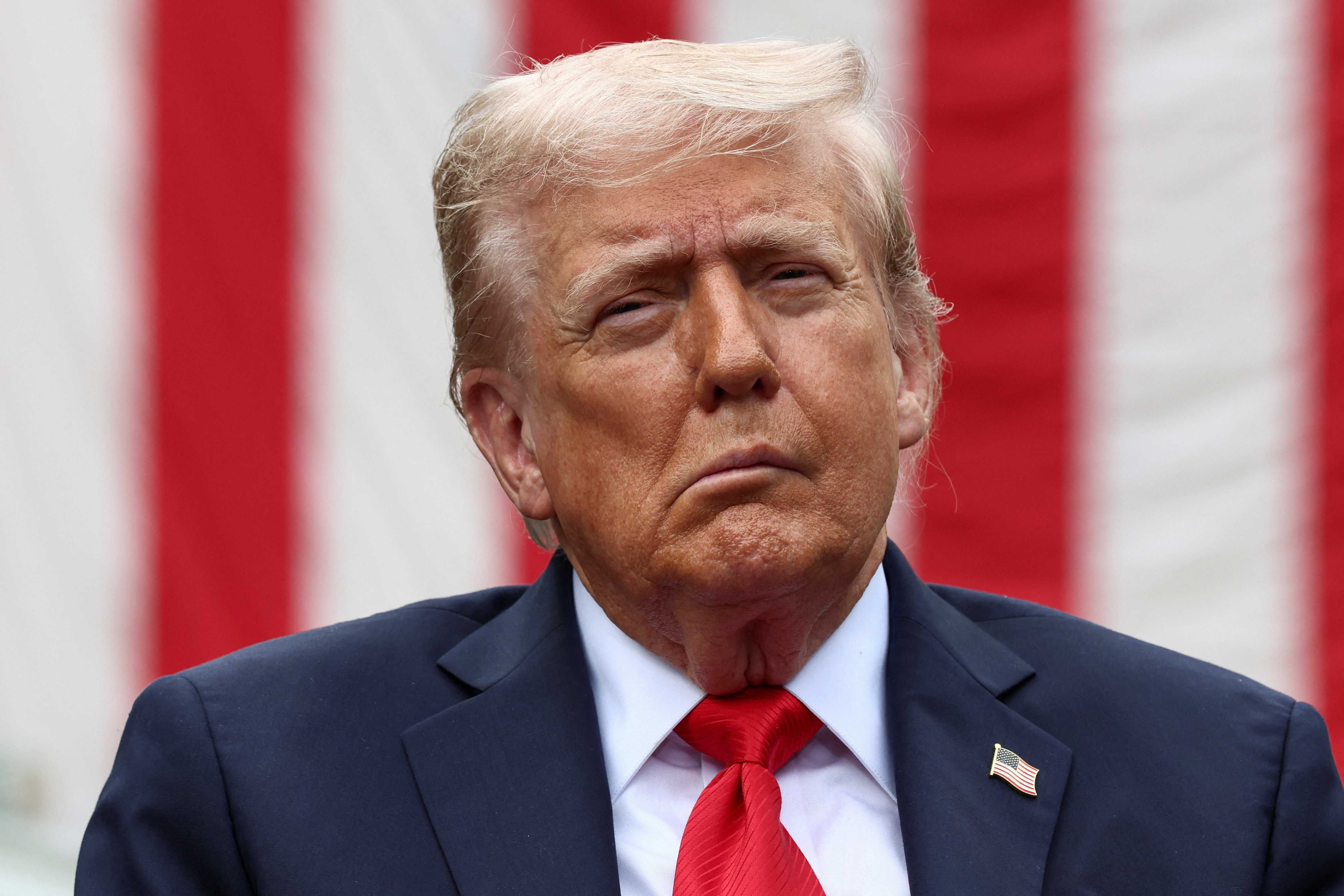
U.S. President Donald Trump attends a ceremony marking the 24th anniversary of the September 11, 2001, attacks on the United States at the Pentagon, in Washington D.C., U.S., September 11, 2025. REUTERS/Evelyn Hockstein
The editorial board at the staunchly conservative magazine The National Review has made a bold statement on President Donald Trump’s war with Iran, comparing the outcome to that of the Vietnam War — which was famously among the United States’ most terrible military debacles.
The Review’s comparison was inspired by a statement by Vietnam War-era State Department official John Negroponte, who, following Richard Nixon’s murderous 1972 Christmas bombing campaign, declared, “We bombed them into accepting our concessions.” In other words, regardless of all the bombs dropped, it was the U.S. that ended up yielding.
“A similar verdict,” asserted the Review, “seems appropriate for President Trump’s war on Iran.”
According to the outlet’s editors, “The memorandum of understanding that both parties are signing is lopsided in Iran’s favor. The main concession from the Iranians is reopening the Strait of Hormuz, but the commercial artery won’t be returning to the status quo ante. The memorandum says that Tehran will not charge fees ‘for 60 days,’ implying that Iran will begin extracting tolls thereafter. In exchange, the U.S. is lifting its blockade on Iranian ports and agreeing to let the Iranians sell oil, a source of revenue totaling tens of billions of dollars a year.”
And that’s just the beginning of the Review’s list of grievances toward the agreement. The editors decry that it will unfreeze Iranian assets to the tune of $24 billion, wondering “how many proverbial pallets will be needed to deliver this cash windfall to Iran” — a snarky reference to Trump’s 2015 campaign accusation that President Obama had sent “pallets of cash” to Iran as part of his nuclear deal. As the Review points out, Trump’s deal also floats the idea of lifting all sanctions and provides Iran with a $300 investment fund.
The editors also took issue with Trump’s handling of the nuclear question, explaining, “In a lamentable press availability at the G-7 summit, President Trump explicitly said Iran should be able to enrich at low levels. This, coupled with Trump’s consistently dismissive remarks about obtaining Iran’s nuclear ‘dust,’ suggests that Iran won’t give up enrichment or hand over its uranium, both of which have long been considered key benchmarks for setting back Iran’s program.”
“Meanwhile,” notes the Review, “there is no reference to Iran’s missiles, even though ending Iran’s missile threat was originally one of the U.S. war aims. At his presser, Trump pooh-poohed constraining Iran’s missile arsenal, arguing — incredibly enough — that any individual missile strike only causes limited damage. There’s similarly no direct mention of Iran’s support for regional proxies; that Obama’s JCPOA didn’t address this, either, was supposed to be one of the main criticisms of it. Finally, the memorandum says the conflict will also end in Lebanon, an Iranian ploy to protect Hezbollah and drive a wedge between the U.S. and Israel.”
These poor outcomes, assert the editors, arose because Trump’s “conception of the war was beset by a lack of realism and reckless optimism.” He overestimated what the death of the previous Ayatollah Khamenei would mean for the conflict, and didn’t take expert warnings about the risks regarding Hormuz seriously. He also failed to obtain congressional authorization, and “did almost nothing to make the public case for it beforehand. Thus, there was no reservoir of political support to fall back on when things didn’t go as he had hoped. His seat-of-pants governance and executive high-handedness bear much responsibility for the unsatisfactory outcome.”
In the end, “the Iranian regime is living to fight another day with greater control over the strait and significant financial relief.” What’s more, “Trump has dropped all talk of the Iranian people taking back their country, when his assurances that ‘help is on its way’ during last year’s street protests helped create the predicate for Operation Epic Fury.”
The Review’s conclusion is anything but positive. As the editors note, “Trump has said in the past that Iran has never won a war, yet never lost a negotiation. As the president and his administration now make the case for a memorandum of understanding that doesn’t meet any U.S. strategic objective, it’s impossible to say he was wrong.”