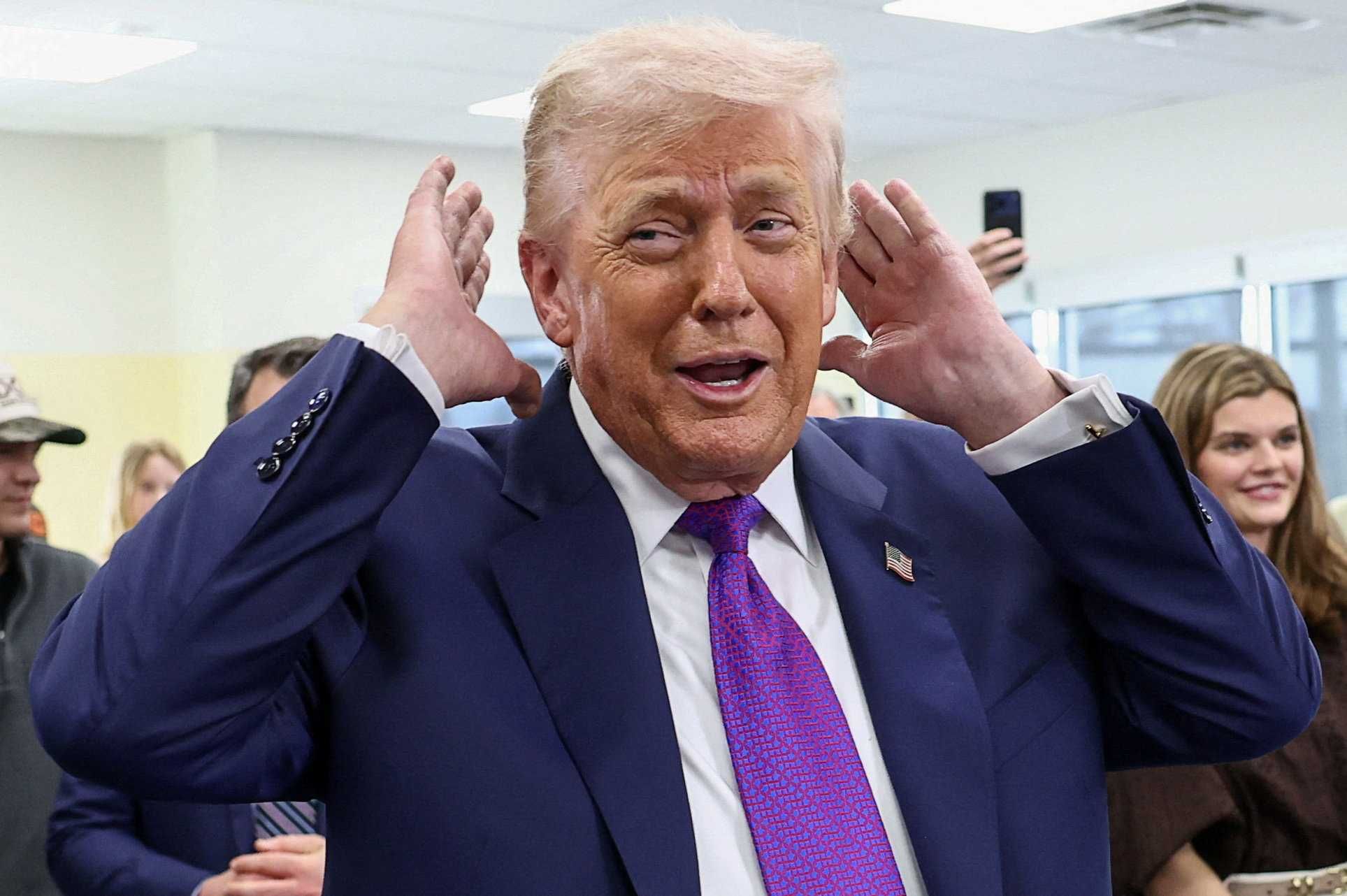
U.S. President Donald Trump checks his hair before sitting down for a podcast interview at the Varsity restaurant, in Rome, Georgia, U.S., February 19, 2026. REUTERS Kevin Lamarque
According to White House insiders, the “uncertainty and incompetence” of President Donald Trump’s administration is on full display as he becomes increasingly desperate for ideas on how to end his war with Iran. New reporting from Politico has revealed the administration’s internal turmoil as it struggles to extract itself from the Middle East in a situation “reminiscent of the darkest days of the Iraq war.”
“The moment is extremely dangerous,” said Elliott Abrams, a longtime Middle East hawk who worked for Trump in his first term. “And the Trump administration is showing uncertainty and incompetence.”
He isn’t alone in this assertion. According to insiders, writes Politico, “Trump is further damaging America’s reputation by constantly vacillating about what to do in Iran and by fraying U.S. alliances with countries that could help.” Officials who spoke with Politico on the condition of anonymity have made it clear that there is “a sense of despair” in the White House. As one said, “I don’t see a way out of this,” arguing that Trump “fundamentally misunderstands” Iran’s rulers. According to the official, Trump and his aides “have always felt like they can just keep applying pain and Iran will crumble, but the regime is not going to crumble.”
Politico reports that ideas for how to move forward fall into three camps, “all of which seem grounded more in hope than reality.”
One camp is comprised of hawks who advocate for a maximalist military approach, whether that means seizing key islands, expanding bombing missions, or taking other action. They argue “that it’s better to leave Iran as a failed state, even if it falls into civil war, than to leave the regime in charge.” But according to Politico, “Let’s put aside the morality of pushing a country into chaos. There’s no guarantee that more military measures will lead the Islamic Republic to fall. The regime is embedded throughout Iran in ways that the personalist dictatorship of Saddam Hussein in Iraq never was.”
Another camp is made of those who advocate restraint. They want de-escalation regardless of what the U.S. has to give up to achieve it, and argue that a deal should be struck even if it means offering major concessions. And if a deal isn’t possible, they assert that the U.S. should just “cut our losses.” But as Politico warns, “The danger is that this could lead to the emboldened Iran the hawks fear — one even more likely to partner with China and Russia and sow terror that ultimately could reach America.”
The third camp falls in the middle, arguing for “the U.S. to maintain its blockade on Iranian sea traffic. The hope is that such a move, along with existing and new sanctions, will grind down Iran’s economy until the regime gives into U.S. demands or is ousted by its own citizens.” But according to Politico, “Iran’s breaking point may be more difficult to calculate than many in this group think. As the U.S. official familiar with the administration’s Middle East strategy noted, with more than a little frustration: ‘The U.S. government has always, going back decades, assessed that Iran’s economy is on the brink of collapse.’”
“The echoes of Iraq make the situation in Iran even more maddening to foreign policy practitioners,” writes Politico. “Once again, the U.S. is dealing with a bitter Middle Eastern adversary; the fear of weapons of mass destruction; a U.S. president willing to take astonishing risks; and an administration that didn’t think far enough ahead.”
“Like Iraq,” said Suzanne Maloney, an Iran analyst with the Brookings Institution in Washington, “this is a predicament of our own making and one that should have been anticipated and that could have been mitigated with better informed planning.”
Politico is not optimistic about Trump’s chances of ending the war, concluding, “It may require a new U.S. president for Washington to come to terms with Tehran. Iran analysts, some of whom are in touch with regime officials, tell me that Tehran appears to believe that Trump isn’t interested in a serious peace pact and can’t be trusted to uphold one anyway. Whoever succeeds Trump, then, will have an extraordinary mess on their hands, but also an extraordinary opportunity to show global leadership.”