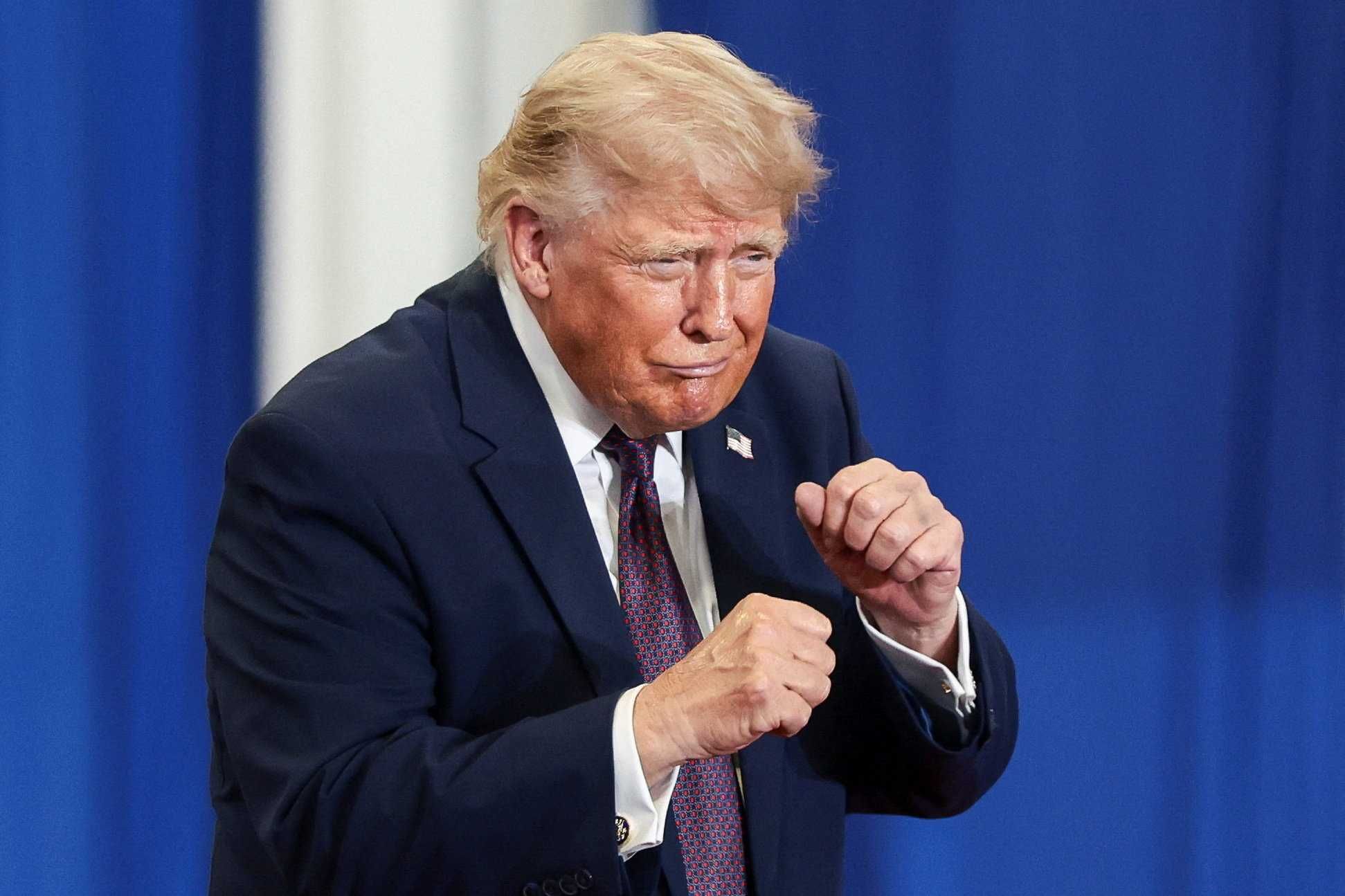
U.S. President Donald Trump gestures as he delivers remarks during a visit to a Mack Trucks' assembly plant, in Macungie, Pennsylvania, U.S., June 23, 2026. REUTERS/Evelyn Hockstein
As President Donald Trump’s war with Iran creeps into its sixth month, it’s become clear not only that the United States has lost and Iran has been empowered, but that “the American Age in the Persian Gulf is over.”
This is according to distinguished war historian and security scholar Phillips P. O’Brien, who wrote on Thursday how since the end of World War II, "the USA has become the dominant outside security player in the region. It overthrew governments, it made massive military sales … it established military bases and it also fought shorter wars (First Gulf War) and decades-long wars (War on Terror/Afghanistan) to impose its influence. The USA even had one of its most important, if less well-known, foreign policy doctrines aimed precisely at the region: the Carter Doctrine. Announced in the State of the Union address in 1980, the Carter Doctrine made it American policy to resist any other power interfering with trade into and out of the Persian Gulf and stated that the USA would use military force to keep the Gulf open.”
With all this in mind, writes O’Brien, “It is ironic, then, that the USA, in using military force, caused another power to close the Gulf and led to the demise of its own doctrine. For the states of the region, this is also a transformational development that will (or at least should) lead to massive changes in their security architecture. For many decades … they based their security on making vast and expensive purchases of military equipment from the USA, housing US military forces, and acting as US allies. That entire paradigm is gone.”
According to O’Brien, a key factor in this shift has involved the fact that, as reported earlier this week, the U.S. has burned through nearly all of its long-range precision missiles over the course of the war. As a result, “the USA cannot protect its forces against Iranian strike, as cheap and less advanced as that strike is compared to American capabilities. The upshot of this weakness (and indicative of why the U.S. is running out of anti-air systems) is that the USA is already pulling its forces out of the Persian Gulf — in some cases precipitously.”
He cites a new Wall Street Journal story on how this new dynamic is impacting Kuwait. As O’Brien explains, “The U.S. has made Kuwait a major base for its influence in the region since the First Gulf War in 1991, but the results of Trump’s War (if you remember the first mass casualty hit by the Iranians was on a U.S. facility in Kuwait) has caused the U.S. to pull many of its forces out of the country already. Trying to sugarcoat the pull, the WSJ says the USA is ‘rethinking’ its defensive posture in the region, but the truth is that it has been forced to pull out precipitously because it cannot protect its forces and it is struggling to protect the Kuwaitis. This recent report comes after months of reports of withdrawals from other facilities — leaving many U.S. bases in the Gulf supposedly empty.”
Now states in the region see that the U.S. can protect neither its own troops nor the Gulf states, and it’s making them realize that American partnership may actually be a “strategic liability.” Because of all this, writes O’Brien, “The entire security architecture that was constructed by the states in the Persian Gulf and wider Middle East will have to be entirely remade. There are signs that they already know that. The US is showing its weakness so dramatically and in adding to that its unreliability and fickleness, is compelling the states to think more regionally.” He notes examples like Saudi Arabia and Jordan, which are beginning to reconsider their U.S. relations.
“We need to be honest about what we have seen here,” O’Brien concludes. “The U.S. is already running out of weapons, it is already pulling forces back, it is already discrediting itself. The states in the region are only acting rationally in looking at a very different future, one that relies as little as possible on the whims of a declining and fickle USA.”