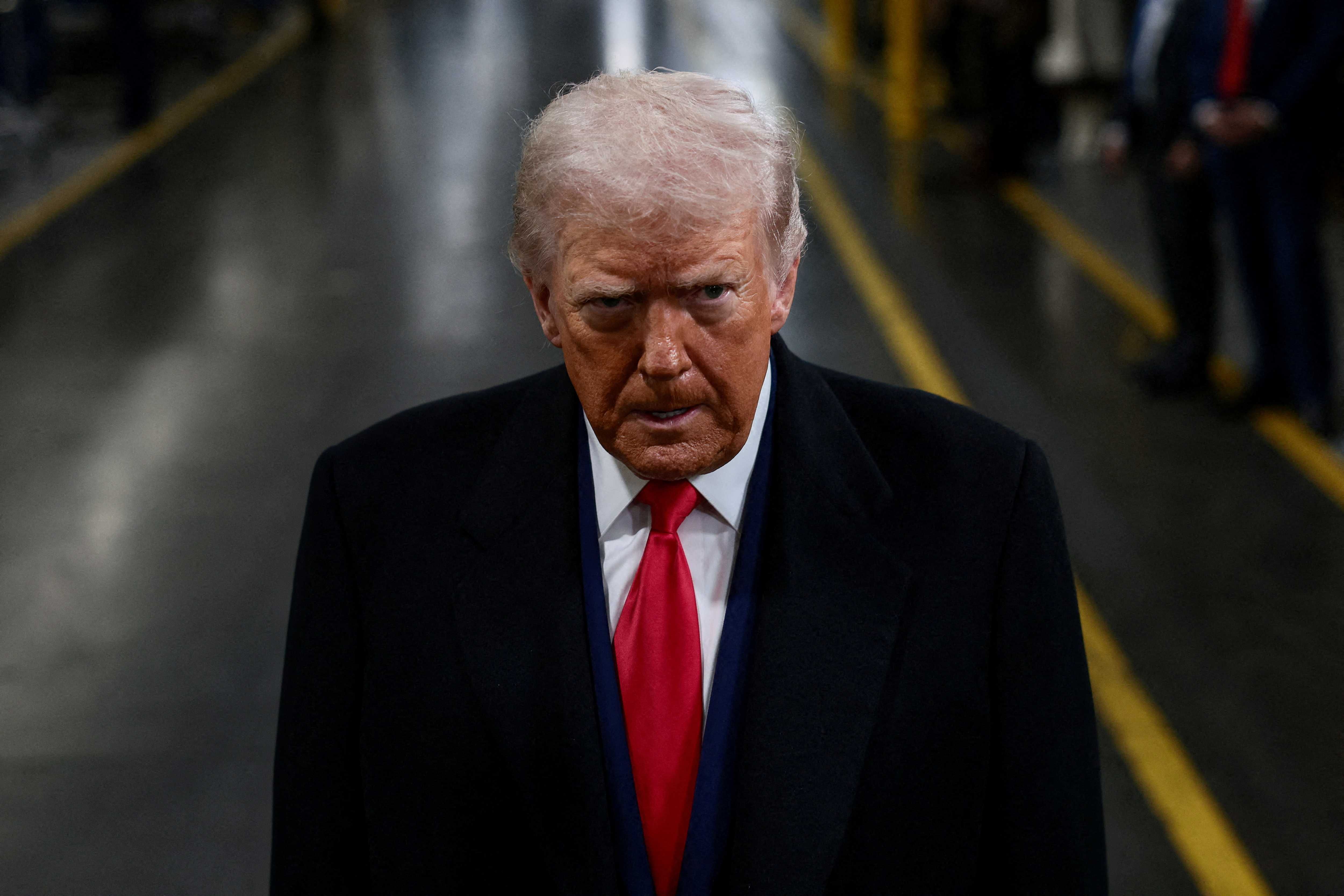
U.S. President Donald Trump in Dearborn, Michigan, January 13, 2026. REUTERS/Evelyn Hockstein
On Monday, President Donald Trump made an announcement that Wall Street Journal National Security Reporter Alex Ward says amounts to a declaration of “forever war.”
Trump’s proclamation came via Truth Social, where he posted, “The Hormuz Strait is OPEN, and will remain OPEN, with or without Iran. We are reinstating the THE IRANIAN BLOCKADE, so named because it is only stopping Iran’s ships or customers from entering or leaving. All other countries will have fair and open use of the Strait. The U.S.A. will be, from this point forward, known as ‘THE GUARDIAN OF THE HORMUZ STRAIT,’ but as such, and as a matter of FAIRNESS, will be reimbursed, at the rate of 20 percent on all cargo shipped, for any and all costs necessary to do the job of providing safety and security to this very volatile section of the World. The process and formation will begin immediately.”
This post followed a Fox News interview in which Trump suggested that the U.S. will “keep” Hormuz, and that “we’ll probably run it.”
The president’s claims come amidst the breakdown of the tenuous ceasefire between the U.S. and Iran, which have been exchanging strikes with increasing frequency, culminating in the total collapse of the MOU last week and the reclosure of the strait. The reopening of Hormuz has become the key goal of the war, which was the only reason it closed in the first place. Prior to Trump’s decision to start the conflict in February, passage through the strait was safe and free, making it one of the world’s most essential trade waterways, particularly for oil.
Trump’s suggestion that the U.S. will charge passage through the strait flies in the face of not only international precedent but the claims of his own administration. In June, for example, Secretary of State Marco Rubio declared, "No country is allowed to charge tolls or fees on an international waterway."
To that end, Trump’s claim that the U.S. will “keep” the strait not only implies a looming international fight over the matter, but places the country in a position that would mean defending the waterway on a continual basis against a hostile adversary that has already proven formidable — Iran — hence Ward’s suggestion that this scenario amounts to “forever war.’
This isn’t the first time since the war began that Trump has said he would use American military might to force open Hormuz. In May, he announced “Operation Freedom,” in which the U.S. Navy would guide ships through the passage, only to abandon the scheme in less than 48 hours when international support for it failed to materialize. For Trump to attempt such a plan again without major support from global partners would demand an extensive and ongoing military effort on the part of America.
Concerns that the war could turn into a “quagmire” from which the U.S. would be unable to extract itself have persisted since the conflict's earliest days, with many experts arguing that it could turn into another Iraq or Vietnam. In May, responding to the specter of past intractable wars, Trump listed off several of America’s most notoriously protracted conflicts, mentioning famously long engagements in Vietnam, Korea, Iraq, and Europe, and shrugging off his ongoing fight with Iran by saying, “We’re in it for what? Six weeks?”
Now, nearly three months on, talk of “forever war” has returned. According to Tommy Vietor, former National Security Council staffer for Barack Obama, this is a “totally predictable outcome of starting yet another regime change war in the Middle East.”