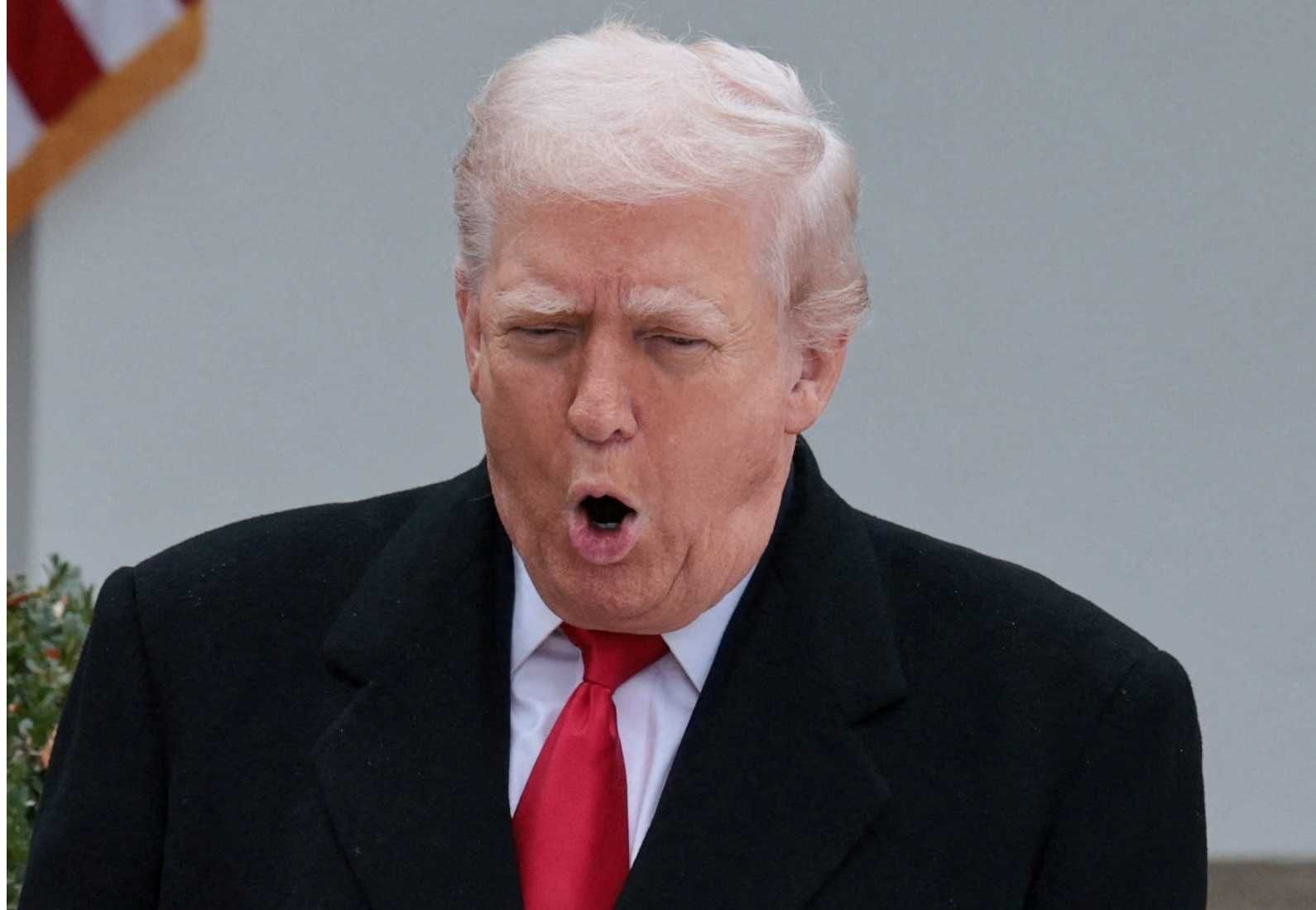
U.S. President Donald Trump speaks during the annual Thanksgiving turkey pardoning ceremony in the Rose Garden at the White House in Washington, D.C., U.S., November 25, 2025. REUTERS Nathan Howard
As the war with Iran moves into its third month, President Donald Trump is increasingly desperate for the “magic formula” that will deliver victory, but according to Iran expert Steven Erlanger, he can’t win because he “doesn’t understand” the situation in the first place. Not only was he misinformed about what the conflict would entail, but he is ignorant of the psychology of the Iranian regime.
Writing for the New York Times, Erlanger details Trump’s efforts so far, from the airstrikes against Iranian nuclear facilities last June, to the initial attempt at regime change in February, to the blockade of Hormuz he hopes will reopen that very strait.
“But,” says Erlanger, “Mr. Trump’s conviction that these tactics will bring about Iran’s capitulation is deeply flawed, officials and analysts say. They say it is a misreading of the Islamic Republic’s strategy, psychology and capability for adaptation. The Iranian government believes that it has the upper hand for now, and that it can withstand economic pressure, as it has in the past, longer than Mr. Trump can tolerate rising energy prices brought about by the halting of traffic through the strait.”
Said Ali Vaez, Iran project director for the International Crisis Group, “At every point when pressure has not delivered the intended result, he’s sought a new tool of coercion which he believed would magically conjure victory. He always believes he’s one little turn of the screw away. Trump doesn’t understand that no matter the pressure, so long as you don’t give them a face-saving way out and a mutually beneficial agreement — not capitulation or surrender — you won’t get a deal.”
This is because Trump misunderstands Iranian history and what has allowed the regime to remain so durable.
According to Suzanne Maloney, an Iran specialist and director of the foreign policy program at the Brookings Institution, the U.S. “can certainly do more damage to the Iranian economy, but they have withstood more pressure than any other economy in history, and that hasn’t produced the collapse of the regime or more reasonable positions.”
To a large degree, this is because Iran is an authoritarian state where the public lives under severe repression. There is therefore no electoral or otherwise internal political pressure to make a compromise. Trump, on the other hand, presides over a liberalized society where his party faces major losses in the coming midterms.
What’s more, explained Sanam Vakil, director of the Middle East and North Africa program at Chatham House, the American and Iranian negotiators “have culturally very different approaches to deal-making and they talk past each other. I think President Trump doesn’t really understand what drives the Iranians. They don’t make decisions based on their GDP, because if so, they would have done a deal years ago.”
In fact, in the face of an overtly hostile enemy, the regime’s usual tactic involves doubling down and upping the tension, if only to instill the Iranian people with a sense of its unshakeable strength and authority. This is why previous American administrations have found greater success at negotiating by applying gradual, long-term pressure rather than leaping directly to war.
“In the past,” writes Erlanger, “strong American and international sanctions on Iran’s economy and oil industry did eventually bring it to negotiate. Years of talks did finally lead to the 2015 Iran nuclear deal, when Iran agreed to strict limits on its nuclear enrichment program for more than a decade in return for the lifting of most of those harsh economic sanctions. Iran kept to the deal. But Mr. Trump, in his first term, abandoned it in 2018 and reimposed severe economic sanctions in a policy called ‘maximum pressure,’ to force Iran to negotiate a more restrictive agreement. Despite severe economic hardship and Iran’s decision to sharply reduce its oil output, there was no new nuclear deal.”
Now even amidst the war, Erlanger says that “quiet talks with the Americans continue as the regime sees this moment of impasse as a chance to solve its longstanding conflict with the United States. But that is different than caving under coercion.”
According to Vaez, Iran wants to make a deal, but the regime has concluded that to surrender under pressure now means further capitulations in the future. It therefore wants to retain control of the strait as an ongoing bargaining chip, as it sees no reason to believe anything Trump has offered. As Vaez explained, “They don’t want to survive the hot war to freeze in a cold peace.”