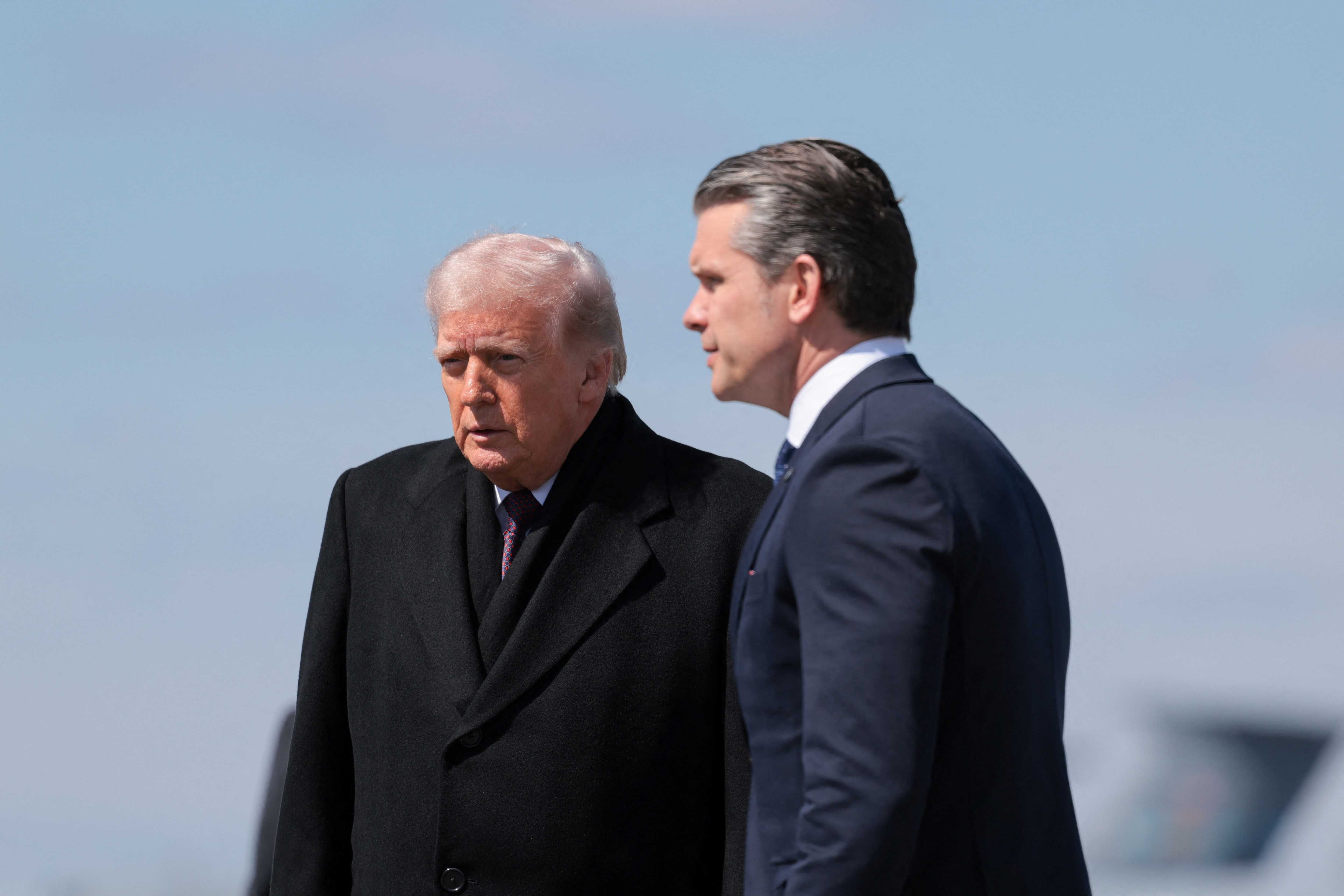
U.S. President Donald Trump and Secretary of Defense Pete Hegseth arrive at Dover Air Force Base in Dover, Delaware, U.S., March 18, 2026. REUTERS/Kylie Cooper
As President Donald Trump’s war on Iran moves into its second month, former White House and Department of Defense official Ilan Goldenberg is worried that “a short war now seems unlikely…Instead, we may be staring at something far worse: A war with no clear endpoint.”
Post on X, Goldenberg — who has worked on war game scenarios specifically involving Iran — expressed a series of growing concerns about the conduct of the war and its global consequences, writing, “This war has the potential to go nowhere good and to do far more damage than anyone anticipated. It could reshape the Middle East in deeply negative ways, damage the global economy and further erode America’s standing in the world.”
According to Goldenberg, the Trump Administration’s 15-point peace plan submitted to the Iranian government is doomed to fail as it is “not a serious diplomatic framework.” It overreaches in its demands, requiring concessions to which the Iranian regime would never agree, which “suggests either a profound overestimation of U.S. leverage, a refusal to accept reality, or a basic inability to conduct effective diplomacy.” At the same time, Iran is also making major demands, which signals they “do not feel pressure to end the war.”
Goldenberg points out that some in the White House have suggested striking key Iranian oil infrastructure to force Iran into submission, but “that theory feels deeply unrealistic. If anything, it is more likely to cause Iran to double down and escalate its attacks on energy infrastructure.” Now with ground invasion seemingly imminent, he worries that the spiraling war will have severe consequences for the world.
Some of these concerns are economic. Goldenberg has worked on war games that explore the closure of Hormuz, and the outcome is not good: “Scenarios in which the Strait of Hormuz stayed shut for 4-10 weeks, estimated prices would rise to $185 to $200 per barrel. We are at around $115, but it feels to me like markets are still underreacting and waiting for a near end that isn’t coming. We may not have even scratched the surface of the economic consequences of this war.”
On top of that, Goldenberg is concerned about how the situation will impact different nations and peoples. The Gulf states, for example, have spent years working to build regional stability, but “if these countries face sustained missile attacks for six months or more, does that model survive? Do investors stay? Does that future still feel possible?”
And for the Iranian people, he argues that the war has only resulted in a regime that is “more hardline, more militarized, more isolated…a much larger, more dangerous version of North Korea,” with “90 million people increasingly cut off, impoverished and repressed.”
At the same time, Lebanon is poised to “become the next major front,” with the Israeli Defense Minister “openly talking about turning southern Lebanon into the next Gaza,” “the human consequences could be catastrophic.”
And speaking of Gaza, Goldenberg worries about what the conflict means for Palestinians too, questioning, “Have you heard much about it in the past month? Aid is down. Reconstruction has not begun. Plans for the post-conflict are stalled. As attention shifts to Iran, Gaza is fading from view — but conditions on the ground are not improving.”
At the same time, war is breeding extremism in Israel, driving a notable increase in settler violence toward Palestinians. According to Goldenberg, “The Israeli government is not just failing to stop this — it is complicit.”
For the U.S., Goldenberg forecasts this could be an historic disaster, writing, “How many wars of choice can we undertake before the world loses faith in the system we helped build after World War II? That system — imperfect as it is — has always been underwritten by American military power. But it was also anchored by American leadership, alliances and a commitment to stability and rules. Each unnecessary war erodes that foundation. At some point, the damage becomes irreversible.”
He says the solution involves the “end military operations in exchange for a limited, realistic set of conditions: Constraints on Iran’s nuclear program, an end to attacks on its neighbors, and no interference in shipping through the Strait of Hormuz.” In exchange for this, the U.S. would end operations and restrain Israel.
But based on the White House’s actions so far, Goldenberg has little faith in that outcome.
“The United States does not appear to have a realistic strategy,” he surmises, “and the Trump Administration seems to misunderstand the position it is in.”