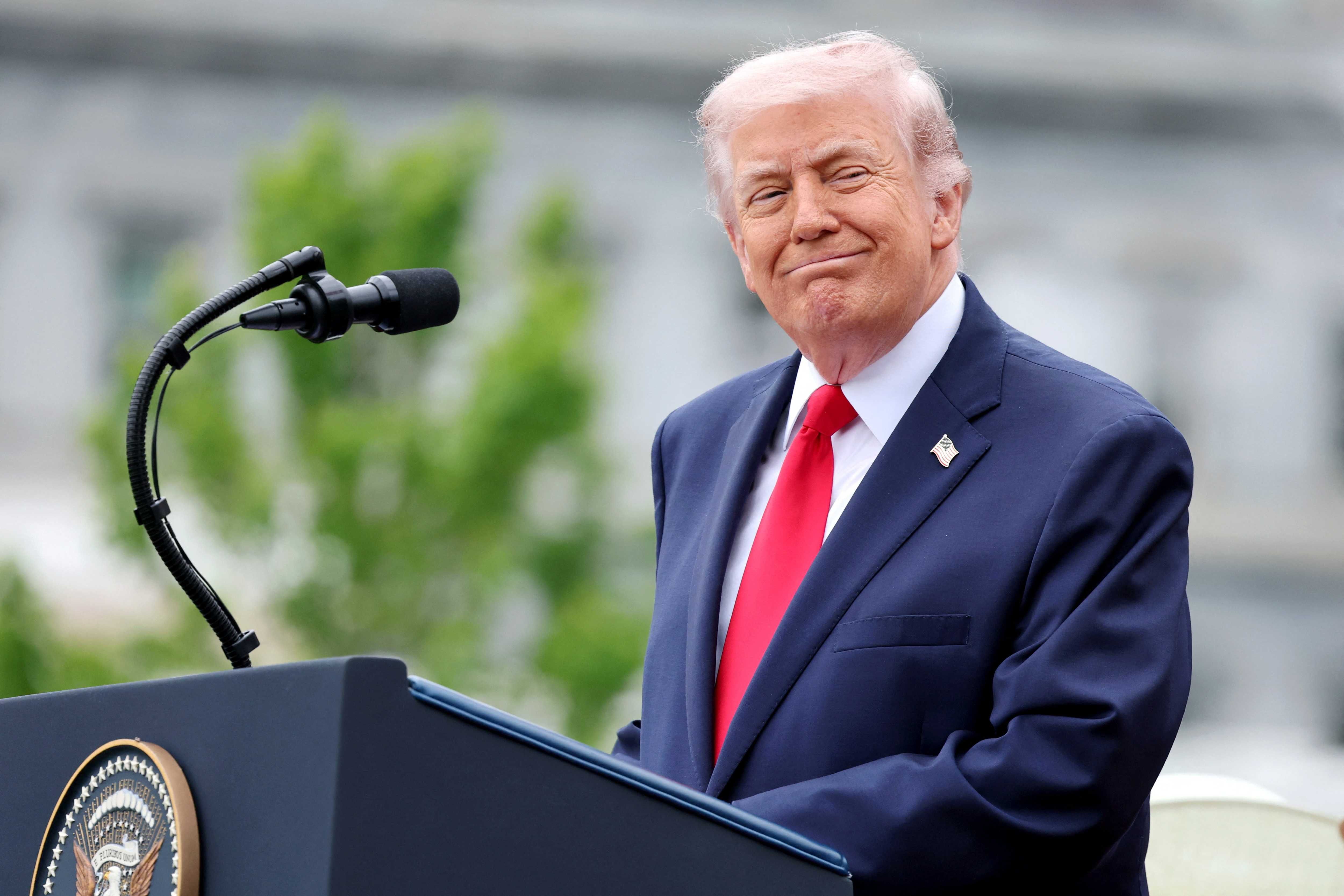
U.S. President Donald Trump on the South Lawn of the White House on April 28, 2026 in Washington, DC. Chris Jackson/Pool via REUTERS
Although President Donald Trump often describes himself as a victim of his opponents, he also expresses confidence on a range of issues — from the Iran war to the economy to health care. Trump is quite dismissive of the many polls showing him with poor approval ratings, insisting that he is more popular than ever. And he dismisses those polls as "fake news" from media organizations that are out to get him.
But the New York Times' Thomas L. Friedman, in his May 1 column, lays out some reasons why Trump is in a much weaker position than he thinks.
Friedman, who leans conservative but describes his outlook as "radical centrism" and supported Hillary Clinton in 2016 and Joe Biden in 2020, points to the Iran war and technology (specially, artificial intelligence or AI) as areas where Trump thinks he has the upper hand but doesn't.
"Trump is betting that by blockading Iran to prevent it from exporting its oil, he can force Tehran to negotiate on his terms," Friedman explains. "But some experts think Iran has enough income and can store enough oil to hold out for at least several months. Meanwhile, Iran is betting that by choking off the Strait of Hormuz — and driving up gasoline and food prices for Americans and all their allies — Trump will eventually act in accord with his TACO label: Trump Always Chickens Out…. This is painful to watch…. Iran is to Trump what Ukraine is to Vladimir Putin, what Hamas and Hezbollah have been to Benjamin Netanyahu and — wait for it — what the next generation of cyberhackers will be to China and America and every other nation-state."
Trump, Friedman argues, "does not understand how much asymmetric warfare has reshaped geopolitics in just the last few years."
"In the age of intelligence," the Times columnist argues, "artificial-intelligence agents that are built on large language models — like Anthropic's Claude, Google's Gemini and OpenAI's ChatGPT — can now be directed by humans with a single command, and they will autonomously execute, and self-optimize, multi-stage cyberattacks on their own. To put it differently, information-age tools vastly amplified trained operators within organizations, including terrorist organizations. Intelligence-age tools replace trained operators with vastly more intelligent, autonomous and skilled AI agents with more destructive reach at little cost…. It is hard to exaggerate how destabilizing these rapid advances in AI sophistication could become."