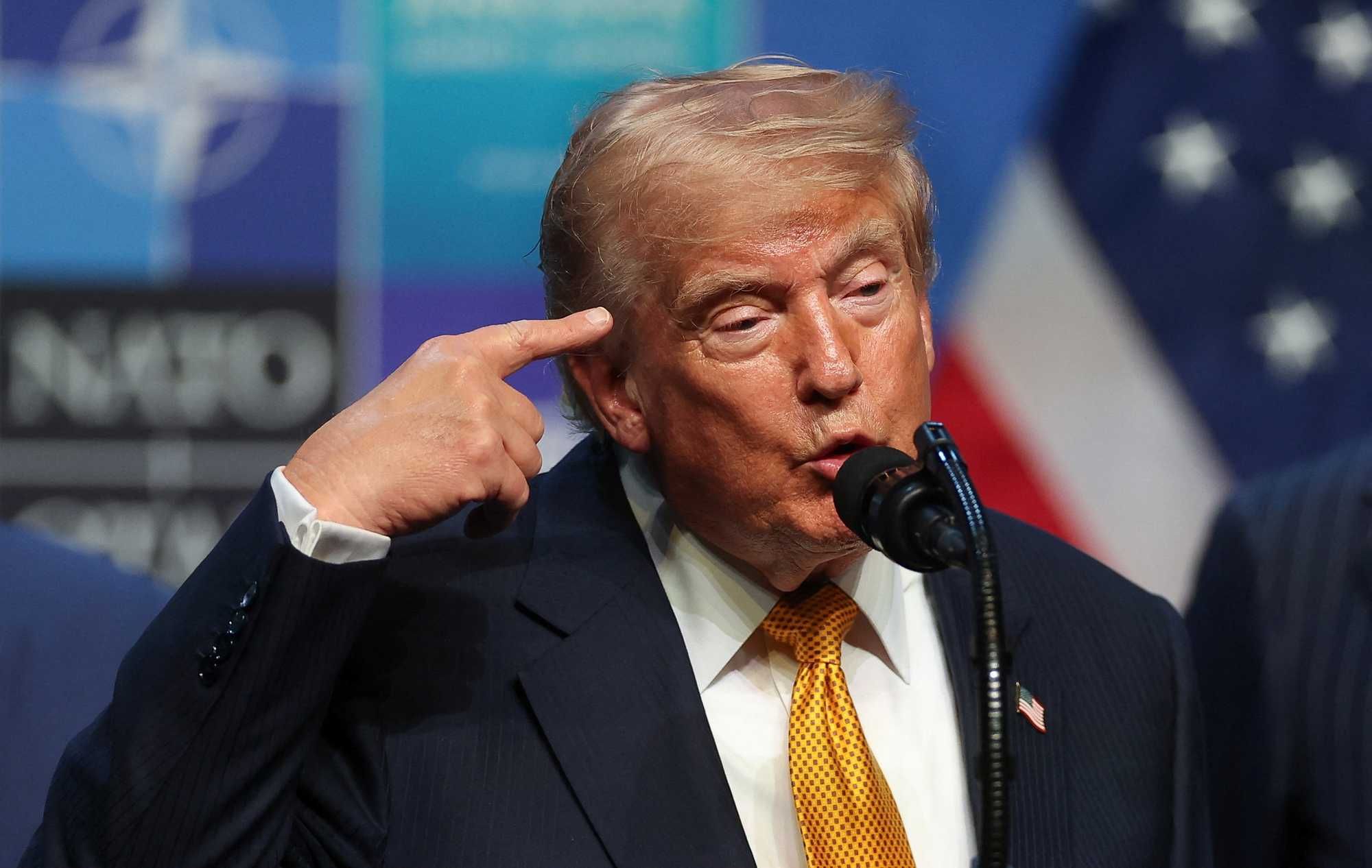
U.S. President Donald Trump gestures as he speaks to the media on the day of a NATO leaders' summit in Ankara, Turkey, July 8, 2026.
President Donald Trump has put the United States in a box with his approach to the war against Iran, one that he has repeatedly struggled to bring to a conclusion, according to a former Secretary of the Air Force.
“As one of your earlier guests said, that's a war crime,” Secretary Frank Kendall, who served under President Joe Biden, told CNN on Monday. Kendall was referring to Trump’s threat to go after civilian infrastructure, and Kendall noted that in addition to the moral problems with such an approach, it also would likely not be effective in getting Iran to capitulate.
“But that doesn't seem to have constrained this president very much,” Kendall explained. “And so he can do that and inflict greater pain on Iran. I think it's unknown how much they're willing to accept to make their point that they want to control the Straits of Hormuz.”
After being asked whether Trump’s approach is driving a wedge between America and its allies among the Gulf states, Kendall confirmed that this is indeed the case.
“I think the intent is to extract a price from other countries in the region and discourage them from supporting the United States,” Kendall said. “There's also some indication that the war will widen — that the Houthis will now try to close the Red Sea, basically to Saudi Arabia, and prevent their shipments out by that alternative route. So we don't see a good outcome anywhere in sight at this point.”
He added that Iran is also overplaying its hand.
“They can't get much more out of President Trump than he's already willing to concede, and they should recognize that and cut a deal with him,” Kendall said. “But that doesn't seem to be the path they're on. And Trump is left with very few options but to escalate and try to convince them that it's time to do a deal. So that's where we are.”
He noted that Iran’s behavior is in general “impossible to predict.”
“The Iranians have their own way of looking at the situation,” Kendall said. “I can't really get inside their heads. It's not the transactional approach that our president brings to the table. They've gone way beyond that. And I think the big surprise for him has been their resilience and willingness to accept punishment, and their continuing attempts to demonstrate that they can control the Straits, and to not give us the kind of limitations on their nuclear program that we'd like to have.”
He added, “The president, on the other hand, can't go into a situation that's a clearer loss than the one he had before he started this war. So we're in a box — they're both in a box. Hopefully the Iranians will come to the point of view that they've accomplished what they can and cut a deal. That's what we need to see happen.”
In addition to the toll taken on Iran, Trump’s war has also caused gas prices to go up to much higher levels than they were during the Biden administration.
“Even if hostilities do not restart, the price of oil will not return to pre-Trump levels because there’s a new risk premium that they could restart at any time, increasing tanker insurance costs for example, and because oil infrastructure has been degraded, reducing supply for some time,” Dr. Robert Shapiro, who served as a top economic adviser to President Bill Clinton, explained to AlterNet in April. “An Iran-controlled toll to use the Strait will produce big bucks for Iran, but its impact on world prices for oil, natural gas, helium, etc. should be minimal. Another source of economic friction will be the now-intense uncertainty about what the Trump administration will do next—in the Mideast and in scores of policies at home; and uncertainty dampens investment.”
He added, “As it is, the economy was weakening before this crisis began, and these and other factors will exacerbate those downward pressures. A resolution over the next two weeks will not stop the deterioration in economic conditions.”
By contrast White House spokeswoman Taylor Rogers told AlterNet at the time that “the United States’ energy dominance status, as the world’s leading producer and a top exporter of oil and natural gas, has positioned us to not rely on the free flow of oil through the Strait of Hormuz like other countries. If anything, Operation Epic Fury actually underscored the importance of producing reliable, affordable, and secure energy here at home. Many of our allies that have tried transitioning to intermittent and unreliable renewable energy sources have predictably failed to break their reliance on foreign oil that goes through the Strait."
She continued, "Several countries from around the world are now looking to emulate the president’s energy dominance agenda and are advancing new partnerships that enhance their energy security with the United States.”