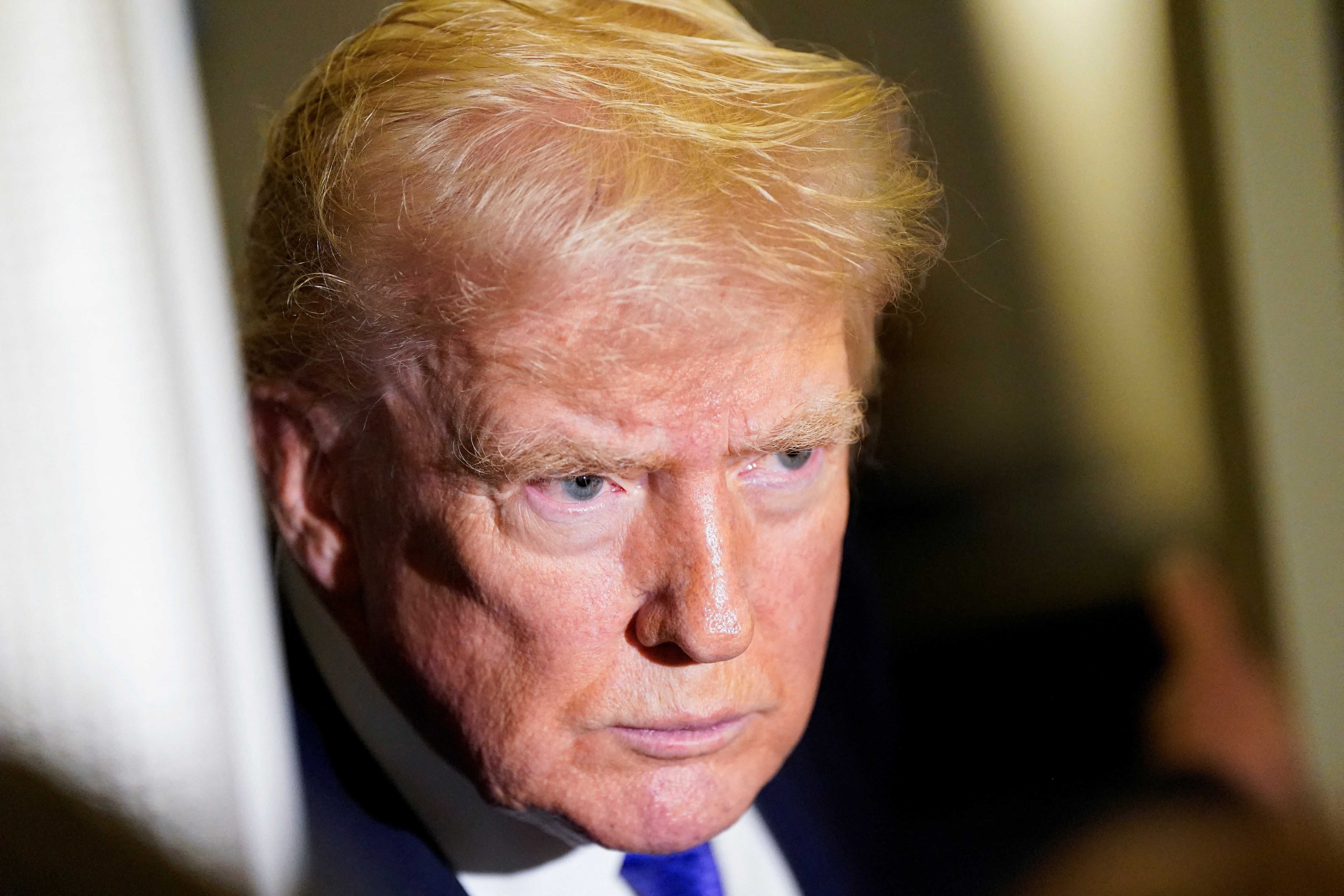
U.S. President Donald Trump looks on as he speaks to reporters onboard Air Force One, on travel from West Palm Beach, Florida, to Joint Base Andrews, Maryland, U.S., February 16, 2026. REUTERS Elizabeth Frantz
With the war with Iran over, “at least for now,” Washington Post foreign policy analyst Jason Willick has pointed out a consequence of the conflict that has left the United States “dangerously exposed.”
On Friday, Willick detailed a range of the war’s negative impacts, like the fact that “the real wage gains Americans experienced in the first year and a half of the Trump presidency have been erased by higher prices resulting from the closure of the Strait of Hormuz,” and that the war has only further entrenched the Iranian regime. But he also asserts that it elevated a risk President Donald Trump clearly hadn’t considered: that the U.S. military is more “constrained” than many realized.
“One constraint is military,” writes Willick. “Even in an air and naval war with mercifully few U.S. casualties, burning through air defenses and precision bombs will eventually leave the U.S. and its allies dangerously exposed to attack.”
He’s referring to a rising concern over the course of the war that the conflict was using too many weapons that were theoretically being reserved in case of major hostilities with China. According to CNN, “munition levels have been a significant concern for the Pentagon. Recent analysis by the Center for Strategic and International Studies found that the US expended at least 45 percent of its Precision Strike Missile stockpile, and roughly half of its stockpiles of Patriot air defense interceptor missiles and THAAD missiles.”
“The high munitions expenditures have created a window of increased vulnerability,” explained Mark Cancian, a retired US Marine Corps Colonel and one of the authors of the recent CSIS report, told CNN. “It will take one to four years to replenish these inventories and several years after that to expand them to where they need to be.”
Trump, recognizing the problem too late, has just invoked the Defense Production Act to ramp up weapons manufacturing. In the relevant document, he admitted “that conditions exist which may pose a direct threat to the national defense or its preparedness programs.”
Even so, Defense Secretary Pete Hegseth has attempted to downplay the danger, saying a mere three days after Trump signed the order that there was no weapons shortage and that the matter was “a manufactured story that the media wants to peddle.” But this sentiment is not shared throughout the Pentagon. According to CNN, “Before the war with Iran began, Chairman of the Joint Chiefs of Staff Gen. Dan Caine warned that a prolonged military campaign against Iran could impact US weapons stockpiles.”
What’s more, writes Willick, “The sharp economic and political damage the war inflicted will make future American presidents reluctant to ‘mow the lawn’ again — and the Iranian regime, having survived an attempt on its life, has a stronger incentive than before to develop a nuclear weapon.”