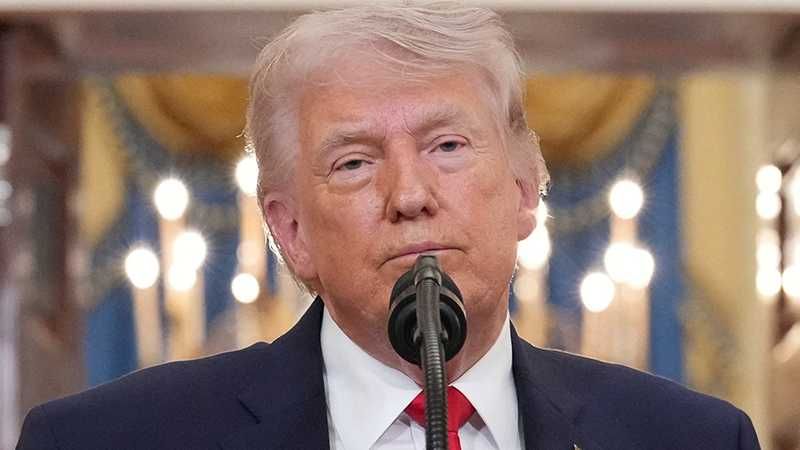
President Donald Trump delivers an address to the nation about the Iran war at the White House in Washington, D.C., April 1, 2026. Alex Brandon/Pool via REUTERS
President Donald Trump's latest ploy to achieve peace in the Middle East was called a "Hail Mary" by The Hill, and according to a new report from the outlet, it has already crashed and burned in the face of reality.
On Monday, Trump demanded that more nations in the Middle East and Gulf state regions sign on to the Abraham Accords, a diplomatic agreement brokered during his first term that attempted to normalize relations between Israel and various Arab nations. Only a few of the latter nations have since signed on, however, including the United Arab Emirates, Morocco, Bahrain and Sudan. The accords have been criticized by leaders in the Middle East and experts for a variety of reasons, most notably their lack of provisions to address the Israeli-Palestinian conflict.
Trump claimed in a post to Truth Social that he had spoken with leaders in Saudi Arabia, Qatar, Pakistan, Egypt, Jordan, Bahrain, Turkey and the U.A.E. over the weekend, and asserted that, "after all the work done by the United States to try and pull this very complex puzzle together, it should be mandatory that all of these Countries, at a minimum, simultaneously, sign onto the Abraham Accords."
In a Friday update on the situation, The Hill noted that this pitch has already "run into a complicated reality" and stalled out. Most of the nations called on in Trump's post have stayed quiet, while one has outright refused.
"Pakistan, which has been mediating talks between the U.S. and Iran, outright rejected the idea of joining the Abraham Accords, while other countries have stayed notably silent," the report explained. "Experts say the demand is confusing and highly improbable given regional tensions."
Trump remains under intense pressure from certain factions in the GOP to secure a nuclear deal with Iran that can be touted as stronger than the one reached under Barack Obama in 2015. The Hill suggested that "an expansion of the Abraham Accords could theoretically blunt Iran’s threat to the region by normalizing relations with its rivals — as well as achieving one of Trump’s main foreign policy priorities heading into his second term."
“I think at least in part this war was pitched as an effort at regional transformation,” David Schenker, senior fellow with the Washington Institute for Near East Policy and former Assistant Secretary of State for Near Eastern Affairs during Trump’s first term, told The Hill. “This ambitious transformational agenda has fallen short. The president is looking to make lemonade out of lemons.”