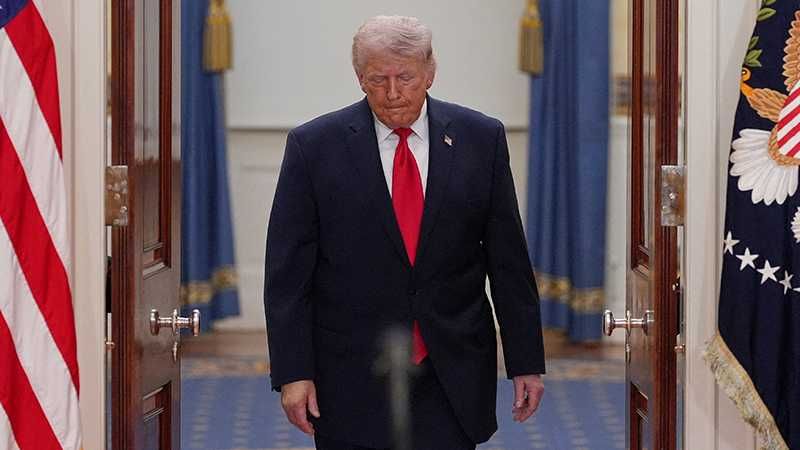
President Donald Trump arrives to speak about the Iran war from the Cross Hall of the White House on Wednesday, April 1, 2026, in Washington. Alex Brandon/Pool via REUTERS/File Photo
President Donald Trump, despite his persistent demands, is facing down a "long, drawn-out" negotiation process to end his war of choice with Iran, and according to a new piece from MS NOW, he only has himself to blame for this.
"Peace talks between Iran and the U.S. are proceeding neither quickly nor smoothly this week, in part because Iran’s government 'has not yet decided' if it will participate in a second round of peace negotiations on how to end the war," MS NOW's Zeeshan Aleem wrote on Thursday. "One factor that explains the sluggishness is that Iran’s government is reportedly unable to settle on a clear counteroffer to the U.S.’ latest position on ending the war."
Rather than this situation merely being an example of "Iranian dysfunction," Aleem argued that Trump "bears enormous responsibility" for it, owing to the fact that "he has killed so many of Iran’s leaders."
"Trump has sown the seeds for a drawn-out conclusion to a war he desperately wants to end," he added.
The many assassinations of Iranian leaders by the U.S. and Israel have left Iran's government "more decentralized, more factionalized and more reactionary," with Aleem further citing an Axios report about officials being split by "warring factions" that are not able to settle on a "coherent" strategy for the peace talks. The report gave considerable blame to Israel’s assassination of Ali Larijani, the previous secretary of Iran’s Supreme National Security Council, who “had the authority and political weight to hold Iran’s decision-making together," a position with which geostrategic analyst Imran Khalid agreed in another recent piece for MS NOW.
"Larijani and other slain high-ranking officials represented the ‘deep state’ in its traditional sense; they were men who understood the nuances of diplomacy and the necessity of maintaining certain backchannels, even during periods of intense hostility," Khalid explained. "Larijani in particular, a former Revolutionary Guards commander who was once speaker of Iran’s Parliament and Iran’s chief nuclear negotiator in the early 2000s, embodied the dual military-political roles."
"In other words, the U.S. has lost the exact kind of player it would have wanted to engage with in order to advance credible and politically sophisticated U.S.-Iranian negotiations," Aleem explained.
He added later: "This is yet another reason that Trump’s lack of strategic clarity when beginning this reprehensible war of choice was such a problem. One cannot pursue 'regime change' and lighter-touch coercive diplomacy at the same time. If he wanted to ensure reliable off-ramps from the conflict, then the U.S. and Israel should not have killed the people who might facilitate a (relatively) speedy exit from the war, to the extent that one was possible."