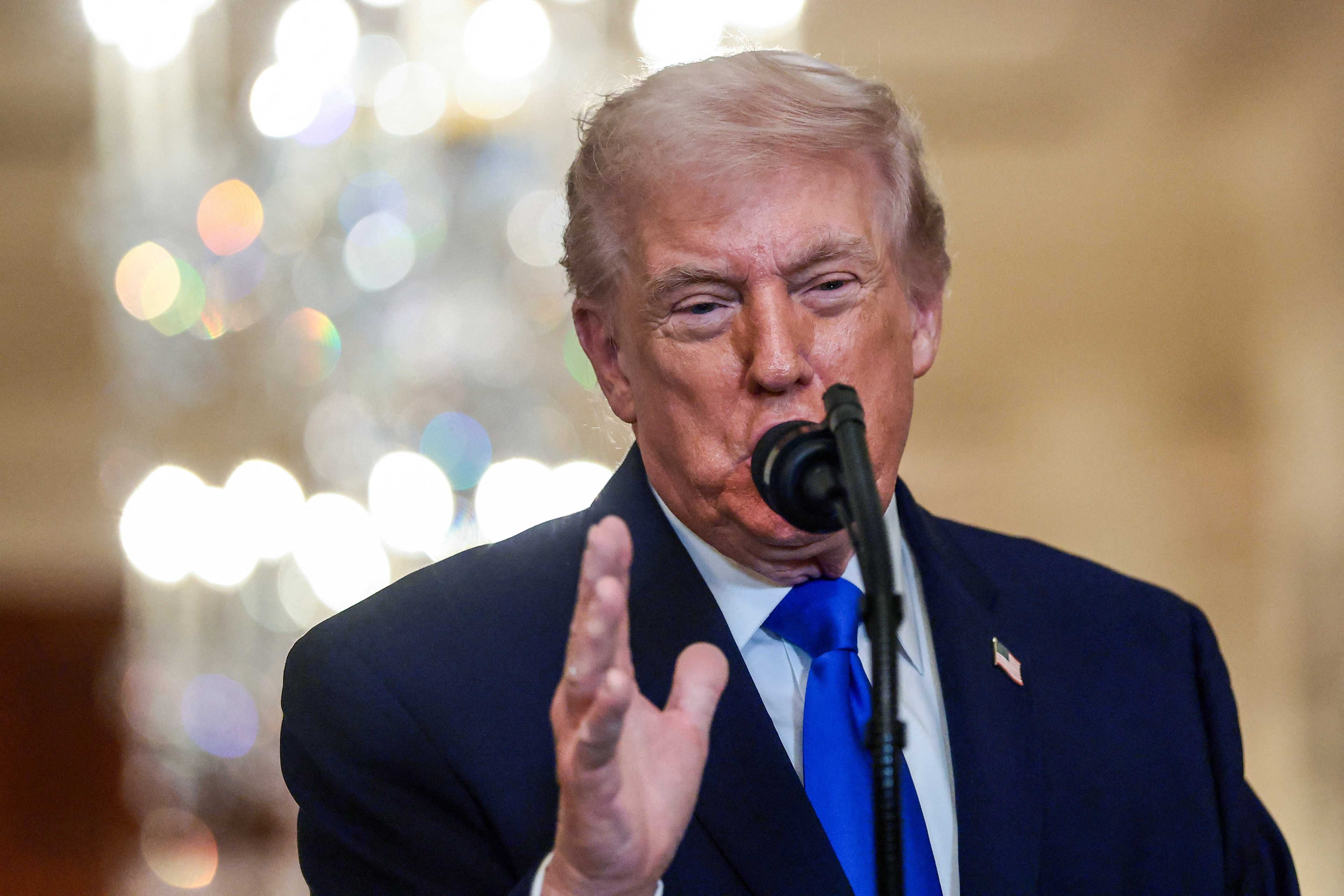
U.S. President Donald Trump at the White House in Washington, D.C., U.S., February 23, 2026. REUTERS/Evelyn Hockstein
Former Obama Deputy National Security Advisor Ben Rhodes said disrupting the government of a nation like Iran has a way of spilling chaos into neighboring nations, which is why Obama and other presidents thought hard about attacking the nation before doing it.
President Donald Trump, however, is not a thinker.
“We did war games, essentially scenario planning, where you anticipate what might happen in the event of a military conflict,” Rhodes told New York Times columnist Ezra Klein. “… [H]aving been through Iraq and Afghanistan and Libya in the Obama administration, we had just seen the uncertainties that are unleashed in any kind of military conflict in the region.”
The problem behind Trump’s removal of Iranian leader Ali Khamenei, said Rhodes, is that he represents a “deep, deep regime within ideological institutions” that dig deep into Iran’s national psyche.
“So what you could have is an implosion,” said Rhodes. “If there’s an uprising and then there’s a chaotic civil war — which is not hard to imagine because we’ve seen that in Libya, Iraq and Afghanistan, the other places where the U.S. has been involved militarily — and there are millions of refugees.”
But Klein said Trump’s belief appears to be that he can decapitate a regime and control its successors without events spinning out of his control.
“Trump is a man who has not read much history, but who certainly intends to make it,” Klein said.
However, Iran is not Venezuela, said Rhodes. Trump may ask Iranians to “rise up” after cutting the head off their leadership but Arab Spring was not a roaring success, and the potential consequences that military action could unleash across the region is very much an unpredictability.
But, again, Trump is not a thinker, nor a history buff.
“I truly believe Trump thinks in news cycle increments,” said Rhodes. “So, it’s: I’ll kill someone to make it look like we changed the regime. We got rid of the bad guy. We slayed the dragon here. But there’s no: ‘What happens in one year? In three years? In five years?’… So there’s this strategic incoherence about what the objective of this whole thing is — and that’s seen not just by the Iranians, it’s seen by the gulf Arabs, who are now furious at everybody.”
Rhodes then invoked the failed policies of his own Obama administration. “You remember the Libya intervention? We did the same thing, essentially. Qaddafi was killed — there was an airstrike, and then he was killed by people on the ground. Terrible guy, reprehensible leader. When that regime was removed, no one was able to fill the vacuum in Libya except for the most heavily armed people, who were a series of different militias.”
“That civil war spread across borders, and suddenly that part of North Africa becomes an arms bazaar, conflict is spreading to neighboring states,” Rhodes added.
The U.S. military can destroy anything, but it can’t engineer the politics of other countries or build what comes after a thing that is destroyed, said Rhodes.
“We had 150,000 troops in Iraq, and we couldn’t stop the violence. And look — do you know who knows that? The (Iranian) Islamic Revolutionary Guard Corps colonel, who’s a total hard-liner right now, knows that [Trump is] going to lose interest in this. He knows that if they weather this, on the back end, they can potentially do what they want. There’s a callousness in the way that Trump has done this.”