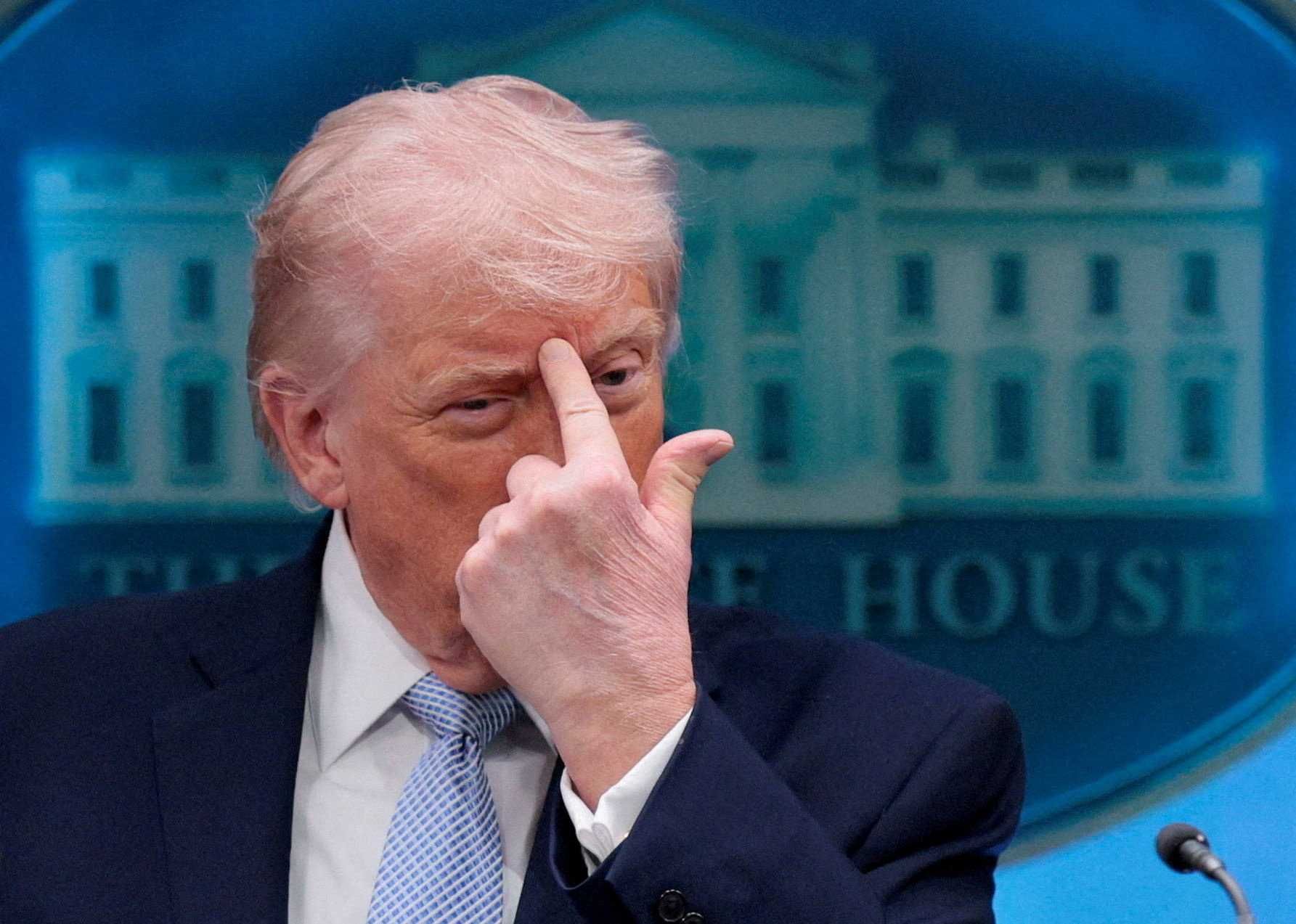
Donald Trump
President Donald Trump’s choice to fight global hunger subscribes to a philosophy that will only make it worse.
Trump appointed Luke Lindberg, the Department of Agriculture’s undersecretary for Trade and Foreign Agricultural Affairs, to lead the Rome-based World Food Program, which is the world’s largest humanitarian agency, according to a report by PassBlue. Yet Lindberg’s most recent job was rebranding the Food for Peace international food aid program as "America First" international food assistance. Under Trump the federal government has pushed for cuts to the McGovern-Dole program, which provides food assistance to low-income nations, as well as for Lindberg’s own Food for Peace program.
“Under the second Trump administration, funding for the World Food Program was slashed in half after the dismantling of USAID,” PassBlue reported. “The loss of $2.6 billion in US funding in the last year triggered the layoff of a third of WFP’s staff and a surge in malnutrition in some of the most fragile countries. Despite the cuts, Washington remains at the top of the donors’ list for WFP. This reality makes it more likely that Trump’s nominee will pull through the Senate confirmation hearings without major opposition.”
In addition to supporting Trump's funding cuts, Lindberg is also linked with unpopular food distribution methods. Both the World Food Program and other UN humanitarian agencies prefer to either provide cash or help local and regional governments obtain food, arguing that these approaches are cheaper, more efficient and less disruptive. But Lindberg advocates exporting US-grown commodities to provide the same international food aid.
“Sam Vigersky, an international affairs fellow at the Council on Foreign Relations, said that recourse to the old practice of WFP procurement restricted only to US commodities is a strong possibility if an American leads the agency again,” PassBlue reported.
“The practice is inefficient in that it involves shipping grain at significant cost from America, which is rarely the most readily available or the cheapest source; nor is it always the locally preferred kind of grain,” Nick Coghlan, a former Canadian diplomat with experience in Sudan and South Sudan, told PassBlue.
He added, “Moreover, the practice seriously undermines regional food markets which would otherwise receive a useful boost; and it discourages more innovative WFP programmes that require cash injections.”
When Trump dismantled USAID, more than a million people were left without three months worth of food because $98 million in ready-made meals and other rations were abandoned in four warehouses by the administration.
“Contracts with suppliers, shipping companies, and contractors have been canceled since USAID was taken over by the Trump administration's so-called Department of Government Efficiency, with the White House saying the agency—with a relatively small budget of just $40 billion—was responsible for ‘significant waste,’” Common Dreams reported in May. “Since DOGE, run by tech billionaire Elon Musk, targeted USAID in one of its first full-scale attacks on a federal entity, the agency is being run by Secretary of State Marco Rubio.”
In response to Trump’s attacks on food programs, a current federal official told NOTUS in July that Trump’s actions are a sign of America slipping into authoritarianism.
“Take it from those of us who worked in authoritarian countries: We’ve become one,” the official told NOTUS. “They were so quick to disband AID, the group that supposedly instigates color revolutions. But they’ve done a very foolish thing. You just released a bunch of well‑trained individuals into your population. If you kept our offices going and had us play solitaire in the office, it might have been safer to keep your regime.”