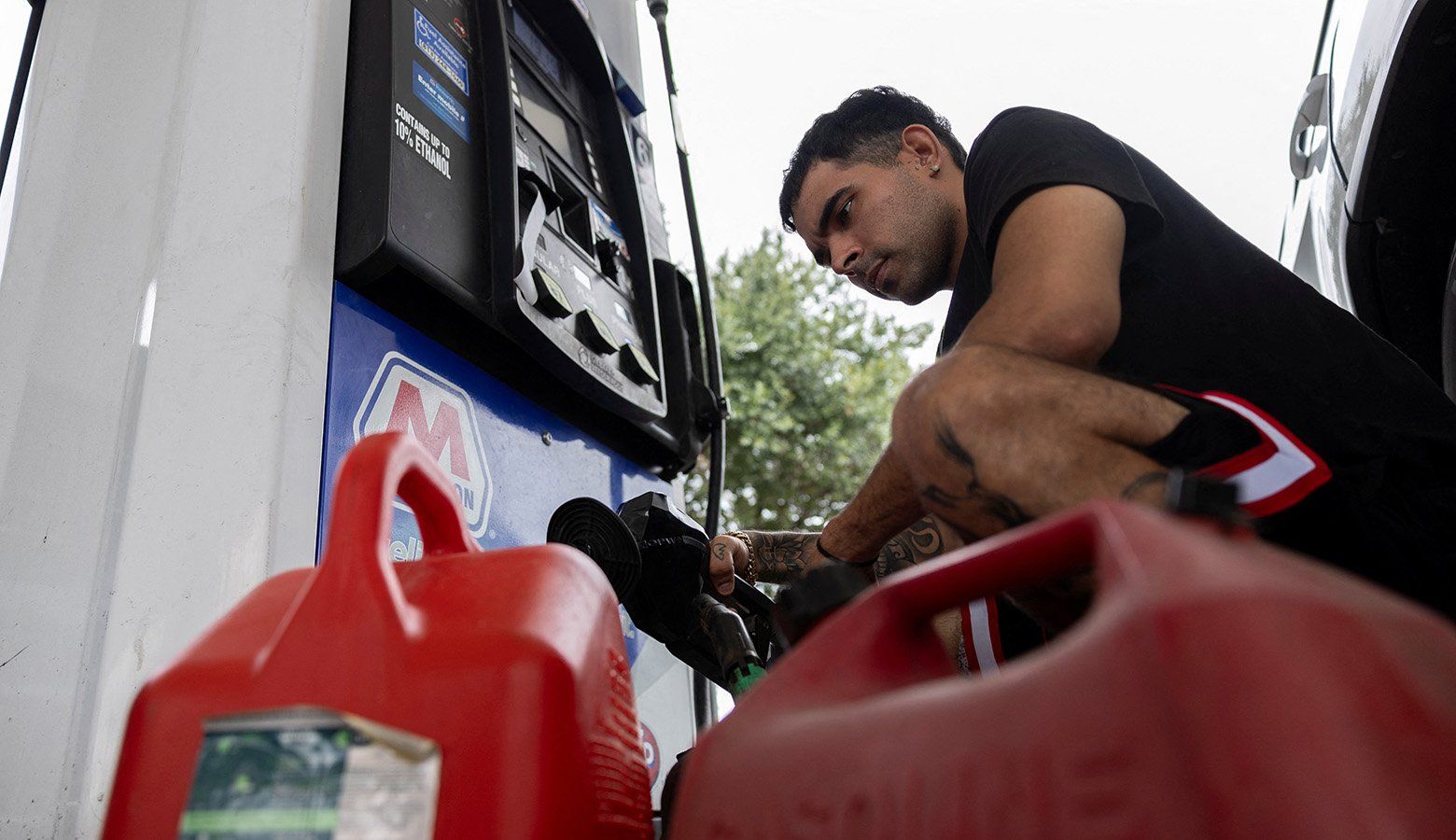
A man fills up reserve gas containers, as Hurricane Milton approaches, in Tampa, Florida October 8, 2024. REUTERS/Ricardo Arduengo
President Donald Trump’s war against Iran is having harsh effects on the price of gas for consumers, but no one is being harder hit than his red-state base.
According to Patrick De Haan, the widely-cited head of Petroleum Analysis at GasBuddy, as of Thursday morning, the national average price of gasoline stands at $3.24 per gallon.
“That’s now just 1.4 cents shy of its highest national average since 2024 — and, based on GasBuddy’s tracking, the highest national average so far during President Trump’s two terms,” De Haan writes.
What that means is collectively, he says, Americans are paying about $90 million more at the pump than just one week ago.
At the state level, 49 out of 50 states have seen at least a ten-cent increase since last week. And twelve states are seeing at least a 30-cent increase in just the past week.
Who is being hit the hardest?
Nine of the top ten highest price increases are being seen in red states.
De Haan says that Louisiana is being hit the hardest, with a 39.7-cent per gallon increase over last week.
Georgia is seeing a 37.5 cent increase. Iowa, Indiana, and West Virginia are all in the 35-cent range. Oklahoma, North Dakota, and Ohio in the 34-cent range. South Dakota comes in at a 32.6-cent increase. And Illinois, a blue state, comes in at number ten, at 31.1 cents per gallon.
According to Michael Gunther, senior vice president at Consumer Edge, the “pain isn’t evenly distributed.”
He says that “customers of value-oriented, drive-dependent brands — Dollar General, Jack in the Box, Boot Barn — allocate the highest share of their wallet to gas. Lower-income, suburban consumers with very little cushion to absorb a sustained spike.”
De Haan adds that gas prices will continue to climb.
“While the national average gas price is seeing a slower climb today, increases will likely throttle back up soon as wholesale gasoline prices jump again,” he notes.