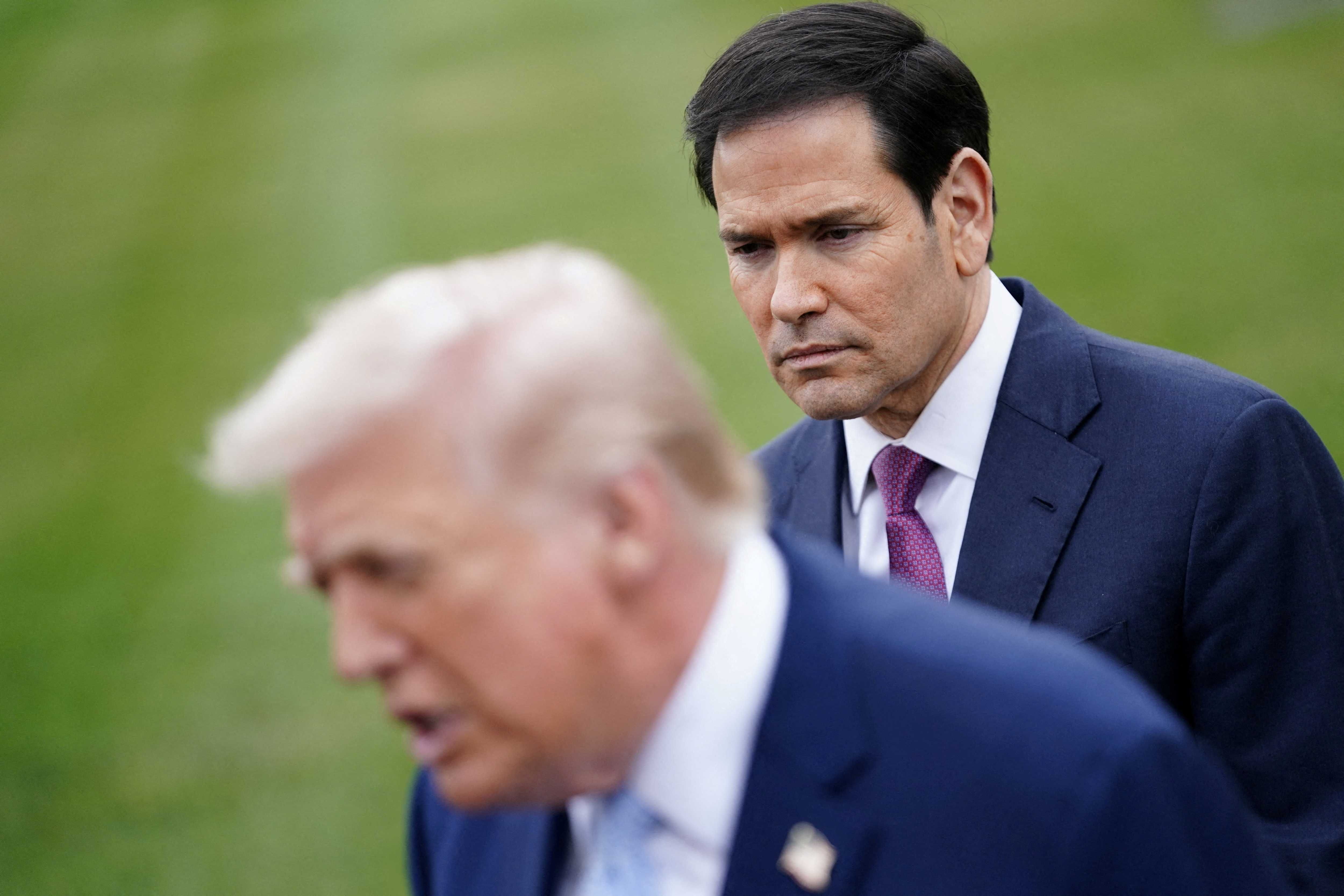
U.S. Secretary of State Marco Rubio listens to U.S. President Donald Trump speaking to the media, as Trump departs the White House for Florida, in Washington, D.C., U.S., March 20, 2026. REUTERS/Nathan Howard/File Photo
Donald Trump held another one of those televised meetings today during which the cabinet secretaries take turns pandering to him. It was obscene, per usual, but also oddly affirming.
Why? Because I think it demonstrated something that the Secretary of Defense Rock told me yesterday. (He’s the anonymous publisher of History Does You, a newsletter about the intersection of military and civilian life.) SODR told me that Trump may think he’s winning the Iran war, because “his briefings are essentially CENTCOM highlight-reels.” Watch enough stuff getting blown up, he said, and you too might think you’re winning a war you’re losing.
In today’s cabinet meeting, Trump referred repeatedly, as he often does, to the damage being done by US forces. He’s titanically self-centered and surrounded by yes-men. That might result in him believing that "the conflict is in its final stages," as the Wall Street Journal said.
Of course, it’s not in its final stages. The Iranians control the Strait of Hormuz. They are turning it into a tribute system. They said there will not be “any negotiations.” Hardliners are now demanding a restart to the nuclear bomb program. Trump can quit when they say so. Meanwhile, the price of gas in the US keeps going up, with a recession or worse in the offing.
There is, as one expert put it today, a conspicuous gap between what’s the president is saying about the war and what's actually happening, and the gap is getting wider by the day. “Are we deescalating? Or is this just an illusion? Or a ruse? If it is, for what? And even if there is some deal on the horizon, would President Trump actually take it? Would the regime?”
Whatever the case, investors who have kept their faith in the president lost it today. “Stocks had their worst day since the war with Iran started, as doubt took over again from hope on Wall Street about a possible end to the conflict,” according to the Associated Press.
The S&P 500 fell 1.7 percent. The index is headed for a fifth straight losing week, which would be the longest such losing streak in almost four years. The Dow Jones Industrial Average dropped 1 percent, and the Nasdaq composite sank 2.4 percent. They’re the latest flip-flops for financial markets this week after Iran rejected a US offer for a ceasefire. Oil prices rose more than 4 percent, and Treasury yields climbed in the bond market.
But the problem is deeper than a moron easily impressed by CENTCOM videos. “At a more fundamental level, the problem appears to be the absence of a coherent strategy altogether,” the Secretary of Defense Rock said. From that, he added, arises “the illusion of coherence.”
I didn’t include the following interview material with the Secretary of Defense Rock in yesterday’s edition, because the edition was getting too long. I’m publishing it today, because it explains the organizational breakdown between where the war began and where it’s going.
The Secretary of Defense Rock said:
The individual responsible for defining political objectives [ie, the president] either has not articulated them clearly or lacks a settled conception of what success actually looks like. In that vacuum, the rest of the system is left to infer intent rather than execute it. Subordinates, whether planners, commanders, or staff, begin interpreting fragments, signals, and impulses, trying to reverse-engineer a strategy from ambiguous guidance.
The result is predictable. In the absence of clear political direction, organizations default to what they can control, which is tactics. Operations become ends in themselves rather than instruments of policy. Units execute strikes, maneuvers, or shaping actions not because they are tightly linked to a defined strategic objective, but because they are feasible, familiar, and measurable. Activity substitutes for purpose.
This dynamic creates the illusion of coherence. From the outside, it can look like a deliberate campaign with phased objectives when in reality it is a collection of loosely connected actions driven by local logic rather than overarching design. Tactical success in this environment risks becoming strategically meaningless or even counterproductive because there is no clear framework that ties battlefield outcomes to political effects.