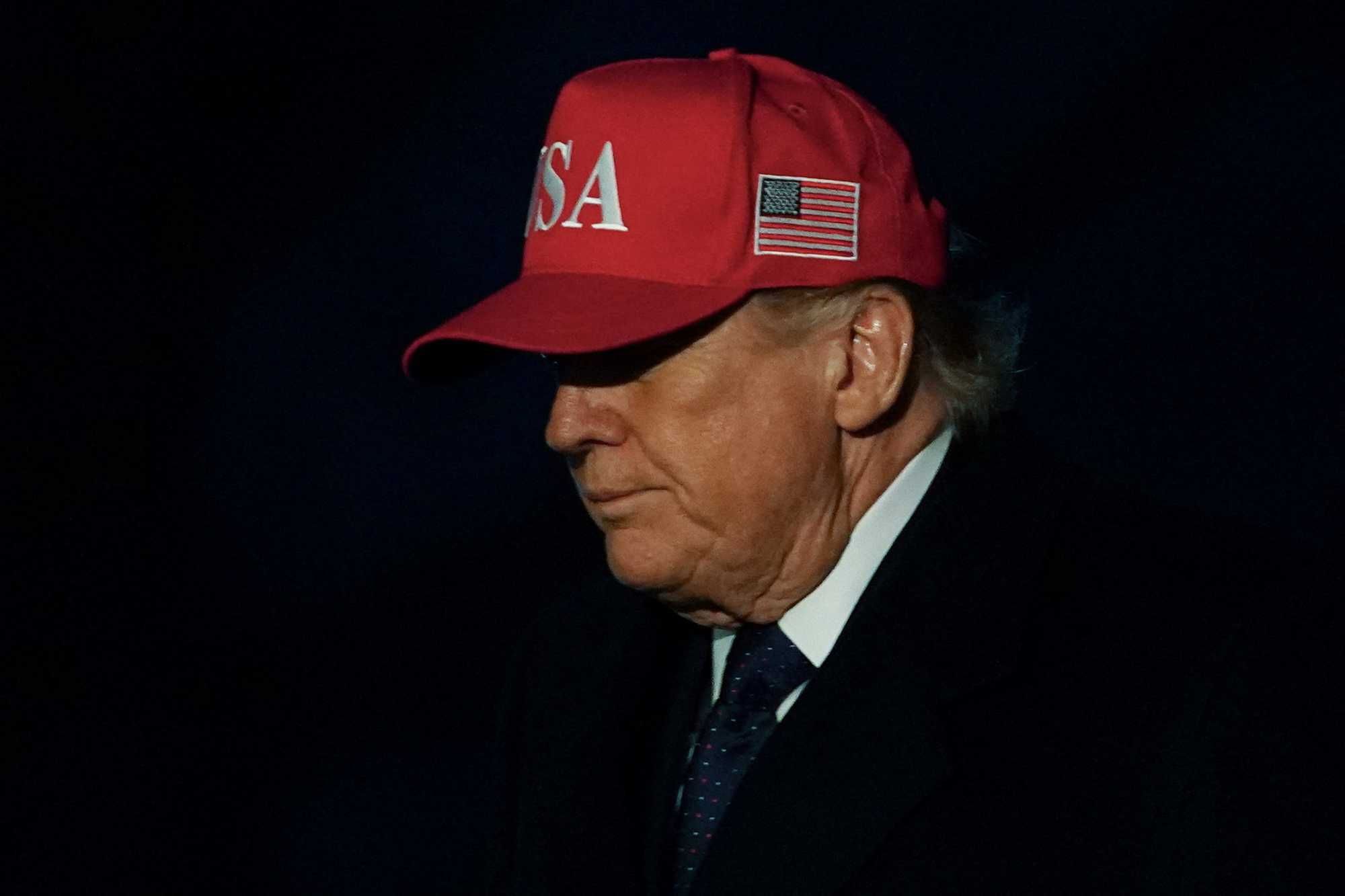
President Donald Trump returns to the White House, after Israel and the U.S. launched strikes on Iran, in Washington, D.C., March 1, 2026. REUTERS/Nathan Howard
President Donald Trump and his allies returned to the White House with grand plans in mind, but according to a new analysis from the New York Times, his "most ambitious project" has completely failed, which actually leaves the country in a much "less dangerous place" than it seemed a year ago.
Jonathan Rauch is a senior fellow at the Brookings Institution, and Peter Wehner is a senior fellow at the Trinity Forum who also worked as a speechwriter for the three GOP presidents prior to Trump, emerging as a major critic of his political agenda even before he secured the Republican nomination in 2016. On Saturday, the pair published a new op-ed for the Times, detailing the extent to which the second Trump administration has "finally lost the plot."
Trump, they explained, has accomplished an alarming amount in his second term and done much to alter the public perception, but now, as his power appears to be dwindling, it can be said that his grandest plans for fundamentally reshaping American society have failed.
"Twenty months into his second term, Mr. Trump has remade the presidency and changed what Americans will tolerate from their government and from one another," Rauch and Wehner explained. "Yet that transformation, sweeping as it is, may prove less important than what Mr. Trump and his allies could not do. They failed at the most ambitious project that they brought to his second term: using the state to remake American society. That failure is a central fact of the past 20 months, and it is why the country is in a less dangerous place than it was a year ago."
As they explained further, the second Trump administration's primary goal was to "convert the executive branch to a form of government that scholars call patrimonialism, in which the state is run as the leader’s personal property and family concern." Under such a system, the "expert bureaucracies and neutral rules" that the American government has relied on would have been "subordinated" to Trump's will. This effort, the pair detailed, could be seen clearly in Trump's "sham" legal efforts to extort billions out of the federal government to enrich himself and his family. Other examples of this attempted shift have been "far too many to enumerate," but have also included Trump's attempt to use the Justice Department to target his enemies and to vilify other adversaries as "vermin."
"So why, despite all that, does the second year of Mr. Trump’s second term seem less menacing than the first year?" Rauch and Wehner posed. "Because the patrimonialism and the re-norming, damaging as they are, were only part of what he and his followers set out to do. The largest of their ambitions was something else: the remaking of American society itself."
The pair suggested that history may view the events in Minneapolis at the start of this year as a turning point when Trump's power began to wane and his efforts to reshape the U.S. began to crumble. Local and national pushback after the deaths of Renee Good and Alex Pretti saw the administration scale back ICE surge efforts in the city, and, as the pair pointed out, saw DHS Secretary Kristi Noem fired a few weeks later and lessened the visibility of Trump's leading immigration attack dog, Stephen Miller.
"By demonstrating that they could face the spectacle of force and win, Minnesotans shook off their despair and found that they were not powerless," Rauch and Weghner added. "The moment became a catalyst far beyond the Twin Cities. The mass public saw what was being done in their name and many were repulsed by it. What they glimpsed was that a country can, in fact, be lost, and that theirs had come nearer the edge than they had believed. The president and his forces lost other key cultural battles, too. From outside his home country, but speaking pointedly to it, the first American pope not only defied Mr. Trump but transcended him, demonstrating a moral authority against which the president had no power. Within the United States, No Kings marches staged some of the largest single-day protests in American history, deploying anger and humor without fear."
They later concluded: "Revolutions can fail but still scar the landscape. And Mr. Trump, with just under two-and-a-half years left in his second term, might emotionally and psychologically blow apart. But things are different than they were. The 80-year-old president is losing his grip on power and even his own base. The MAGA movement is fracturing. And the president no longer inspires the fear he once did. We know something today that wasn’t altogether clear a year ago: America’s civil society is harder to intimidate and rewire than MAGA’s cultural revolutionaries hoped."